
What is StepAudio R1
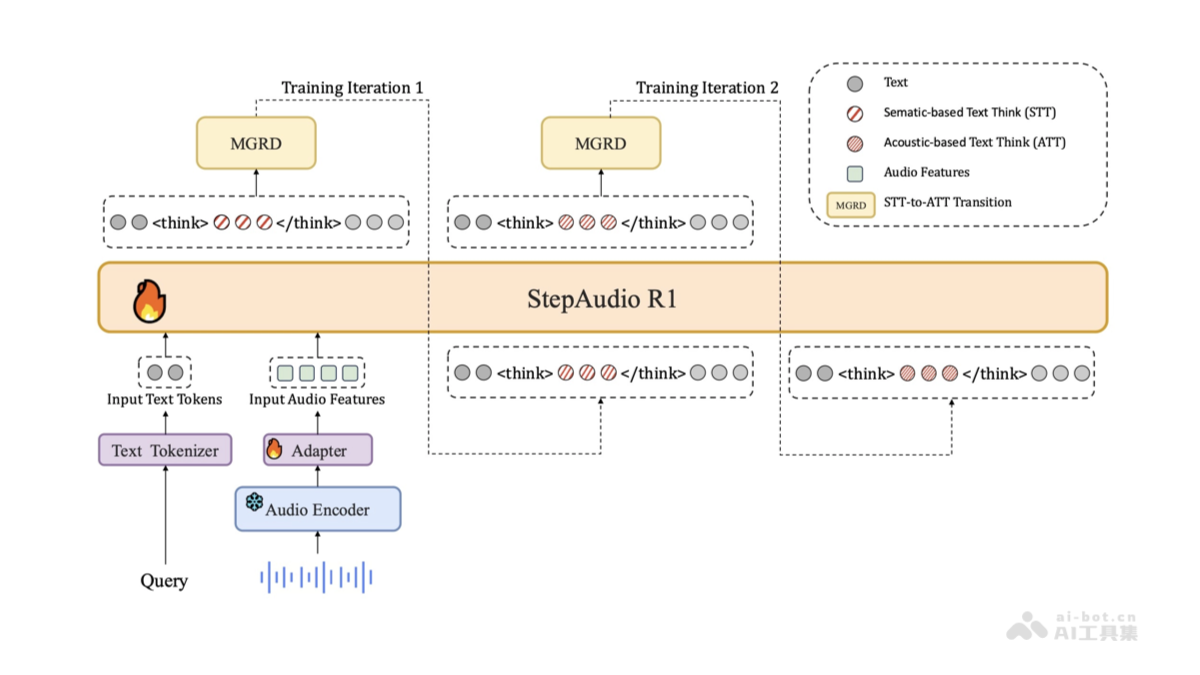
StepAudio R1 is the world's first open-source native audio reasoning model launched by the StepFun team. Through an innovative Modality-Grounded Reasoning Distillation (MGRD) framework, the model solves the performance degradation problem of traditional audio models in complex reasoning, truly achieving deep reasoning based on acoustic features. In multiple benchmark tests, StepAudio R1 surpasses Gemini 2.5 Pro, and is comparable to Gemini 3 . The model has extremely high real-time reasoning capability, with a score of 96% and a first-packet latency of only 0.92 seconds. The model opens up a new path for multimodal reasoning in the audio field, and is widely used in scenarios such as song appreciation, film and television analysis, and interview analysis, bringing revolutionary breakthroughs to intelligent audio processing.
Main Features of StepAudio R1
- Complex Audio Reasoning: StepAudio R1 can handle complex audio reasoning tasks, such as understanding implicit meanings in conversations, analyzing emotions, and inferring character traits.
- Real-Time Audio Reasoning: The model has powerful real-time reasoning capability, capable of performing reasoning at extremely low latency (such as a first-packet latency of 0.92 seconds), making it suitable for real-time dialogue and interactive scenarios.
- Multimodal Reasoning Capability: StepAudio R1 focuses on audio and can combine text reasoning capabilities, becoming a general solution in multimodal tasks.
- Emotional and Social Intelligence Reasoning: The model can analyze emotions, character traits, social relationships, etc. in audio, for example, inferring a person's psychological state, personality traits, or social identity through dialogue.
Technical Principles of StepAudio R1
- Modality-Grounded Reasoning Distillation (MGRD): The core technology of StepAudio R1 is Modality-Grounded Reasoning Distillation (MGRD). The framework transfers reasoning capability from text abstraction to acoustic attributes through iterative self-distillation training. It solves the problem of insufficient alignment between reasoning chains and the audio modality in traditional audio models, enabling the model to generate reasoning chains truly based on acoustic features.
- Audio Feature Extraction and Alignment: The model first extracts key features of the audio (such as intonation, rhythm, emotion, etc.), and aligns the features with reasoning tasks through the MGRD framework, ensuring that the reasoning process is always based on the characteristics of the audio itself, without relying on text transcription or substitutes from other modalities.
- Multimodal Fusion: StepAudio R1 retains text reasoning capability, enabling it to handle multimodal tasks. The fusion capability gives it more advantages when handling complex multimodal scenarios, such as combining audio and text for sentiment analysis or content understanding.
Project Address of StepAudio R1
- Project Website:https://stepaudiollm.github.io/step-audio-r1/
- GitHub Repository:https://github.com/stepfun-ai/Step-Audio-R1
- HuggingFace Model Library:https://huggingface.co/stepfun-ai/Step-Audio-R1
- arXiv Technical Paper:https://arxiv.org/pdf/2511.15848
Application Scenarios of StepAudio R1
-
Music Appreciation: Analyze the melody, lyrical emotion, and style characteristics of songs to help users better understand the meaning of musical works.
-
Film and Television Dialogue Analysis: Analyze dialogue content in film and television works, infer the emotions, personalities, and relationships of characters, and help audiences understand the plot more deeply.
-
Interview Content Analysis: Analyze key information, emotional tendencies, and logical structure in interviews, and extract interview highlights.
-
Academic Speech Analysis: Help researchers analyze the logical structure and key information in academic reports, and improve academic expression skills.
-
Sentiment analysis: By analyzing the intonation, rhythm, and vocabulary in the audio, determine the speaker's emotional state (such as happiness, sadness, anger, etc.).