
What is StepAudio 2.5 ASR
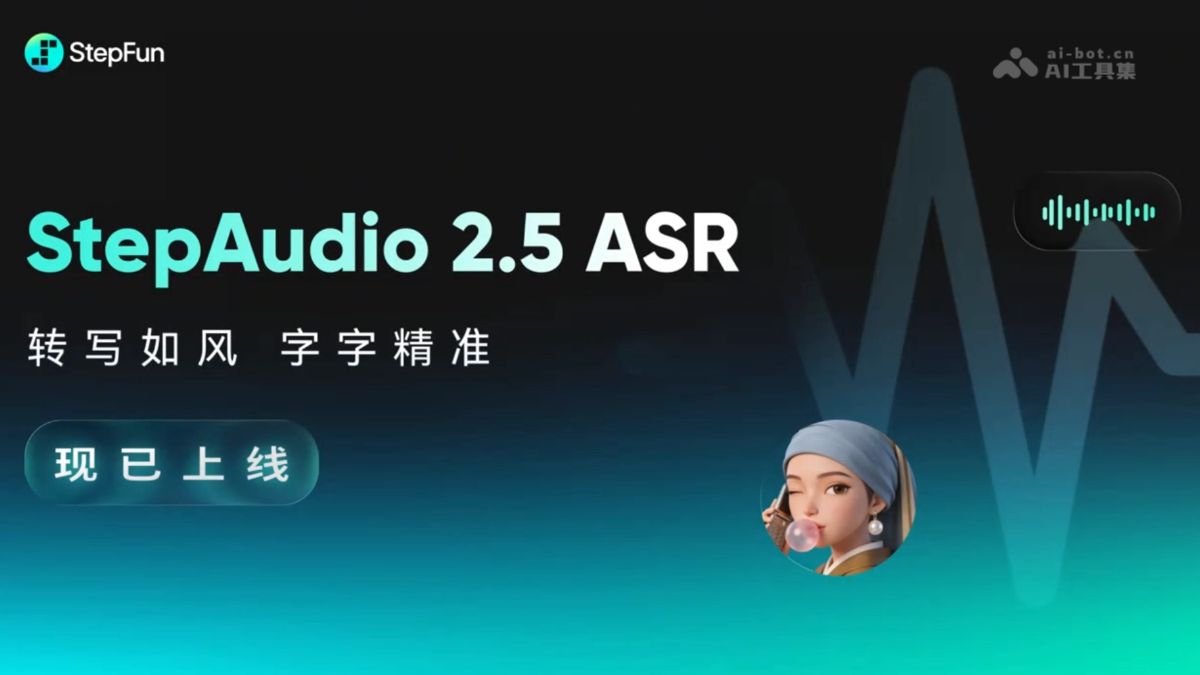
StepAudio 2.5 ASR is a new-generation automaticspeech recognitionmodel launched by StepFun, designed specifically for speech transcription, meeting minutes, and long audio processing. The model adopts an Audio Encoder + Linear Adapter + 4B LLM + MTP-5 architecture, introducing multi-token prediction technology into the field of speech recognition for the first time, achieving extremely fast inference at 500 TPS. The model supports input formats such as OGG, mp3, wav, and PCM, reuses a 32K context window, and can transcribe 30 minutes of audio end-to-end in a single pass, completely eliminating the context fragmentation problem caused by traditional slicing solutions, reaching industry SOTA levels in both speed and accuracy.
Main features of StepAudio 2.5 ASR
-
Ultra-fast speech transcription: The model's peak inference reaches 500 tokens/s, transcribing 5 minutes of audio and video in seconds.
-
Long audio end-to-end recognition: Reuses a 32K context window, fully transcribing 30 minutes of audio in a single pass.
-
Multi-format audio support: Compatible with common audio formats such as OGG, mp3, wav, and PCM.
-
Chinese, English, and dialect recognition: Covers mainstream Chinese and English languages, supports dialects, accented Mandarin, and a small amount of Japanese and Arabic.
-
High-throughput decoding: Based on the MTP-5 architecture, throughput is increased by 400%, and inference cost is reduced by 80%.
Technical principles of StepAudio 2.5 ASR
- Overall architecture design: The model adopts a four-layer stacked architecture of Audio Encoder + Linear Adapter + 4B LLM + MTP-5, balancing audio representation extraction, dimension alignment, language modeling, and high-throughput decoding.
- Audio encoding layer: The 0.6B Transformer audio encoder converts input audio into 12.5 Hz audio embeddings, completing the initial mapping from raw acoustic signals to semantic vectors.
- Dimension alignment layer: The Linear Adapter is responsible for aligning the output of the audio encoder with the LLM hidden dimension, enabling bridging and adaptation between cross-modal feature spaces.
- Language modeling backbone: The 4B parameter LLM serves as the core of the model, undertaking context understanding and autoregressive text generation tasks, and reusing the native 32K context window to achieve end-to-end modeling of long audio.
- MTP multi-token prediction: Introduces the same MTP-5 module as Step 3.5 Flash. A single forward pass can additionally predict 5 candidate tokens in parallel, breaking through the speed bottleneck of traditional ASR sequential token-by-token generation.
How to use StepAudio 2.5 ASR
-
Online experience: Visit the StepFun Experience Center https://www.stepfun.com/studio/audio?tab=speech-recognition,上传音频进行在线转写。
-
API access: Go to the StepFun Open Platform https://platform.stepfun.com/docs/zh/guides/models/stepaudio-2.5-asr or the Step Plan official website https://platform.stepfun.com/docs/zh/step-plan/integrations/audio-api to view the API documentation and obtain the model identifier and sample code.
-
Demo page: Visit the Demo page https://stepaudiollm.github.io/step-audio-2.5-asr/ to view public examples and effect demonstrations.
-
Developer access: Through programmatic calls to the ASR API, integrate recognition results into retrieval, summarization, quality inspection, or archiving pipelines.
Key information and usage requirements of StepAudio 2.5 ASR
- Publisher: Officially released by StepFun, and fully launched on the StepFun Open Platform and Step Plan.
- Model architecture: Adopts a four-layer architecture of Audio Encoder (0.6B) + Linear Adapter + 4B LLM + MTP-5, with an overall parameter scale of approximately 4.6B.
- Inference Performance: Peak reaches 500 tokens/s, throughput increases by 400%, latency decreases by 60%, and inference cost drops by 80%.
- Context Capability: Reuses the LLM's native 32K context window, enabling end-to-end complete transcription of up to 30 minutes of audio in a single pass, with no need for slicing and stitching.
- Supported Formats: Common audio formats such as OGG, mp3, wav, and PCM.
- Language Coverage: Primarily Chinese and English, with support for dialects, accented Mandarin, and a small amount of Japanese and Arabic.
- Benchmark Results: Achieves SOTA levels on multiple authoritative benchmarks for Chinese (AISHELL, Wenet, FLEURS-zh), English (LibriSpeech, Common Voice, VoxPopuli), and long audio.
- Training Data: Pre-training uses speech audio data on the order of tens of millions of hours; ASR-specific training includes 100,000 hours of high-quality short audio (up to 30 seconds) and 50,000 hours of long audio (up to 30 minutes).
- Access Channels: Developers can integrate through the StepFun Open Platform API or Step Plan; general users can try it online in the Experience Center or visit the Demo Page to view effect demonstrations.
Core Advantages of StepAudio 2.5 ASR
- Speed Breakthrough: The first to introduce large language model inference acceleration technology into the speech recognition field, with inference peak reaching 500 tokens/s and throughput increased by 400%.
- Cost Advantage: Inference latency reduced by 60%, inference cost reduced by 80%, achieving a higher transcription ceiling with lower compute.
- Leading Accuracy: Achieves SOTA levels on multiple authoritative evaluation benchmarks for Chinese, English, and long audio, with the industry's lowest overall error rate.
- Long-Form Stability: Reuses the 32K native context window, transcribes 30 minutes of audio end-to-end in a single pass with no accuracy degradation, completely eliminating context breaks caused by slicing and stitching.
- Architectural Innovation: Based on a deeply integrated ASR+MTP-5 architecture, it breaks through the speed bottleneck of traditional token-by-token autoregressive generation through multi-token parallel prediction and verification mechanisms.
- Scenario Coverage: Supports multi-format input such as OGG, mp3, wav, and PCM, covering major Chinese and English languages as well as complex acoustic scenarios such as dialects and accented Mandarin.
Project Address for StepAudio 2.5 ASR
- Technical Paper:https://stepaudiollm.github.io/step-audio-2.5-asr/model-card/
- Online Experience Demo:https://stepaudiollm.github.io/step-audio-2.5-asr/
Comparison of StepAudio 2.5 ASR with Similar Competitors
| Comparison Dimension | StepAudio 2.5 ASR | Qwen3 ASR | Doubao-ASR-2603 |
|---|---|---|---|
| Model Architecture | Audio Encoder+4B LLM+MTP-5 | Not disclosed | Not disclosed |
| Inference Speed | 500 TPS, throughput increased by 400% | Standard autoregressive | Standard autoregressive |
| Average Chinese CER | 2.97% | 3.17% | 3.34% |
| Average English WER | 3.68% | 3.85% | 6.67% |
| Long Audio WER | 3.70% | 4.20% | 6.11% |
| Maximum Context | 32K (30-minute end-to-end) | Not specified | Not specified |
| Cost Optimization | Inference cost reduced by 80% | None | None |
Application Scenarios of StepAudio 2.5 ASR
- Meeting Minutes and Interview Transcription: End-to-end transcription of long-duration meetings and interview recordings, maintaining terminology consistency and contextual coherence without the need for segmentation and reassembly.
- Subtitle Generation and Media Asset Preprocessing: Rapidly generate video subtitles, supporting batch processing of audio in multiple formats such as OGG, mp3, wav, and PCM.
- Long Audio Content Archiving: Suitable for complete transcription and retrieval archiving of 30-minute-level audio such as podcasts, lectures, and court hearings.
- Real-Time Voice Quality Inspection: With low latency and high throughput characteristics, suitable for customer service call quality inspection and content compliance review scenarios.
- Backend System Integration: Recognition results can be directly integrated into retrieval, summarization, quality inspection, or archiving pipelines, meeting industrial-grade terminology consistency and stability requirements.