
What is Step3-VL-10B
Step3-VL-10B is an open-source multimodal model launched by StepFun with only 10B parameters, achieving the performance level of 200B-parameter models in tasks such as visual perception, logical reasoning, math competitions, and general conversation. Through full-parameter end-to-end multimodal joint pre-training, large-scale reinforcement learning, and the Parallel Coordinated Reasoning mechanism (PaCoRe), the model performs excellently in tasks such as complex counting, high-precision OCR, and spatial reasoning. The model's open-source nature allows developers to achieve powerful multimodal reasoning capabilities on terminal devices at low cost, driving the transformation of human-computer interaction.
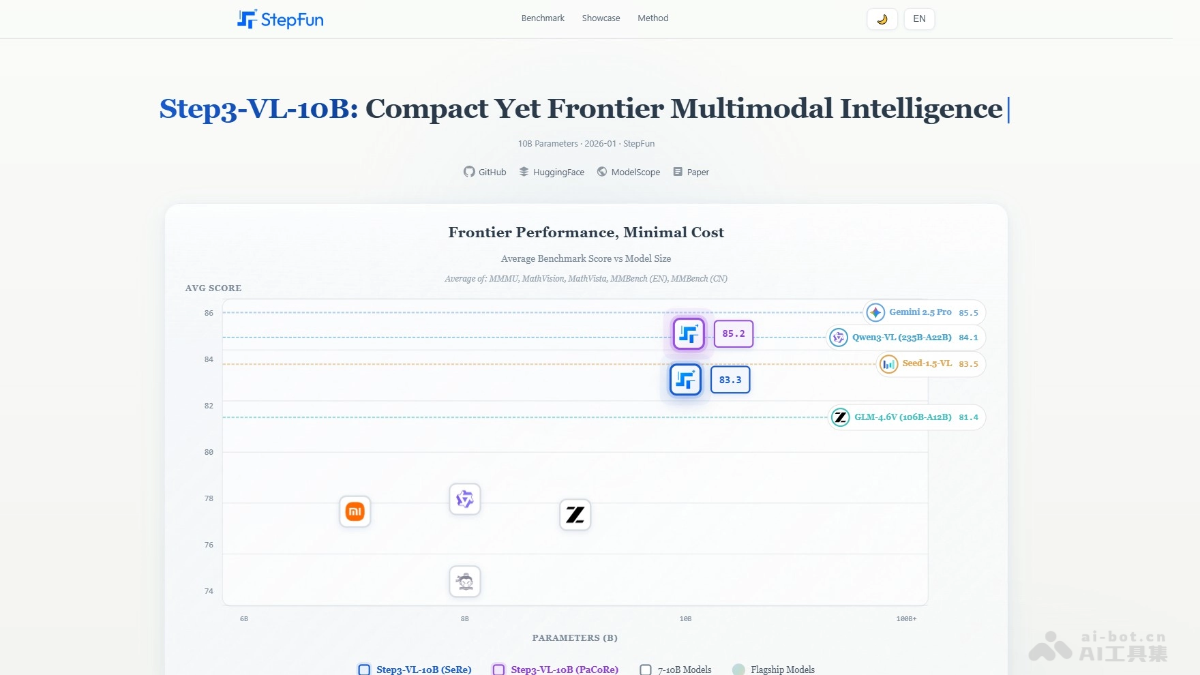
Main Features of Step3-VL-10B
- Extreme Visual Perception: Performs excellently in tasks such as complex counting, high-precision OCR (Optical Character Recognition), and spatial topology understanding, accurately recognizing and processing detailed information in images.
- Deep Logical Reasoning: The model supports multi-step reasoning and complex logical deduction, demonstrating powerful reasoning capabilities in math competitions, programming environments, and visual logic puzzles.
- On-Device Interaction Capabilities: The model can accurately recognize and operate complex graphical user interfaces (GUIs), suitable as the core engine for on-device Agents, supporting efficient operation on terminal devices such as phones and computers.
- Multimodal Reasoning:
- Integrates visual and language information, supports cross-modal tasks such as Visual Question Answering (VQA) and document parsing, and can handle interaction and reasoning tasks involving multiple modal data.
- Efficient Code Generation: Performs excellently in real programming environments, can generate high-quality code, and supports dynamic programming tasks.
Technical Principles of Step3-VL-10B
- Full-Parameter End-to-End Multimodal Joint Pre-Training: The model undergoes full-parameter joint training on a 1.2T high-quality multimodal dataset, abandoning the traditional staged frozen-module training approach, achieving deep alignment between visual features and language logic in the underlying semantic space.
- Large-Scale Multimodal Reinforcement Learning: The model has undergone over 1,400 iterations of optimization, using reinforcement learning (RL) to improve the model's performance in tasks such as visual recognition, mathematical and logical reasoning, and general conversation.
- Parallel Coordinated Reasoning Mechanism (PaCoRe): The model supports dynamic compute scaling during the inference stage, significantly improving the model's accuracy in complex tasks by exploring multiple perceptual hypotheses in parallel and aggregating multi-dimensional evidence.
- Efficient Architecture Design: The model uses a PE-lang vision encoder (1.8B parameters) and a Qwen3-8B decoder, combined with a multi-crop strategy and projection layer, achieving efficient visual and language processing capabilities.
- Multi-Stage Training Strategy: Includes pre-training (1.2T tokens), supervised fine-tuning (226B tokens), and reinforcement learning (>1,400 iterations), ensuring the model's generalization ability and performance optimization across multiple tasks.
Step3-VL-10B Project Address
- Project Official Website:https://stepfun-ai.github.io/Step3-VL-10B/
- GitHub Repository:https://github.com/stepfun-ai/Step3-VL-10B
- HuggingFace Model Library:https://huggingface.co/collections/stepfun-ai/step3-vl-10b
- arXiv Technical Paper:https://arxiv.org/pdf/2601.09668
Application Scenarios of Step3-VL-10B
-
Intelligent Education: The model can assist students in solving math problems, parse educational documents, provide personalized learning tutoring, and improve learning efficiency.
-
Intelligent Office: The model can automatically process documents, spreadsheets, and GUI operations, optimize office workflows, and improve work efficiency.
-
Intelligent Devices: Achieve efficient multimodal interaction on mobile phones, computers, and smart homes, enhancing the user experience.
-
Industrial Automation: Used for industrial visual inspection, quality control, and robot control, improving production efficiency and intelligence.
-
Intelligent Customer Service: The model can provide accurate question answering and customer feedback analysis through visual and language interaction, improving customer service quality.