
What is Step-R1-V-Mini
Step-R1-V-Mini is the latest multimodal reasoning model launched by StepFun. It supports image-text input and text output, has good instruction-following and general capabilities, and can perceive images with high precision to complete complex reasoning tasks. The model performs outstandingly in the field of visual reasoning, and is also in the first tier in mathematics, code, and text reasoning. It adopts multimodal joint reinforcement learning and introduces a verifiable reward mechanism in the image space based on the PPO strategy, improving generalization and robustness. Through multimodal synthetic data training, it effectively solves the seesaw problem in training.
Main functions of Step-R1-V-Mini
- Multimodal input and output: Supports image-text input and text output, can process image and text information, outputs reasoning results in text form, and has good instruction-following and general capabilities.
- High-precision image perception and reasoning: Can perceive images with high precision and complete complex reasoning tasks, such as identifying specific locations through images, analyzing food pictures and generating detailed recipes, etc. It ranks first in China on the MathVision visual reasoning leaderboard.
- Mathematical problem solving: Can construct reasonable reasoning chains, plan and solve complex mathematical problems step by step, including Olympiad problems and geometry problems.
- Logical reasoning analysis: Independently tries multiple problem-solving approaches, asks itself questions to ensure all good solutions are enumerated, and checks for omissions before submitting.
- Complex algorithm problem solving: Can correctly solve algorithm problems rated "Hard" on the LeetCode technical platform.
- Code logic construction: Gradually analyzes user needs and intentions, constructs code logic, and intersperses analysis and verification of the current code snippet during code writing.
- Literary creation: Deeply understands users' expression needs, analyzes requirements such as creative themes and literary genres, endows things with symbolic meaning at the human emotional level, and adds personalized and innovative expression styles.
Technical principles of Step-R1-V-Mini
- Multimodal joint reinforcement learning: Step-R1-V-Mini is based on the reinforcement learning method of the PPO (Proximal Policy Optimization) strategy. PPO is an On-Policy algorithm that updates the model in real time by generating samples online. In the image space, the model introduces a verifiable reward mechanism, solving the problems of complex reasoning chains in image space and the susceptibility to confusing correlation and causal reasoning errors. Compared with traditional methods such as DPO (Direct Preference Optimization), PPO is more generalizable and robust when handling complex chains in image space.
- High-quality multimodal data synthesis: Because feedback signals for multimodal data are relatively difficult to obtain, Step-R1-V-Mini has designed a large number of multimodal data synthesis chains based on environmental feedback. By synthesizing multimodal reasoning data that can be trained at scale, combined with PPO-based reinforcement learning training, the model can simultaneously improve text and visual reasoning capabilities. It effectively avoids the "seesaw" problem in training, that is, the problem where the capabilities of different modalities trade off against each other.
- Cold start and multi-stage reinforcement learning: The training process of Step-R1-V-Mini also involves cold start and multi-stage reinforcement learning. First, the base model is fine-tuned by collecting high-quality cold start data (such as CoT data) to obtain an initial model. Then, large-scale reinforcement learning training is performed based on the model, enabling it to develop reasoning capabilities. Next, the trained model is used to generate high-quality SFT data, which is mixed with data from other domains for another round of SFT training. Finally, the data from all domains is used for the final reinforcement learning to obtain the final model.
How to use Step-R1-V-Mini
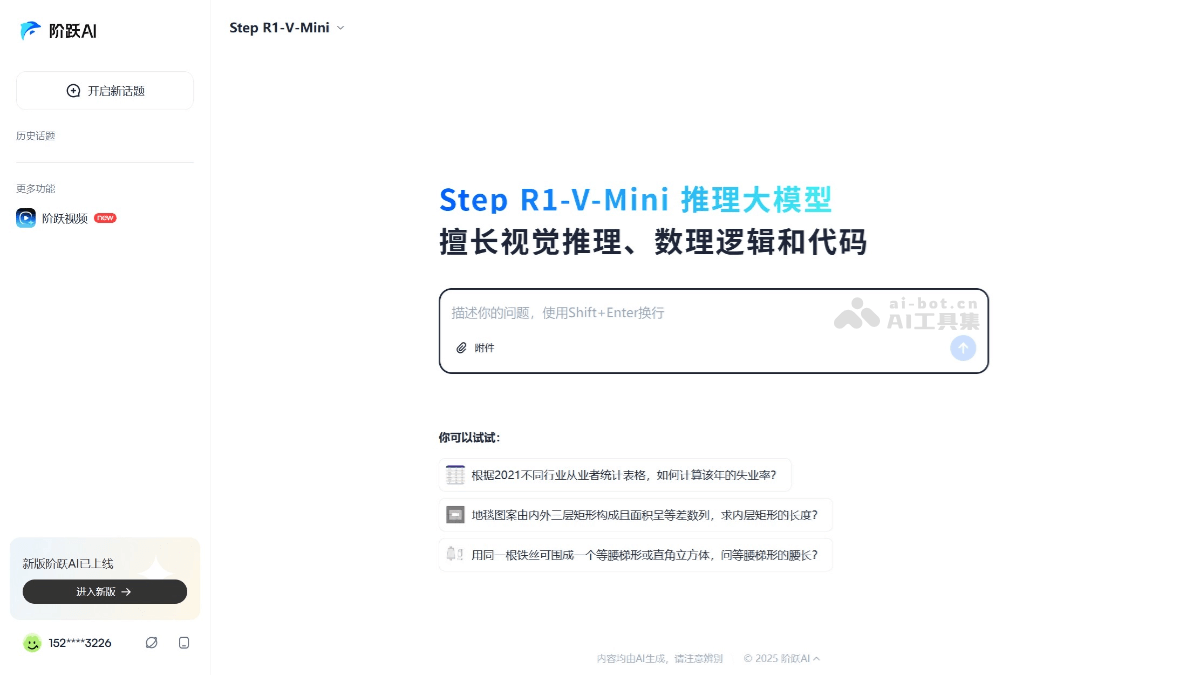
- Visit the Step AI web interface: Step-R1-V-Mini has been officially launchedStep AI, and you can visit the official website to directly select the model for inference tasks.
- Call the API interface: For developers or enterprise users, Step-R1-V-Mini provides an API interface on the StepFun Open Platform. You can visit the StepFun Open Platform to obtain detailed API documentation and usage instructions.
- Visual reasoning: Users can upload images and input related questions. The model can perceive images with high precision and complete complex reasoning tasks, such as identifying locations in images, counting objects, recipe recognition, and more.
- Mathematical and logical reasoning: By inputting mathematical problems or logic puzzles, the model can construct a reasonable reasoning chain and solve them step by step.
Application scenarios of Step-R1-V-Mini
- Image recognition and analysis: It can perceive images with high precision and complete complex reasoning tasks. The model can quickly identify elements in the image, combine information such as color and objects, comprehensively determine that the location is Wembley Stadium, and provide possible information about the two competing sides.
- Object counting: By inputting an image showing objects of different shapes, colors, and positions, the model can identify them one by one and perform logical reasoning, ultimately determining the number of remaining objects.
- Recipe recognition: By inputting an image of food, the model can accurately identify the dishes and dipping sauces, and list the specific amounts in detail.
- Multimodal data fusion: It can process multimodal data containing text and images to generate comprehensive reasoning results.
- Cross-modal reasoning: It converts images into formal textual descriptions, enabling language models to accurately process and reason about images.