
What is Step Edge
Step Edge is an all-in-one on-device model suite launched by StepFun, comprising four members: the base model, Audio, GUI, and Gen, designed for terminals such as smartphones and cars. Through a device-cloud collaborative architecture, the models enable Agents to achieve 0.1-second-level responses locally while ensuring privacy for all-modal data, ranking first in 29 core benchmarks, and are paired with the self-developed Step Inference NPU engine to optimize terminal inference.
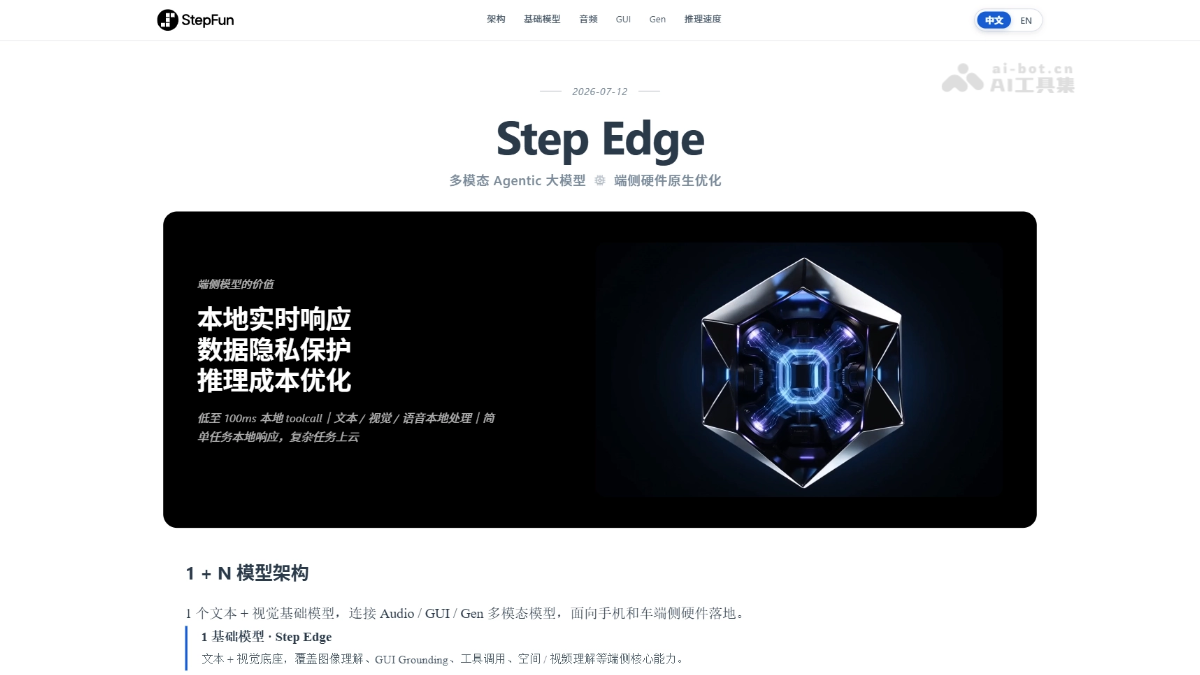
Step Edge's main features
-
Step Edge base model: On-device multimodal understanding and reasoning, supporting text, images, video, OCR, spatial understanding, and tool calling.
-
Step Edge Audio: On-device audio understanding and speech recognition, covering multilingual ASR such as Chinese and English as well as audio question answering.
-
Step Edge GUI: On-device GUI Agent, supporting visual perception, element localization, and automated operations for mobile and desktop applications.
-
Step Edge Gen: On-device image generation and editing, supporting text-to-image, image-to-image, and local editing, leading in benchmarks such as OneIG and DPG-Bench.
Step Edge's technical principles
-
Device-cloud collaborative architecture: Simple, high-frequency tasks are handled locally on the device, while complex, long-chain reasoning is completed in the cloud, achieving an overall balance of speed, capability, and cost.
-
All-modal local inference: Multimodal data such as text, vision, and speech is processed locally on the terminal, sensitive information does not leave the device, and privacy and security are ensured through local computation.
-
Step Inference NPU engine: A self-developed terminal inference engine that performs operator and memory optimization for hardware such as smartphones and cars, reducing end-to-end latency for input modalities such as text, vision, and speech.
-
Low-latency Toolcall execution: On-device local tool calling latency is as low as 0.1 seconds, supporting real-time responses in high-frequency interaction scenarios and reducing reliance on cloud links.
How to use Step Edge
The Step Edge suite has not yet clearly opened public beta or an API, and is currently at the launch and unveiling stage.
Step Edge's project address
- Project official website:https://static.stepfun.com/blog/step-edge/
Comparison of Step Edge with similar competitors
| Comparison dimension | Step Edge | Qwen3-VL |
|---|---|---|
| Product form | All-in-one on-device model suite (base + Audio + GUI + Gen) | Open-source multimodal large model series |
| On-device optimization | Deeply optimized for terminal scenarios, paired with a self-developed NPU engine | Supports on-device deployment, but mainly targets general multimodal tasks |
| GUI Agent | On-device GUI model, leading in benchmarks such as OSWorld | Requires combination with external frameworks to achieve GUI automation |
| Audio capabilities | Independent Audio model, integrating ASR and audio understanding | Mainly focuses on vision and text; audio is not a core direction |
| Image generation | Built-in Gen model, supporting on-device text-to-image and editing | Primarily focused on understanding; generation capability is not the main focus |
| Privacy strategy | All-modal local processing, native device-cloud collaboration | Can run on-device, but the collaboration strategy needs to be built independently |
Step Edge's application scenarios
-
Smartphone assistant: On-device real-time speech recognition and GUI automation operations, completing high-frequency tasks such as ordering takeout, sending messages, and checking the photo album offline.
-
In-car smart cockpit: Locally processes voice commands and in-vehicle visual perception, safeguards driving data privacy, and enables zero-latency control of navigation, air conditioning, and entertainment.
-
On-device image creation: Local text-to-image generation and photo editing on mobile phones, with no need to upload photos to the cloud, meeting users' dual needs for instant creation and privacy protection.
-
Industrial terminal inspection: In factories with weak network coverage or outdoor scenarios, the on-device model locally identifies equipment fault images and audio anomalies, and reports key information in real time.
-
IoT edge devices: Deployed in smart homes and wearable devices to complete voice wake-up, visual recognition, and simple decision-making locally, reducing cloud costs.