
What Is Step-DeepResearch
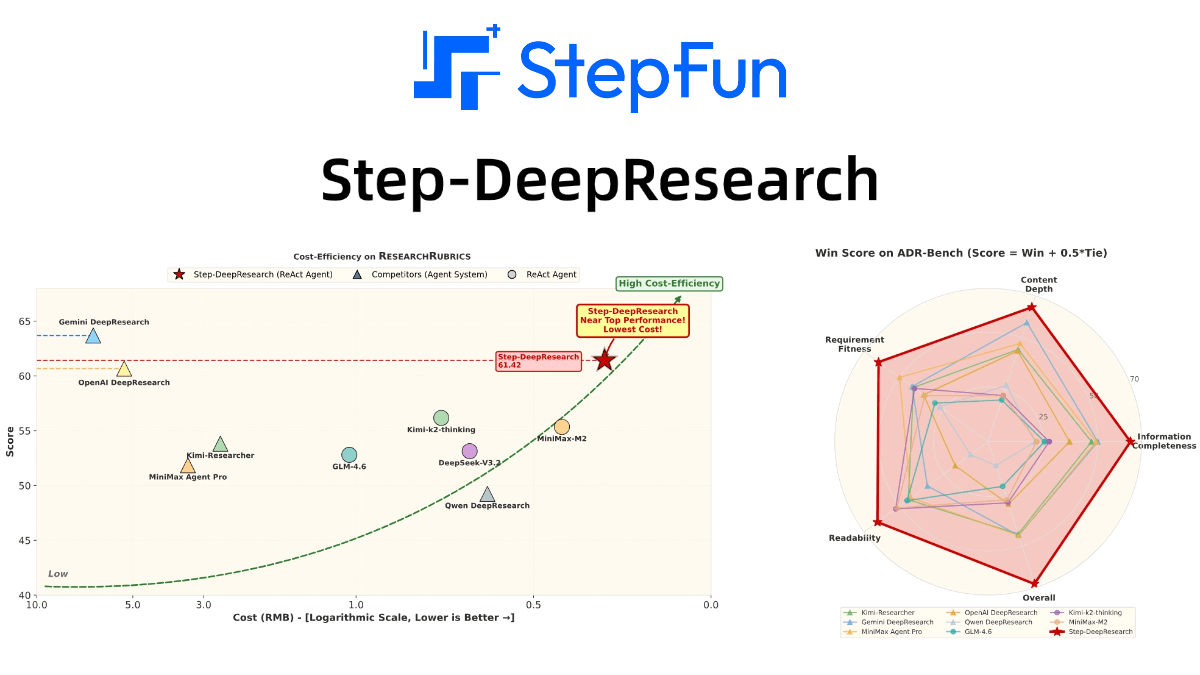
Step-DeepResearch is a 32-billion-parameter deep research AI model launched by StepFun, capable of completing complex research tasks and generating professional reports in a single inference pass. The model adopts a monolithic architecture design and, through four core capabilities—planning, deep search, reflective verification, and report writing—achieves an efficient and low-cost research loop. It scores 61.42 on the ResearchRubrics benchmark, with performance approaching top closed-source models, while the cost per report is as low as 0.5 RMB. Its standout feature is strengthening the model's decision-making ability through Mid-Training; it excels in professional fields such as finance and healthcare, supports features such as focused search and self-selected information sources, and is suitable for scenarios including industry research and academic analysis.
Main Features of Step-DeepResearch
-
Atomic Capability Integration: Decomposes complex research tasks into trainable atomic capabilities such as planning, information retrieval, reflection and cross-validation, and professional report generation, and deeply internalizes them at the model level, ensuring closed-loop reflection and dynamic correction within a single inference pass.
-
Progressive Training Pipeline: Establishes a complete optimization path from agent mid-training to supervised fine-tuning (SFT) and reinforcement learning (RL), reshaping the training objective as 'deciding the next atomic action,' enhancing the model's adaptability and generalization performance.
-
Outstanding Performance Across Model Scales: With only 32 billion parameters, it achieves a score of 61.4% on the Scale AI Research Rubrics test, on par with OpenAI Deep Research and Gemini Deep Research, and in the ADR-Bench expert human evaluation its Elo score significantly outperforms larger-scale models.
-
Exceptional Cost-Effectiveness: While maintaining expert-level research capabilities, its deployment and inference costs are extremely low, making it the industry's most cost-effective deep research agent solution.
-
High-Quality Data Synthesis: Adopts a data synthesis strategy based on atomic capabilities to generate 'PhD-level' training data with detailed reasoning traces, overcoming the challenge of scarce research data.
-
Authoritative Information Acquisition and Processing: Adopts a curated authoritative index strategy, isolating 600+ authoritative domains to ensure factual grounding, uses knowledge-intensive retrieval at paragraph-level granularity to maximize information density per token, and prioritizes highly credible sources when semantic relevance is comparable.
-
Dynamic Dual-Loop Cognitive Architecture: Builds a 'dynamic planning-hierarchical synthesis' dual-loop workflow; after the planner agent initially generates a research outline, it continuously optimizes the research path based on new findings through reinforcement learning algorithms.
-
Professional Report Generation: Based on an 'industry template library + dynamic knowledge base,' it generates vertical-domain documents that meet format requirements; important viewpoints in the report have clear information source citations, providing the credibility of professional research.
Technical Principles of Step-DeepResearch
-
Single-Agent Architecture and Dynamic Loop: Based on a single-agent architecture, it follows the ReAct paradigm and reframes deep research tasks as a dynamic reasoning-action-observation loop. Through core stages such as planning and reflection, tool execution, and feedback and cross-validation, it uses a dedicated toolset to generate comprehensive research reports.
-
Construction and Training of Atomic Capabilities: Decomposes complex research tasks into trainable atomic capabilities such as planning, information retrieval, reflection and cross-validation, and professional report generation. Data is generated through specific closed-loop processes, such as designing error reflection loops in long-horizon reasoning, to improve the model's anti-interference ability and cross-validation level.
-
Progressive Training Strategy: A phased training process is adopted, including mid-training with medium-length contexts, mid-training with long contexts, and a reinforcement learning stage. By gradually extending the context length and optimizing the model's atomic capabilities, the model's performance on complex tasks is improved.
-
Data Synthesis and Reinforcement Learning: An atomic-capability-based data synthesis strategy is adopted to generate "doctoral-level" training data with detailed reasoning traces. Through reinforcement learning algorithms, expert-aligned scale judgments are converted into binary reward signals, accelerating the model's convergence toward expert-aligned behavior.
-
Authoritative Information Acquisition and Processing: A curated authoritative index strategy is adopted, isolating 600+ authoritative domains to ensure factual grounding. Knowledge-intensive retrieval maximizes single-token information density at paragraph-level granularity, and prioritizes highly credible sources when semantic relevance is comparable.
-
Dynamic Planning and Optimization: A "dynamic planning-hierarchical synthesis" dual-loop workflow is constructed. After the planner Agent initially generates a research outline, it continuously optimizes the research path based on new findings through reinforcement learning algorithms.
Step-DeepResearch Project Address
- Github Repository:https://github.com/stepfun-ai/StepDeepResearch
- arXiv Technical Paper:https://arxiv.org/pdf/2512.20491
Step-DeepResearch Application Scenarios
-
Academic Research: Helps researchers quickly generate literature reviews, research proposals, and preliminary research reports, accelerating the academic research process.
-
Business Analysis: Provides business analysts with market trend analysis, competitor research, and industry report generation, facilitating business decisions.
-
Policy Making: Assists policymakers in conducting policy background research, impact assessments, and writing policy recommendation reports, supporting the scientific and rational nature of policy making.
-
Technology Development: In the technology field, it is used for new technology research, technology trend analysis, and feasibility study report generation, promoting technological innovation.
-
Education: Assists teachers and students in course research, project design, and academic paper writing, improving education quality and research capabilities.
-
Healthcare: Supports medical researchers in disease research, treatment method evaluation, and medical literature reviews, promoting the development of medical technology.