
What is Step Audio 3
StepAudio 3 is launched by StepFunspeechlarge model series, including five models: Realtime, ASR, TTS, Gen, and Music. Among the models, Realtime's speech reasoning accuracy is 99.7%, and ASR's word error rate is 1.7%, both ranking first globally on the Artificial Analysis leaderboard. StepAudio 3 can understand and speak, and can further understand emotional tone, complete complex reasoning, uniformly generate vocals and sound effects, and participate in the entire music creation process, covering scenarios such as real-time conversation, subtitle transcription, film and television dubbing, and music production.
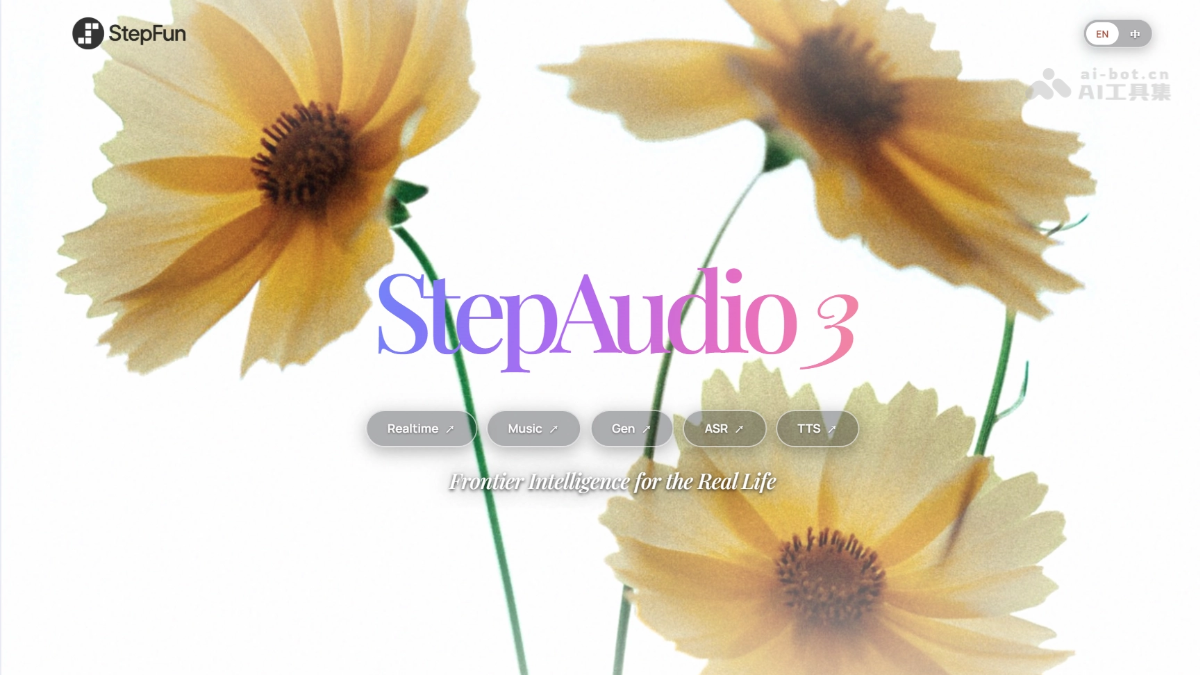
Main features of Step Audio 3
-
Realtime real-time conversation: Supports native full-duplex interaction, and can listen, think, judge the rhythm of the conversation, and execute tasks.
-
ASR speech recognition: High-precision transcription of Chinese, English, dialects, and mixed Chinese-English speech, with understanding of technical terms and complex contexts.
-
TTS speech synthesis: Generates human-level speech, reproducing tone, emotion, pauses, and paralinguistic details such as laughter and hesitation.
-
Gen audio generation: Generates vocals, sound effects, ambient sounds, and background music in one pass, with fine control over the timing of each element.
-
Music music creation: Supports generation from scratch, a cappella accompaniment, song covers, and multi-turn interactive creation using ABC notation.
Technical principles of Step Audio 3
-
Realtime: Adopts a native full-duplex architecture, with listening and speaking proceeding in parallel; during continuous dialogue, the model simultaneously completes audio understanding, reasoning, and speech generation, supporting parallel reasoning and generation and asynchronous Tool Call execution.
-
ASR: Combines high-precision speech recognition with a large language model, using the large model's contextual understanding, knowledge base, and reasoning capabilities to correct homophones, personal names, place names, and technical terms, upgrading from "sound transcription" to "contextual understanding".
-
TTS: Based on a streaming generation architecture, it generates while playing to meet the low-latency requirements of real-time interaction; at the same time, it models timbre, intonation, rhythm, and breath pauses, and autonomously adjusts emotion and tone based on semantics.
-
Gen: Uses a unified model to replace the traditional fragmented dubbing, sound effects, and scoring processes, simultaneously generating multiple layers of sound based on natural language descriptions and reference audio, and participating in sound design through the ability to temporally arrange dialogue, sound effects, and ambient sound.
-
Music: Supports both generation from scratch and conditional creation, by understanding the musical elements in a cappella singing, lyrics, and melody, providing structured control with the help of ABC notation, and modeling song sections, melodic development, and energy changes to output structurally complete works.
How to use Step Audio 3
- Visit the official website: Visit the StepAudio 3 homepage https://static.stepfun.com/blog/stepaudio3/ to learn about the capabilities of each model.
- Choose a model: Choose Realtime, ASR, TTS, Gen, or Music according to your needs.
- Enter the experience center: Visit the StepFun speech experience centerhttps://www.stepfun.com/studio/audio在线试用各模型效果。
- Register on the open platform: Go to the StepFun open platform https://platform.stepfun.com/ to register an account and obtain an API Key.
- Consult the API documentation: View the request parameters and calling examples on the integration guide page for the corresponding model on the open platform.
- Integrate and call: Integrate the API into your own application according to the documentation, and pass in text, audio, or natural language descriptions to generate results.
- Debug and optimize: Adjust parameters such as timbre, emotion, speaking rate, and structure based on the returned results until the requirements are met.
Core Advantages of Step Audio 3
- Strong leaderboard results: Realtime's speech reasoning accuracy (99.7%) and ASR's word error rate (1.7%) both rank first globally on Artificial Analysis, backed by third-party validation.
- Interaction feels more human: It can perceive tone, emotion, and conversational rhythm, knowing when to jump in, when to wait, and how to handle interruptions.
- Can handle tasks while chatting: Reasoning, tool calls, and long tasks can run asynchronously in the background without blocking the current conversation, turning the voice assistant from a chat tool into an assistant that can get work done.
- One model handles the entire audio pipeline: Voiceover, sound effects, ambient sound, and music originally required multiple tools working separately; now a single generation produces complete sonic layering, and the timing and order in which each type of sound appears can be precisely arranged.
- Creative control returned to the user: Supports multiple input methods such as a cappella, lyrics, melody, and ABC notation, with AI helping you continue and refine your work.
How to Use Step Audio 3
-
Learn about the product: Visit the StepAudio 3 official website homepagehttps://static.stepfun.com/blog/stepaudio3/,熟悉 to see the respective capabilities of the five models: Realtime, ASR, TTS, Gen, and Music.
-
Try online: Enter the StepFun Voice Experience Center, input text or upload audio, and experience the results of each model for free.
-
Register on the platform: Register an account on the StepFun Open Platform, create an application, and obtain an API Key.
-
Consult the documentation: Open the integration guide page for the corresponding model to learn about the endpoint URL, request parameters, and billing method.
-
Make a call: Pass text, audio files, or natural language descriptions through an API request to obtain speech synthesis, recognition, or generation results.
-
Tune parameters for optimization: Adjust parameters such as timbre, emotion, speaking rate, language, and sound arrangement based on the results.
-
Integrate and launch: Embed the API into your own product or workflow, complete deployment, and continuously monitor performance.
Step Audio 3 Project Address
- Project official website:https://static.stepfun.com/blog/stepaudio3/
Comparison of Step Audio 3 with Similar Competitors
| Comparison Dimension | StepAudio 3 Music (StepFun) | MiniMax Music 3.0 |
|---|---|---|
| Product positioning | The music creation module in the StepAudio 3 five-model matrix | An independent open-source weight music generation model that can be deployed locally |
| Input methods | Lyrics, a cappella, reference songs, melody, ABC notation | Creative description + optional lyrics, supports [Verse] [Chorus] and other structural tags |
| Creation mode | Generation from scratch + multi-turn interactive creation, supporting a cappella scoring and cover versions | Generates a complete song in a single pass, providing a Prompt auto-expansion Skill |
| Structural control | Natural language control of genre, sections, emotion, and arrangement | Structured Caption structured description: genre, BPM, key, section-by-section arrangement changes |
| Generation duration | Not explicitly stated in the original text | Natively supports complete songs of about 5 minutes |
| Output audio quality | Not explicitly specified in the original text | 32kHz, 16-bit stereo WAV |
| Technical Architecture | Models verse/chorus/bridge structure and cross-section melodic development | 8B Global LLM + 0.6B Local LLM hierarchical architecture, with Flow Matching and Flow-VAE |
| Degree of Openness | Cloud API access only | Open model weights, supports local deployment via SGLang-Omni, Diffusers, and ComfyUI |
Application Scenarios of Step Audio 3
- Intelligent Customer Service and Voice Assistants: Full-duplex real-time conversation, able to sense user emotions and execute tasks asynchronously, making customer service communication more natural and efficient.
- Meeting Minutes and Subtitle Generation: ASR accurately transcribes long audio and multi-party conversations, automatically recognizes professional terminology, and directly generates meeting minutes or video subtitles.
- In-Car Voice Interaction: Supports noisy environments, dialect accents, and mixed Chinese-English speech, with low-latency responses, enhancing the voice control experience in driving scenarios.
- Film/TV and Audio Content Production: In radio dramas, audiobooks, and animated dubbing, it generates vocals, sound effects, ambient sounds, and background music in one pass, eliminating multi-tool collaboration and post-production mixing.
- Music Creation and Cover Production: Provides automatic instrumentation and arrangement from a cappella, or continues a complete song based on lyrics and melody, helping musicians quickly complete demos and finished products.