
What is Step 5 Preview
Step 5 Preview is the new-generation flagship foundation model launched by StepFun, designed for real-world Agentic tasks. The model adopts a sparse MoE architecture, with 600B total parameters and only 27B activated, supports a one-million-token context, and is natively multimodal. In authoritative global evaluations, it ranks among the top three open-source models, with performance second only to GPT-6 Astra and Claude Opus 5, while the cost per single task is only 1/8 of the latter.
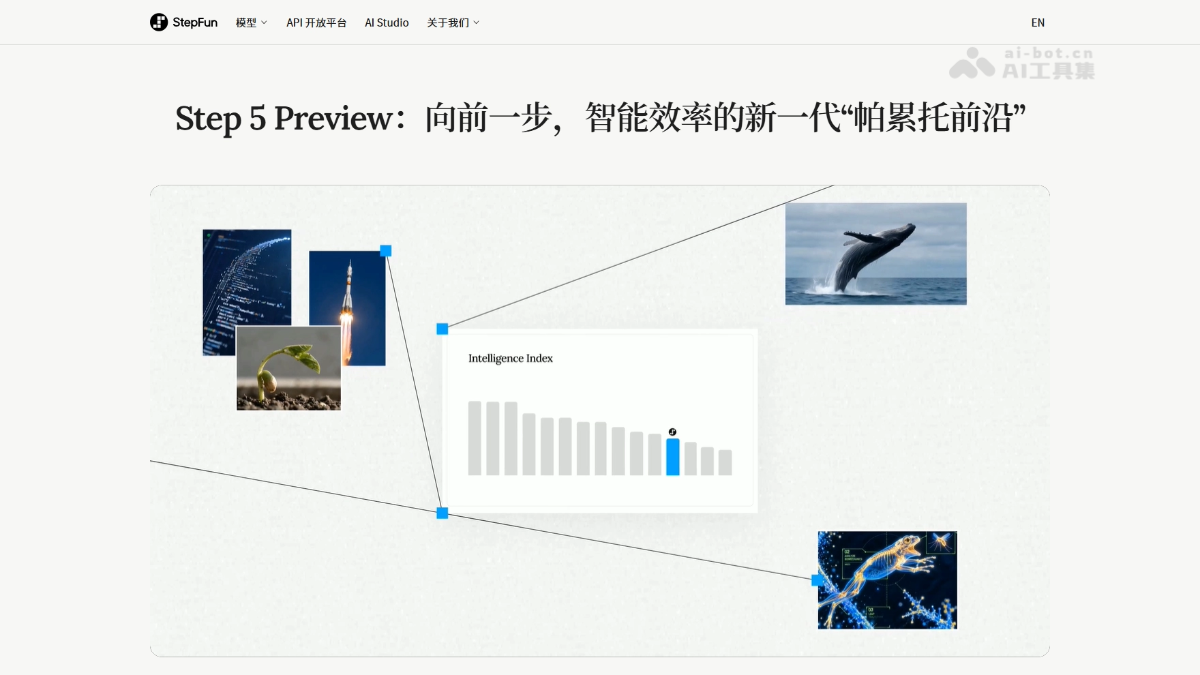
Main features of Step 5 Preview
- AI programming and software engineering: It covers real development tasks such as bug fixing, feature development, and refactoring across 553 code repositories and 33 programming languages, and can also operate real hardware devices for continuous debugging lasting over 3 hours.
- Long-horizon autonomous tasks: It can continuously execute complex tasks within 24 hours, such as optimizing GPU kernels from scratch and automating post-training data pipelines.
- Frontend and creative development: It can call Blender to generate 3D assets and integrate them into Three.js interactive applications.
- Financial analysis: It has three types of capabilities: information retrieval and verification, corporate valuation modeling, and deep research report generation, and has been validated through the external FrontierFinance evaluation.
- Ultra-long context understanding: It supports a 1 million Token window and can continuously track context in long task chains and call tools multiple times to complete delivery.
Technical principles of Step 5 Preview
-
Sparse MoE architecture: The model has 600B total parameters, but only activates 27B parameters per inference. Through an "on-demand expert invocation" approach, it greatly reduces computational cost while maintaining flagship-level capabilities, which is the core reason its cost per single task is only 1/8 of Claude Opus 5.
-
Long-context continuous tracking: With a 1 million Token context window, the model can fully retain historical execution records, tool return results, and debugging feedback in tasks lasting dozens of hours, judge the next action based on runtime feedback, and achieve long-horizon planning and continuous iteration.
-
Agentic tool-calling loop: The model has an autonomous "plan—execute—observe—correct" loop capability, can access external tools such as serial ports, cameras, and APIs, and continuously modifies code based on the states and errors returned by the real environment until the task is completed.
-
Native cross-modal fusion: Text and visual inputs are natively processed in the same foundation, enabling the model to both understand visual information such as documents and screenshots and generate and iterate visual content.
-
Efficiency Scaling route: Continuing the technical approach of Step 3.5 Flash, the core proposition is how to more efficiently convert computation into model capability, and through architectural design, push the Pareto frontier of "capability—cost—efficiency" outward.
How to use Step 5 Preview
-
Online experience: Visit the Studio platform https://studio.stepfun.com/,注册登录后可在网页端直接对话试用模型。
-
Domestic API access: Go to https://platform.stepfun.com/ to register an open platform account, create an API Key, and then call the Step 5 Preview interface according to the documentation.
-
Overseas API access: Overseas users visit https://platform.stepfun.ai/,同样注册获取 API Key and then integrate it into their own applications or Agent workflows.
-
Access Agent tasks: Configure long-context and tool-calling parameters in API calls to enable the model to execute complex Agentic tasks such as programming and financial research.
Core Advantages of Step 5 Preview
- Optimal Balance of Performance and Cost: It scored 44 points on the globally authoritative Artificial Analysis Intelligence Index, ranking in the top three among open-source models, while its cost per task is only 1/8 that of Claude Opus 5, significantly advancing the Pareto frontier of intelligence efficiency.
- Flagship-Level Long-Horizon Agent Capabilities: It can continuously perform autonomous tasks for over 22 hours, such as optimizing a GPU kernel to 508 TFLOPS, surpassing Claude Opus 5, demonstrating sustained planning and self-correction capabilities.
- Ultra-Long Context Window: It supports a 1 million Token context, can fully retain historical records in long task chains, and continuously understands context, making it suitable for complex multi-turn tool-calling scenarios.
- Efficient Sparse MoE Architecture: With 600B total parameters but only 27B activated, it achieves flagship-level performance at extremely low inference cost, allowing equivalent capabilities to be put into practical work at lower cost.
- Broad and Deep Scenario Coverage: It performs outstandingly in areas such as AI programming (553 repositories, 33 languages), financial research, and front-end creative development, possessing comprehensive cross-industry task-handling capabilities.
Project Address of Step 5 Preview
- Project Official Website:https://www.stepfun.com/step-5-preview
Comparison of Step 5 Preview with Similar Competitors
| Comparison Dimension | Step 5 Preview | Claude Opus 5 |
|---|---|---|
| Developer | StepFun (StepFun) | Anthropic |
| Model Architecture | Sparse MoE (600B total parameters / 27B activated) | Not disclosed |
| Intelligence Index | 44 points (top three globally among open-source models) | Slightly higher than Step 5 Preview |
| Cost per Task | Baseline cost | 8 times that of Step 5 Preview |
| Context Window | 1 million Tokens | 200K Token |
| Input Modality | Native text + vision | Text + vision |
| GPU Kernel Optimization | 508 TFLOPS (better) | 493 TFLOPS |
| AIME24 Post-Training | 53.3% → 60% (on par, with lower token consumption) | 53.3% → 60% |
| Open-Source Status | Full weights released on October 15, 2026 | Closed-source, available only via API |
Application Scenarios of Step 5 Preview
- AI Programming and Software Development: It covers tasks such as bug fixing, feature development, code refactoring, and environment configuration, supports 33 programming languages, and can serve as a developer's daily primary coding model.
- Long-Horizon Scientific Research and Engineering Tasks: Examples include continuously optimizing GPU kernels for 24 hours and automating post-training data pipelines, suitable for research-oriented work that requires long periods of autonomous iterative operation.
- Hardware Development and Embedded Debugging: It can autonomously read device documentation, operate serial ports and cameras, and continuously debug code based on errors returned by real hardware, such as ESP32 development board modification projects.
- Financial Analysis and Investment Research: It covers financial information retrieval and verification, corporate valuation modeling, and in-depth research report writing, serving investment research personnel and financial professionals.
- Front-End and Creative Content Development: From web interfaces and data visualization to Blender 3D asset generation and Three.js interactive applications, it supports designers and creative workers in rapidly bringing ideas to fruition.