
What is START
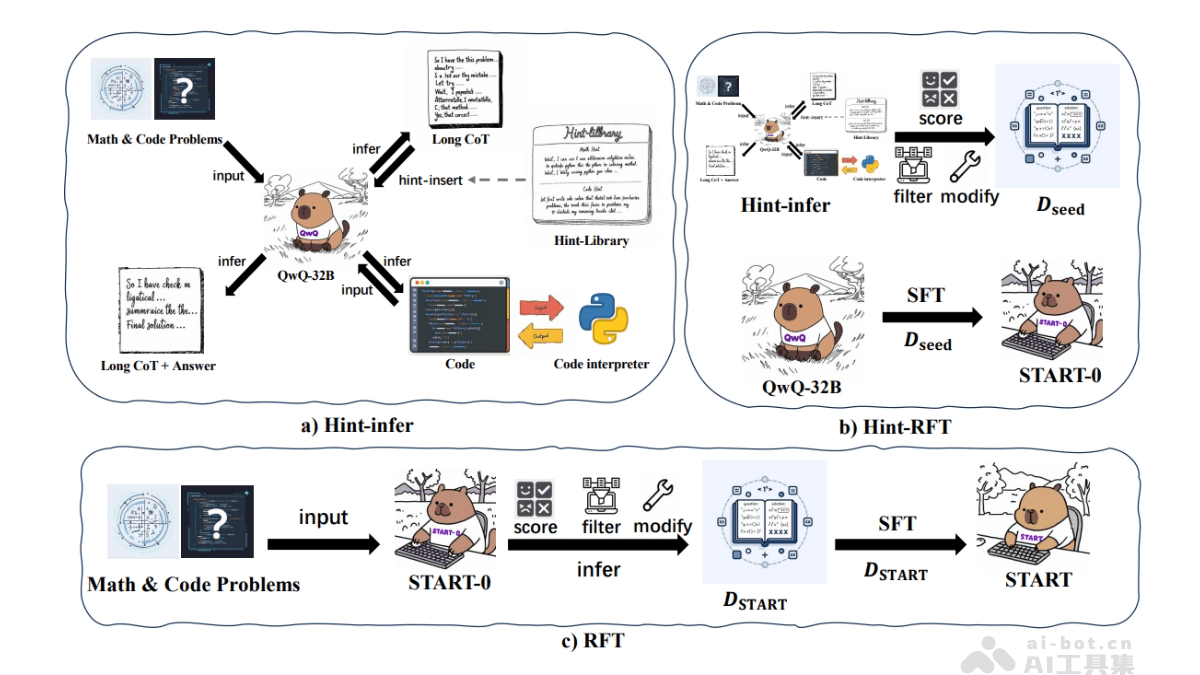
START (Self-Taught Reasoner with Tools) is a new tool-augmented reasoning model launched by Alibaba Group and the University of Science and Technology of China. It combines external tools (such as a Python code executor) to enhance the reasoning capabilities of large language models (LLMs). START is based on the "Hint-infer" technique to insert hints during the reasoning process, stimulating the model to use external tools, and performs self-learning and fine-tuning based on the "Hint-RFT" framework. Building on long chain reasoning (Long CoT), START introduces tool invocation, significantly improving accuracy and efficiency in complex math problems, science question answering, and programming challenges. START performs excellently in multiple benchmarks, surpassing existing models, and becomes the first open-source model combining long chain reasoning with tool integration.
START's main features
- Complex computation and verification: Invokes a Python code executor to perform complex mathematical calculations, logical verification, and simulation.
- Self-debugging and optimization: START uses tools to execute code and verify output, automatically detects errors and debugs them, improving answer accuracy.
- Multi-strategy exploration: Based on hints, it guides the model to try multiple reasoning paths and methods, enhancing the model's flexibility and adaptability when facing complex problems.
- Improved reasoning efficiency: Based on tool invocation and self-verification, it reduces the model's hallucination phenomenon in complex tasks, improving reasoning efficiency and reliability.
START's technical principles
- Long chain reasoning: Inherits the advantages of long chain reasoning, decomposes problems into multiple intermediate reasoning steps, simulates the human process of deep thinking, and improves the model's reasoning ability in complex tasks.
- Tool integration: START compensates for the shortcomings of traditional long chain reasoning by invoking external tools (such as a Python code executor). The model generates code during the reasoning process and uses tools to execute and verify the results.
- Hint-infer: Inserts manually designed hints during the reasoning process, stimulating the model's ability to invoke external tools. It guides the model to call tools at specific nodes without additional demonstration data.
- Hint-RFT: Combines Hint-infer and rejection sampling fine-tuning (RFT), scoring, filtering, and modifying the reasoning trajectories generated by the model, further optimizing the model's tool use capability.
- Self-learning framework: Based on active learning methods, it selects valuable data from the reasoning trajectories generated by the model for fine-tuning, allowing the model to self-learn how to use tools more effectively.
- Test-time scaling: Inserts hints at the end of reasoning, increasing the model's thinking time and number of tool invocations, improving reasoning accuracy and success rate.
START's project address
- arXiv technical paper:https://arxiv.org/pdf/2503.04625
START's application scenarios
- Mathematical problem solving: Solves complex math problems, such as math competitions and advanced mathematics problems, using code verification to improve accuracy.
- Scientific research assistance: Helps handle complex calculations and scientific problems in fields such as physics, chemistry, and biology.
- Programming and debugging: Generates code and automatically debugs it, solves programming challenges, and improves development efficiency.
- Interdisciplinary problem solving: Comprehensively applies multidisciplinary knowledge to solve complex tasks such as engineering design and data analysis.
- Education and learning: As an intelligent tutoring tool, it assists students in learning mathematics and science, providing detailed problem-solving processes and feedback.