
What is STAR
STAR is an innovative real-world video super-resolution (VSR) framework jointly launched by Nanjing University, ByteDance, and Southwest University. It can generate high-resolution (HR) videos from low-resolution (LR) videos while maintaining detail clarity and temporal consistency. STAR integrates a powerful text-to-video (T2V) diffusion model to enhance the spatial detail and temporal modeling capabilities of videos. STAR introduces a Local Information Enhancement Module (LIEM) to enrich local details before the global attention block, mitigating the artifact problems introduced by complex degradations. STAR proposes a Dynamic Frequency (DF) loss to guide the model to focus on different frequency components at different diffusion steps, improving restoration fidelity.
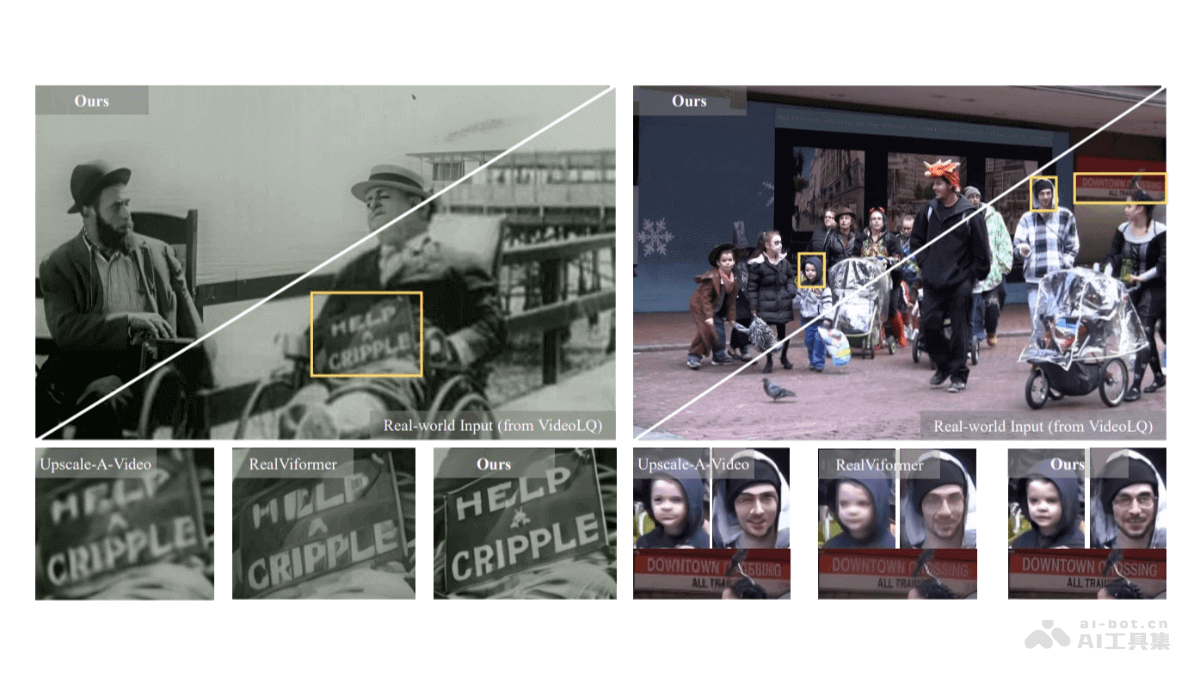
STAR's Main Features
- Real-World Video Super-Resolution: Upscales low-resolution videos in the real world to high resolution while restoring details in the videos, such as clear facial features and accurate text structures.
- Enhanced Spatial Details: Based on the powerful generation capability of the text-to-video (T2V) diffusion model, it generates videos with rich spatial details, making the video content more realistic and clear.
- Maintained Temporal Consistency: In the process of improving video resolution, it effectively maintains temporal consistency between video frames, avoiding motion blur or incoherence, and making video playback smoother and more natural.
- Reduced Degradation Artifacts: For the complex degradation problems existing in real-world videos, such as noise, blur, and compression, STAR can effectively reduce artifacts introduced by degradation and improve the visual quality of videos.
STAR's Technical Principles
- T2V Model Integration: Integrates large-scale pre-trained text-to-video diffusion models into the video super-resolution task. The T2V model has powerful generation capability and rich spatiotemporal prior knowledge, generates high-quality videos from text descriptions, and provides a strong model foundation for video super-resolution.
- Local Information Enhancement Module (LIEM): Introduces LIEM before the global attention mechanism to make up for the T2V model's shortcomings in handling local details. LIEM focuses on local regions in videos based on a local attention mechanism, enhances the expression of local information, better captures and restores details in videos, and mitigates the artifact problems caused by complex degradations.
- Dynamic Frequency (DF) Loss: STAR proposes the DF loss to optimize the model's training process. The loss function dynamically adjusts the constraints on low-frequency and high-frequency components according to the diffusion step, so that the model prioritizes restoring the video's structure and overall outline (low-frequency information) in the early stages, and then refines details (high-frequency information) in the later stages.
STAR's Project Address
- Project Website:https://nju-pcalab.github.io/projects/STAR/
- GitHub Repository:https://github.com/NJU-PCALab/STAR
- arXiv Technical Paper:https://arxiv.org/pdf/2501.02976
STAR's Application Scenarios
- Film and Television Production: Performs super-resolution processing on classic movies or TV series, presenting better visual effects on modern high-definition televisions or streaming platforms, and attracting more viewers to revisit classics.
- Security Surveillance: In security surveillance videos, performs super-resolution processing on low-resolution face images, clearly presenting facial details, and effectively assisting criminal investigation and security management.
- Athlete Motion Analysis: Performs super-resolution processing on live sports event videos, making athletes' motion details clearer and more visible, facilitating coaches and analysts in motion analysis, and improving competition results.
- Medical imaging processing: Perform super-resolution processing on pathological slide images to clearly present the fine structures of cells and tissues, assisting doctors in making more accurate pathological diagnoses.
- Scientific research: In scientific research experiments, perform super-resolution processing on low-resolution images captured by microscopes to provide researchers with more accurate experimental data and image materials.