
What is Stable Virtual Camera
Stable Virtual Camera is an AI model launched by Stability AI that can convert 2D images into 3D videos with realistic depth and perspective. Users can generate videos by specifying camera trajectories and various dynamic paths (such as spiral, dolly zoom, pan, etc.). The model supports generating videos in different aspect ratios (such as 1:1, 9:16, 16:9) from 1 to 32 input images, with a maximum length of up to 1000 frames. It does not require complex reconstruction or optimization and can generate high-quality 3D videos while maintaining 3D consistency and temporal smoothness.
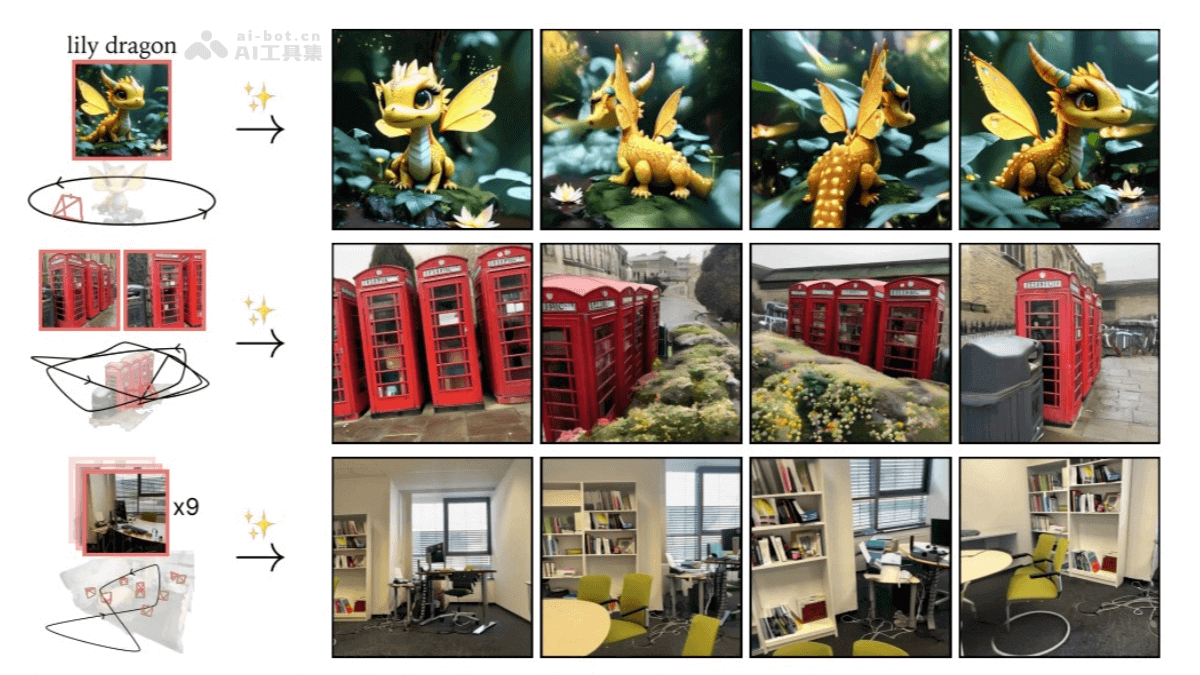
Main Features of Stable Virtual Camera
- 2D Image to 3D Video: It can convert a single or multiple 2D images into 3D videos with depth and perspective effects.
- Custom Camera Trajectories: Users can define a variety of dynamic camera paths, including 360° rotation, ∞-shaped trajectories, spiral paths, panning, rotation, zoom, etc.
- Seamless Trajectory Videos: The generated videos transition naturally between different viewpoints and can achieve seamless looping.
- Flexible Output Formats: It supports generating videos in square (1:1), portrait (9:16), landscape (16:9), and other custom aspect ratios.
- Zero-Shot Generation: Although only square images are used during training, it can also generate videos in different aspect ratios.
- Depth and Perspective: The generated videos have realistic depth and perspective effects and can simulate the movement of a real camera.
- 3D Consistency: It maintains 3D consistency and temporal smoothness along dynamic camera paths, avoiding flickering or artifacts.
- Support for Long Videos: It can generate videos up to 1000 frames long, suitable for scenarios that require long-duration display.
Technical Principles of Stable Virtual Camera
- Generative AI-Based Image Transformation: Stable Virtual Camera uses generative AI technology to analyze and process input 2D images through deep learning models. The model can understand the scene structure, object positions, and texture information in the images, and generate new viewpoints on this basis.
- Neural Rendering Technology: The model is based on neural rendering technology. By simulating the motion paths of real cameras, it generates 3D videos with depth and perspective effects. It supports a variety of dynamic camera paths, such as 360° rotation, spiral paths, dolly zoom, etc., and generates high-quality multi-view videos.
- Multi-View Consistency Optimization: When generating videos, Stable Virtual Camera uses optimization algorithms to ensure consistency and smooth transitions between different viewpoints. Under complex camera paths, it can maintain the stability and coherence of the 3D scene.
- Diffusion Model-Based Generation Process: The generation process of Stable Virtual Camera is similar to a diffusion model. By gradually optimizing the noise and details of the image, it ultimately generates high-quality 3D videos.
Stable Virtual Camera Project Address
- Project Official Website:https://stable-virtual-camera.github.io/
- GitHub Repository:https://github.com/Stability-AI/stable-virtual-camera
- HuggingFace Model Library:https://huggingface.co/stabilityai/stable-virtual-camera
- arXiv Technical Paper:https://arxiv.org/pdf/2503.14489
Application Scenarios of Stable Virtual Camera
- Advertising and Marketing: Used to generate attractive product demonstration videos.
- Content Creation: Helps artists and designers quickly generate creative videos.
- Education and training: Enhance the learning experience through 3D videos.