
What is Stable Fast 3D
Stable Fast 3D (SF3D) is an innovative 3D mesh reconstruction technology launched by Stability AI that can generate high-quality 3D models from a single image in 0.5 seconds. Stable Fast 3D uses an advanced Transformer network, combined with fast UV unwrapping and material property prediction, effectively reducing the impact of lighting effects on the model and improving detail capture capabilities. Stable Fast 3D is not only fast, but also ensures the usability of 3D assets under different lighting conditions, making it suitable for multiple fields such as games, film, e-commerce, and virtual reality.
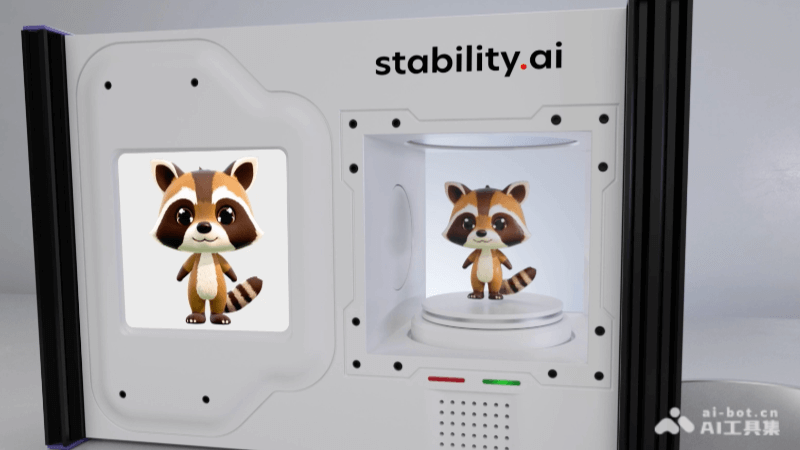
Main features of Stable Fast 3D
- Ultra-fast speed: Imagine taking a photo, and in the blink of an eye, the 3D model is ready.
- Automatic coloring: Stable Fast 3D can not only create the shape of the model, but also automatically color the model, just like the colors in the photo.
- Lighting adjustment: Sometimes colors look different in a photo due to lighting, and SF3D can intelligently adjust them so that the 3D model looks more natural.
- Detail capture: Even very small details in the photo can be captured by SF3D and represented in the 3D model.
- Material awareness: Stable Fast 3D can also infer the material of the model's surface, such as whether it is smooth or rough, making the 3D model look more realistic.
- Easy to use: The completed 3D model files are not large and are easy to use. They can be placed in games, movies, or used to display products.
Technical principles of Stable Fast 3D
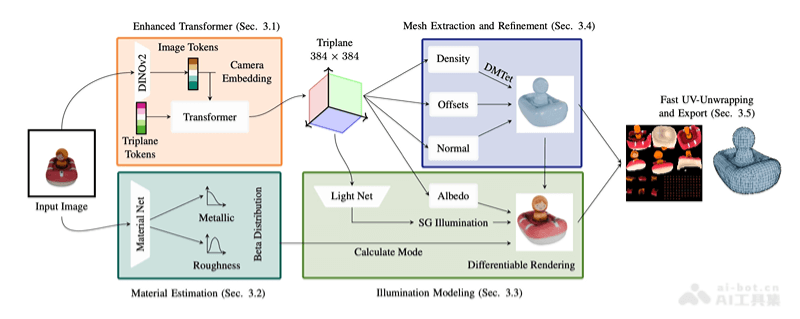
- Image understanding: Stable Fast 3D first needs to understand the input photo. Just like when you look at a photo and know what is in it, Stable Fast 3D analyzes the shape and surface features of the objects in the photo.
- 3D generation: SF3D uses a special network (Transformer network) to convert the objects in the photo into a representation in 3D space. This is like turning a flat drawing into a three-dimensional model.
- UV unwrapping: In 3D modeling, UV unwrapping is a technique that can "flatten" the surface of a 3D model into a 2D plane, making it easier to add colors and textures. SF3D uses fast UV unwrapping technology to make this process complete faster.
- Materials and lighting: Stable Fast 3D can not only generate 3D shapes, but also predict what material the object's surface should be, such as metal, plastic, or wood. Stable Fast 3D can also estimate the lighting conditions in the photo to ensure that the 3D model looks realistic under different lighting.
- Removing lighting effects: Sometimes the lighting in a photo can make the materials of a 3D model look unrealistic. SF3D has a step specifically used to remove these unwanted lighting effects, making the model look good under any lighting.
- Mesh refinement: After generating the 3D mesh, SF3D further refines this mesh, making it smoother and reducing rough edges or unnatural stair-step effects.
- Efficient rendering: SF3D uses efficient rendering technology to generate the final 3D model, and the model can be rendered quickly in any 3D software or game.
- Output 3D model: After all these steps are completed, Stable Fast 3D outputs a complete 3D model. The model contains shape, texture, and material information and is ready for use in various 3D applications.
Stable Fast 3D project address
- Project website:https://stable-fast-3d.github.io/
- Online Demo:https://huggingface.co/spaces/stabilityai/stable-fast-3d
- GitHub repository:https://github.com/Stability-AI/stable-fast-3d
- arXiv technical paper:https://arxiv.org/abs/2408.00653
- YouTube video:https://youtu.be/uT96UCBSBko
Application scenarios of Stable Fast 3D
- Game development: Quickly generate 3D assets required in games, such as characters, props, or environmental elements.
- Film and video production: Used to create special effects elements in films or 3D objects in animations, improving production efficiency.
- E-commerce: Generate 3D views of products for online stores, providing richer product displays.
- Augmented reality (AR) and virtual reality (VR): Create 3D models in AR/VR experiences to enhance immersion.
- 3D printing: Quickly generate 3D models from images for 3D printing various items.
- Education and training: In the field of education, quickly generate complex 3D structures to help students understand better.
- Architecture and interior design: Quickly generate 3D models of architectural elements or interior decorations to assist design and presentation.
- Medical and scientific visualization: Generate 3D models of human organs or scientific concepts for research and education.
- Advertising and marketing: Quickly create attractive 3D advertising materials to improve advertising effectiveness.