
What is SSVAE
SSVAE (Spectral-Structured VAE) is a novel variational autoencoder introduced by Zhipu AI to optimizevideo generation. Through spectral analysis, SSVAE found that if the latent space of a video VAE possesses a spatio-temporal low-frequency bias and a few-mode bias in channel eigenvalues, it can significantly accelerate the training of downstream diffusion models. SSVAE proposes two lightweight regularization methods, Local Correlation Regularization (LCR) and Latent Mask Reconstruction (LMR), to enhance low-frequency energy and promote few-mode bias, respectively. Experiments show that under the same generation quality, SSVAE achieves a 3x speedup in convergence, surpassing traditional models with 4B parameters using only 1.3B parameters, significantly improving video generation efficiency.
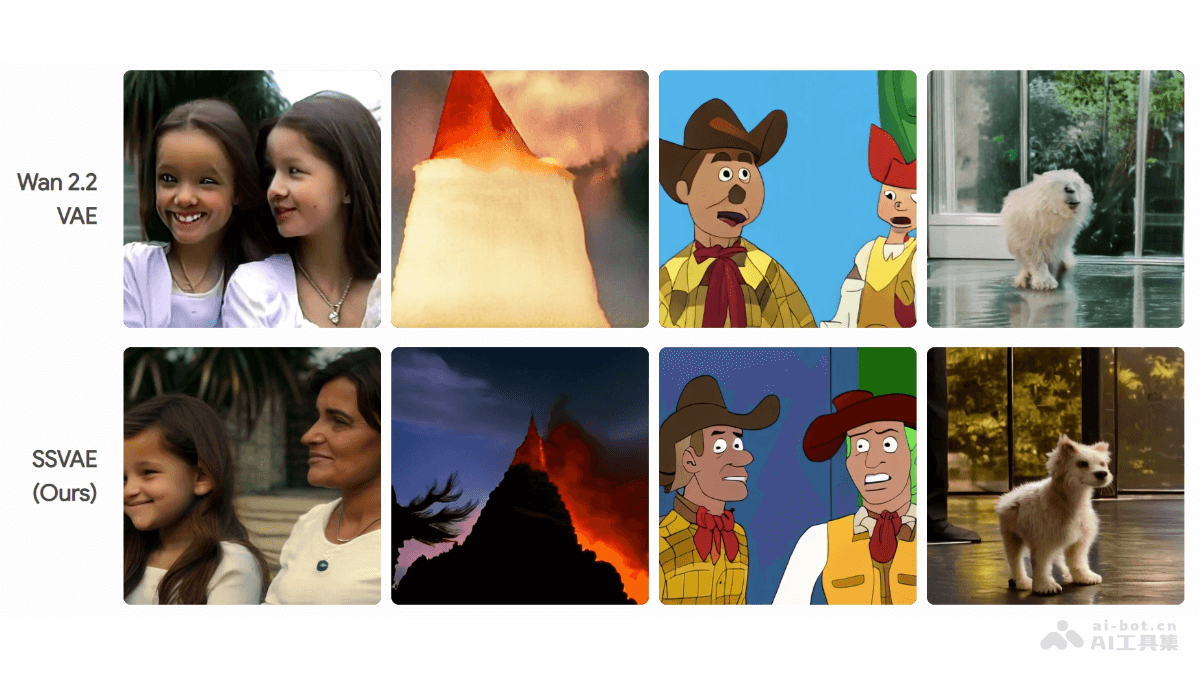
Main Features of SSVAE
-
Accelerate diffusion model convergence: SSVAE optimizes the spectral properties of the latent space, achieving a 3x speedup in diffusion model convergence.
-
Improve generation quality: Generated videos perform better in visual quality, spatio-temporal consistency, alignment with text prompts, etc., with fewer artifacts.
-
Reduce model parameter count: Under the premise of achieving the same generation quality, SSVAE requires fewer diffusion model parameters (e.g., surpassing traditional 4B parameter models with only 1.3B parameters).
-
Enhance latent space robustness: Through Latent Mask Reconstruction (LMR) technology, SSVAE improves the robustness of the VAE decoder to noise, enabling it to better handle high-noise samples generated from diffusion models.
Technical Principles of SSVAE
- Spatio-Temporal Low-Frequency Bias: SSVAE introduces a spatio-temporal low-frequency bias. In video generation, low-frequency components usually contain the main structure and motion information of the video, while high-frequency components contain details and noise. By enhancing low-frequency components, the model can more efficiently recover high-quality video content from high-frequency details with low signal-to-noise ratio. SSVAE achieves this goal with Local Correlation Regularization (LCR). LCR computes the similarity of adjacent spatio-temporal positions in the latent space and optimizes it as part of the loss function, explicitly increasing low-frequency energy.
- Few-Mode Bias in Channel Eigenvalues: In a multi-channel latent space, few-mode bias means that most information is concentrated in a few main feature modes, rather than uniformly distributed across all channels. The bias helps the diffusion model learn the relationship between signal and noise faster, accelerating convergence. SSVAE achieves this goal through Latent Mask Reconstruction (LMR) technology. LMR randomly masks part of the latent space features during training, forcing the decoder to reconstruct videos from incomplete features.
SSVAE Project Address
- Project Website:https://zhazhan.github.io/ssvae.github.io/
- GitHub Repository:https://github.com/zai-org/SSVAE
- HuggingFace Model Library:https://huggingface.co/zai-org/SSVAE
- arXiv Technical Paper:https://arxiv.org/pdf/2512.05394
Application Scenarios of SSVAE
- Film and Television Production: Used to generate high-quality animations, special effects, or virtual scenes, helping film and television production teams quickly generate preliminary materials and reducing the time cost of manual modeling and animation production.
- Short Video Creation: Provide content creators with the ability to quickly generate videos, for example, generating creative videos based on text descriptions, improving the efficiency and diversity of content creation.
- Advertising production: Quickly generate advertising videos, and generate high-quality dynamic advertising materials according to different product and scene requirements.
- Virtual assistant: Combine speech synthesis and video generation technology to create virtual characters that can converse with users in real time, providing a more natural and more vivid interactive experience.
- Online education: Generate virtual teachers or lecturers, and generate video explanations in real time according to the teaching content, enhancing the interactivity and fun of online learning.