
What is SPRIGHT
SPRIGHT (SPatially RIGHT) is a large-scale vision-language dataset focused on spatial relationships, jointly launched by Arizona State University, Intel Labs, Hugging Face, University of Washington, and other institutions. It can address the issue of insufficient spatial consistency in existing text-to-image (T2I) models when generating images. The dataset re-captions approximately 6 million images, emphasizing their spatial relationships and significantly increasing the proportion of spatial relationships in the dataset. By fine-tuning with SPRIGHT, T2I models achieve significant performance improvements in generating spatially accurate images. Based on a detailed evaluation and analysis pipeline, SPRIGHT verifies its effectiveness in capturing spatial relationships, providing rich resources and a foundation for future research.
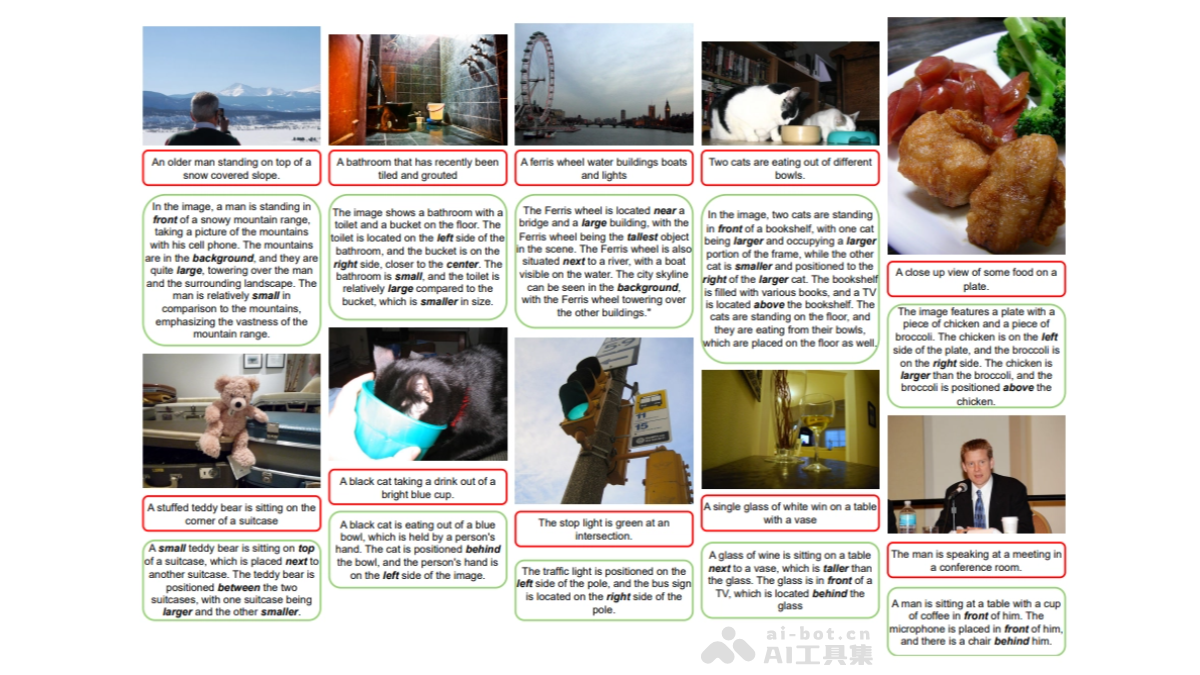
Main Features of SPRIGHT
- Enhance the representation of spatial relationships: By re-captioning images, it emphasizes spatial relationships in images, such as "left/right", "above/below", "front/behind", etc. The dataset can better capture and represent spatial information in images.
- Improve the spatial consistency of T2I models: T2I models fine-tuned with the SPRIGHT dataset can more accurately generate images that conform to the spatial relationships in text prompts, improving the spatial consistency of generated images.
- Support complex image generation tasks: The SPRIGHT dataset contains rich spatial relationship information, which can help models better understand and generate images containing multiple objects and complex spatial layouts.
- Promote the development of vision-language models: SPRIGHT provides rich resources and a foundation for researching and developing more advanced vision-language models, driving technological progress in related fields.
Technical Principles of SPRIGHT
- Dataset Construction:
- Image Sources: The images in the SPRIGHT dataset come from four widely used vision-language datasets, including CC-12M, Segment Anything, COCO, and LAION-Aesthetics.
- Re-captioning: Large language models (such as LLaVA-1.5-13B) are used to re-caption images, generating synthetic text descriptions with spatial relationships. The descriptions contain spatial relationships and emphasize detailed information such as the relative size and position of objects.
- Capture of Spatial Relationships: When generating descriptions, the model is guided to use specific spatial vocabulary (such as "left/right", "above/below", etc.) to describe the objects in the image and their relative positions. This allows the generated descriptions to more accurately reflect the spatial structure in the image.
- Dataset Validation: Based on multi-level evaluation (such as FAITHScore, GPT-4 evaluation, and human annotation), the quality and accuracy of the descriptions generated by the SPRIGHT dataset are verified. The evaluation ensures the dataset's effectiveness in capturing spatial relationships.
- Model Fine-tuning: The SPRIGHT dataset is used to fine-tune T2I models, especially training on images containing a large number of objects, significantly improving the model's spatial consistency. The fine-tuning method allows the model to better understand and generate images that conform to spatial relationships.
SPRIGHT Project Address
- Project Website:spright-t2i.github.io
- GitHub Repository:https://github.com/SPRIGHT-T2I/SPRIGHT
- HuggingFace Model Library:https://huggingface.co/SPRIGHT
- arXiv Technical Paper:https://arxiv.org/pdf/2404.01197
Application Scenarios of SPRIGHT
- Image Generation and Editing: Designers generate images that meet specific creative needs, for example, creating product display images with specific spatial layouts in advertising design, or generating complex scene background images in game development.
- Virtual Reality and Augmented Reality: Build more realistic virtual scenes in virtual reality applications, such as generating buildings and landscapes with accurate spatial relationships in virtual tourism, to enhance users' sense of immersion.
- Education and Training: Develop visual learning tools in the field of education to help students understand spatial concepts through images, for example, generating figures with clear spatial relationships in geometry learning, helping students master the properties and relationships of geometric shapes.
- Scientific Research and Analysis: Generate images of cells or tissues with specific spatial relationships in biological research, helping researchers analyze the morphology and function of biological structures.