
What Is SpikingBrain-1.0
SpikingBrain-1.0 (Shunxi 1.0) is a brain-inspired spiking large model launched by the Institute of Automation, Chinese Academy of Sciences. Based on intrinsic complexity, the model uses a novel non-Transformer architecture to break through the bottleneck of the Transformer architecture in processing ultra-long sequences. The model completes the full-process training and inference on a domestic GPU computing power platform, achieving improvements in the efficiency and speed of large models in ultra-long sequence inference. It has core advantages such as efficient training on extremely low data volumes and order-of-magnitude improvements in inference efficiency, laying the foundation for building a domestically autonomous and controllable brain-inspired large model ecosystem.
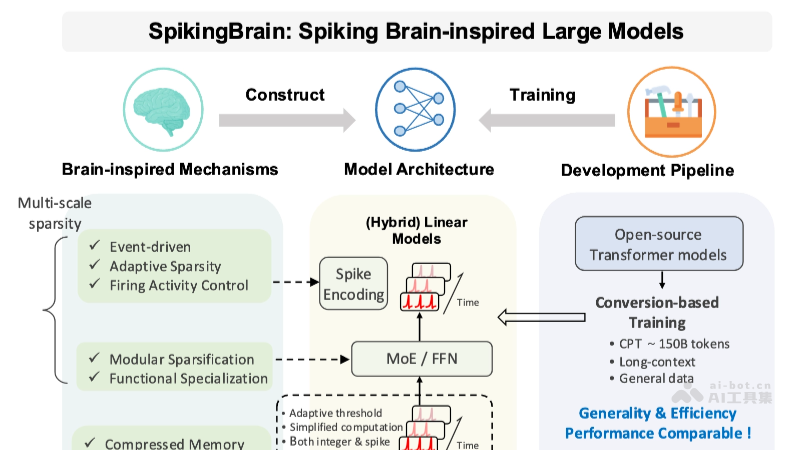
Main Features of SpikingBrain-1.0
-
Ultra-long sequence processing: It can efficiently process ultra-long sequence data, breaking through the performance bottleneck of traditional Transformer architectures when processing long sequences.
-
Low-data-volume training: It can also perform efficient training with extremely low data volumes, greatly reducing training costs and data requirements.
-
Improved inference efficiency: In the inference stage, it can achieve order-of-magnitude efficiency improvements, making it suitable for large-scale applications and real-time processing scenarios.
-
Autonomous and controllable ecosystem: It builds a domestically autonomous and controllable brain-inspired large model ecosystem, providing core support for domestic artificial intelligence development.
Technical Principles of SpikingBrain-1.0
-
Brain-inspired spiking neural network: It is designed based on a brain-inspired spiking neural network (SNN), simulating the spike signal transmission mechanism of biological neurons and getting closer to how the biological brain works.
-
Non-Transformer architecture: Based on a novel non-Transformer architecture, it solves the computational complexity and memory usage problems of the Transformer architecture when processing ultra-long sequences.
-
Intrinsic complexity: Based on the principle of intrinsic complexity, it achieves efficient learning and inference of the model through dynamic interaction and adaptive adjustment among neurons.
-
Domestic GPU computing power: It completes the full-process training and inference on a domestic GPU computing power platform, ensuring the model's autonomy, controllability, and efficient operation.
Project Address of SpikingBrain-1.0
- GitHub repository:https://github.com/BICLab/SpikingBrain-7B
- arXiv technical paper:https://arxiv.org/pdf/2509.05276
Application Scenarios of SpikingBrain-1.0
-
Natural language processing: In the field of intelligent customer service, it quickly understands and handles users' long-text questions, significantly improving user experience.
-
Speech processing: In speech recognition, it accurately recognizes long voice commands or conversation content, and is widely used in intelligent voice assistants and voice conference systems.
-
Financial technology: In risk assessment, it provides strong support for investment decisions by analyzing long-cycle financial data.
-
Intelligent transportation: In traffic flow prediction, it accurately predicts traffic flow by analyzing long-cycle traffic data.
-
Healthcare: In the disease diagnosis process, it assists doctors in diagnosing diseases and formulating treatment plans by analyzing long-cycle medical data.