
What is SpatialVLA
SpatialVLA is a new spatial embodied general manipulation model jointly launched by Shanghai AI Lab, China Telecom Artificial Intelligence Research Institute, ShanghaiTech University, and other institutions. It is pretrained on millions of real-world data to endow robots with general 3D spatial understanding capabilities. SpatialVLA integrates 3D spatial information with semantic features based on Ego3D positional encoding, and discretizes continuous actions using an adaptive action grid to achieve generalizable control across robot platforms. Pretrained on large-scale real robot data, SpatialVLA demonstrates strong zero-shot generalization ability and spatial understanding ability, performing outstandingly in complex environments and multi-task scenarios. SpatialVLA's open-source code and flexible fine-tuning mechanism provide a new technical path for research and applications in the robotics field.
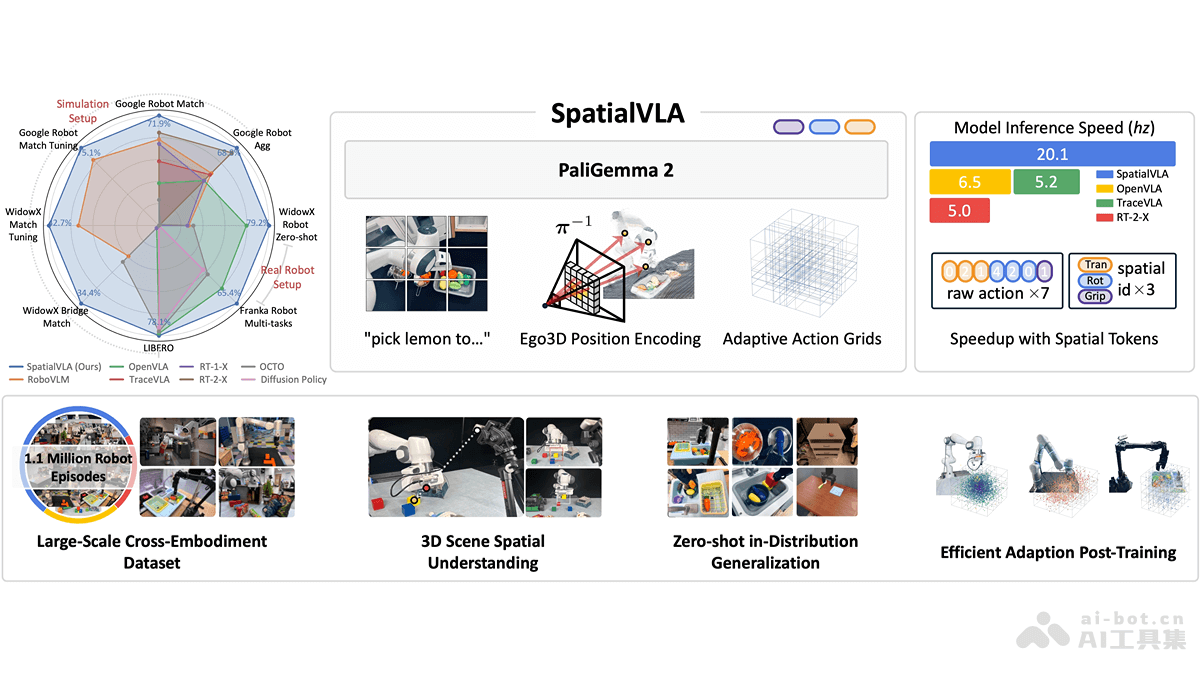
Main Features of SpatialVLA
- Zero-shot generalization control: Directly execute operations in unseen robot tasks and environments without additional training.
- Efficient adaptation to new scenarios: Fine-tune with a small amount of data to quickly adapt to new robot platforms or tasks.
- Powerful spatial understanding ability: Understand complex 3D spatial layouts and execute precise operation tasks, such as object localization, grasping, and placement.
- Universality across robot platforms: Support multiple robot forms and configurations to achieve universal manipulation strategies.
- Fast inference and efficient action generation: Based on a discretized action space, improve model inference speed, suitable for real-time robot control.
Technical Principles of SpatialVLA
- Ego3D positional encoding: Combine depth information with 2D semantic features to construct a robot-centric 3D coordinate system. Eliminate the need for specific robot-camera calibration, allowing the model to perceive 3D scene structure and adapt to different robot platforms.
- Adaptive action grid: Discretize continuous robot actions into an adaptive grid, dividing the action space based on data distribution. Align the actions of different robots with the grid to achieve cross-platform action generalization and transfer.
- Spatial embedding adaptation: During the fine-tuning stage, redivide the grid according to the action distribution of the new robot and adjust the spatial embedding. Provide a flexible and efficient robot-specific post-training method to accelerate model adaptation to new environments.
- Pretraining and fine-tuning: Pretrain on large-scale real robot data to learn general manipulation strategies. Fine-tune on new tasks or robot platforms to further optimize model performance.
Project Address of SpatialVLA
- Project official website:https://spatialvla.github.io/
- GitHub repository:https://github.com/SpatialVLA/SpatialVLA
- HuggingFace model library:https://huggingface.co/IPEC-COMMUNITY/foundation-vision-language-action-model
- arXiv technical paper:https://arxiv.org/pdf/2501.15830
Application Scenarios of SpatialVLA
- Industrial manufacturing: Used for automated assembly and parts handling, quickly adapting to different production lines and improving production efficiency.
- Logistics and warehousing: Precisely grasp and transport goods, adapt to dynamic environments, and optimize logistics efficiency.
- Service industry: Complete delivery, cleaning, and organizing tasks, understand natural language instructions, and adapt to complex environments.
- Medical assistance: Deliver surgical instruments and transport medicines to ensure precise and safe operations.
- Education and research: Support rapid development and testing of new robot applications, and assist academic research.