
What is SPAR3D
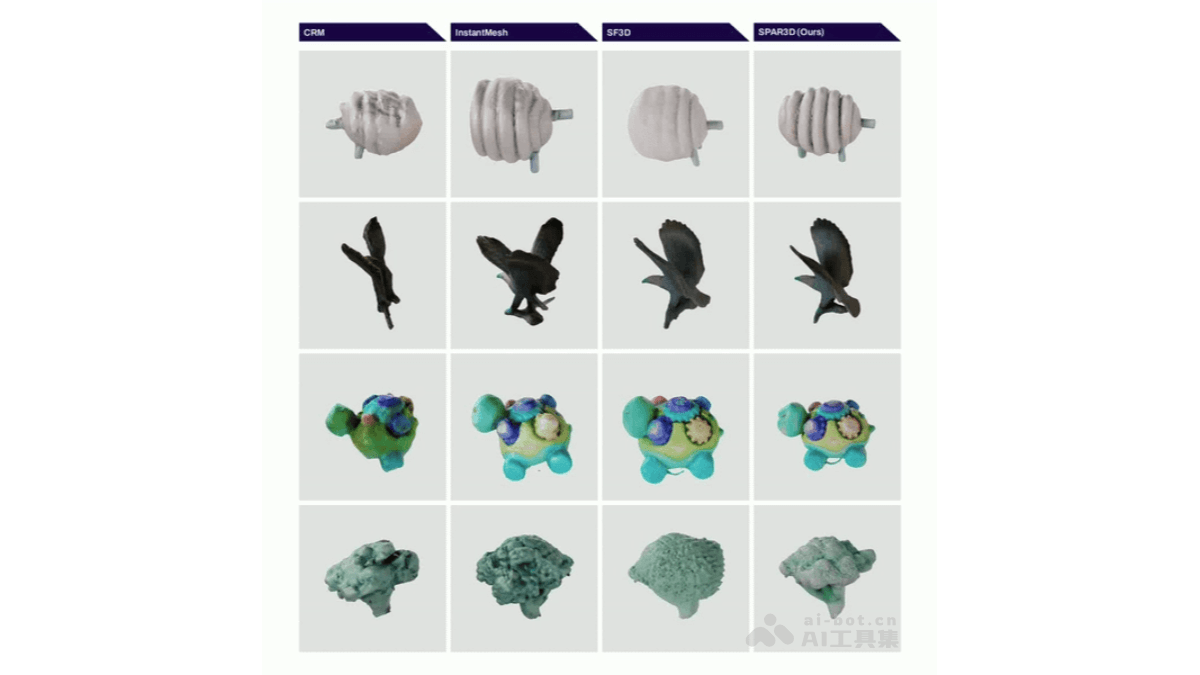
SPAR3D is an advanced single-image-to-3D model method launched by Stability AI and the University of Illinois Urbana-Champaign. It can efficiently reconstruct high-quality 3D objects from a single image. SPAR3D is based on a two-stage design. In the first stage, a point diffusion model is used to generate a sparse 3D point cloud. In the second stage, the sampled point cloud and the input image are combined to generate a highly detailed mesh. SPAR3D combines the advantages of regression models and generative models. It can accurately reconstruct the visible surfaces in the image and also reasonably generate geometric and texture details for occluded parts. SPAR3D performs excellently on multiple datasets, has fast inference speed, and supports users in interactive editing of the generated mesh, providing a practical and efficient solution for single-view 3D reconstruction tasks.
Main features of SPAR3D
- Single-view 3D reconstruction: Reconstruct high-quality 3D mesh models from a single 2D image, suitable for scenarios requiring 3D modeling such as augmented reality, film production, and manufacturing.
- Fast inference: It has efficient inference speed, with reconstruction time for each object only 0.7 seconds, suitable for real-time application needs.
- Supports user editing: The generated 3D mesh supports interactive editing. Users can adjust the details of unseen surfaces based on modifying the point cloud, such as adding object parts or improving local details, to meet personalized needs.
- Strong generalization ability: It not only performs excellently on standard datasets, but also achieves accurate geometric structure reconstruction and good texture effects on multi-image and AI-generated images, with strong generalization performance.
Technical principles of SPAR3D
- Two-stage design:
- Point sampling stage: A lightweight point diffusion model is used to generate a sparse 3D point cloud. The model is based on the DDPM framework, using a forward process to add noise to the original point cloud, and then using a denoiser in the backward process to learn to remove noise, generating a point cloud containing XYZ and RGB information. The low-resolution nature of the point diffusion model makes sampling fast and allows it to initially capture the basic shape and color information of the object.
- Meshing stage: Using the sampled point cloud and the input image as conditions, a large triplane Transformer is used to generate high-resolution triplane features. The triplane features are used to estimate the object's geometry, texture, lighting, and material properties (such as metallicness and roughness). Training is based on a differentiable renderer, rendering the predicted geometry and materials into images, comparing them with real images, optimizing model parameters, and generating a 3D mesh that is highly consistent with the input image and rich in detail.
- Point cloud as intermediate representation: The point cloud serves as a bridge connecting the two stages, providing the necessary geometric and color information for the meshing stage, supporting users in editing at the point cloud level, and enhancing the model's flexibility and interactivity.
- Probabilistic modeling and inverse rendering: In the point sampling stage, probabilistic modeling is used to handle the uncertainty problem in single-view 3D reconstruction and generate a reasonable point cloud distribution. In the meshing stage, inverse rendering is performed to fuse the point cloud and image information, estimating the object's detailed geometric structure and material properties, solving the difficult problem of separating geometry, lighting, and materials from a single image.
SPAR3D project address
- Project official website:https://spar3d
- GitHub repository:https://github.com/Stability-AI/stable-point-aware-3d
- HuggingFace model library:https://huggingface.co/stabilityai/stable-point-aware-3d
- arXiv technical paper:https://arxiv.org/pdf/2501.04689
Application scenarios of SPAR3D
- Home design: Users take photos of a sofa at home, generate a 3D model, and preview the matching effects of sofas in different styles in AR to assist purchasing decisions.
- Film Production: Take photos of castle ruins, generate a 3D model of the castle, and the special effects team uses it as a basis to create a magnificent castle scene that fits the plot.
- Industrial Design: Take photos of a drone prototype, generate a 3D model, and designers adjust the structure on the model to optimize the drone's performance.
- Game Development: Take photos of a forest, generate a 3D forest model, and developers add game elements to build a forest adventure scene.
- Cultural Relic Restoration: Take photos of a damaged Buddha statue, generate a 3D model, and experts analyze its structure based on it, formulate a restoration plan, and restore the Buddha statue to its original appearance.