
What is SPAR
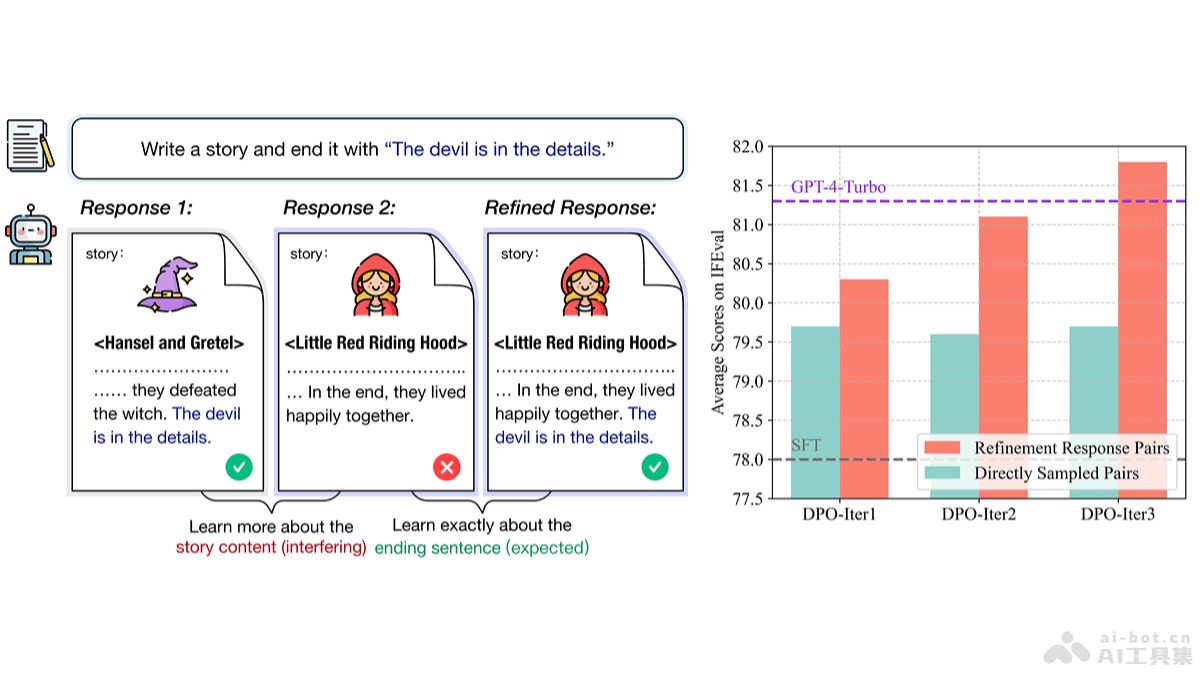
SPAR is a self-play framework introduced by the Zhipu team that enhances the instruction-following capabilities of large language models. The framework is based on interaction between two internal roles: the generator and the refiner. The generator executes instructions to generate responses, while the refiner analyzes and improves the responses. SPAR uses tree search techniques to refine and optimize responses, eliminating irrelevant distracting factors, thereby highlighting the key differences crucial to instruction following. This process improves the accuracy of the model in executing instructions and enhances the model's self-improvement capability. Experimental results show that the SPAR framework significantly improves model performance on evaluation benchmarks such as IFEval, demonstrating its effectiveness in enhancing the instruction-following capabilities of large language models.
Main Features of SPAR
- Enhanced Instruction-Following Capability: Improves the ability of large language models (LLMs) to accurately understand and execute instructions.
- Constructing Effective Preference Pairs: Based on self-play and tree search strategies, it can construct effective and comparable preference pairs that contain no distracting factors, helping the model learn key differences.
- Iterative Self-Play Improvement: The model self-plays by taking on the two roles of generator and refiner, continuously improving instruction-following capability in an iterative manner.
- Tree Search Strategy: Uses tree search algorithms to refine the model's responses, ensuring that the generated replies follow instructions more accurately.
- Model Performance Optimization: Based on optimizing the two models, the generator and the refiner, it improves overall instruction-following performance.
- Scalability and Transferability: Demonstrates scalability and transferability across models of different sizes, and can improve the instruction-following capability of models of various scales.
Technical Principles of SPAR
- Self-Play Framework: In the SPAR framework, LLMs play the two roles of generator and refiner. The generator generates responses, and the refiner evaluates and improves the responses.
- Tree Search Algorithm: Based on tree search algorithms (including breadth-first search BFS and depth-first search DFS), it explores possible response paths and finds the best response.
- Removal of Distracting Factors: Based on refined response pairs, it excludes distracting factors unrelated to instruction following, allowing the model to focus on learning the key requirements of instructions.
- Iterative Training: Based on iterative training, it continuously optimizes the generator and refiner models, with each round of iteration improving on the results of the previous round.
- Data Construction: Constructs high-quality datasets containing complex instruction-following prompts and corresponding supervised fine-tuning (SFT) data, used to initialize and train the actor and refiner models.
- Model Optimization: Using refined response pairs generated by the tree search strategy, SPAR trains the actor and refiner models based on direct preference optimization (DPO) and rejection resampling fine-tuning (RFT), achieving continuous self-improvement.
SPAR Project Address
- GitHub Repository:https://github.com/thu-coai/SPaR
- HuggingFace Model Library:https://huggingface.co/datasets/CCCCCC/SPaR
- arXiv Technical Paper:https://www.arxiv.org/pdf/2412.11605
Application Scenarios of SPAR
- Intelligent Assistant: In personal or enterprise intelligent assistants, it helps the model better understand user instructions and provide more accurate services and responses.
- Customer Service: In the customer service field, train chatbots to more accurately follow customer requests, improving problem-solving efficiency and customer satisfaction.
- Educational technology: In educational applications, assist in developing intelligent teaching assistants that understand and execute complex instructions from teachers or students, providing customized learning experiences.
- Medical consultation: In medical consultation systems, enhance the model's ability to understand patient questions, ensuring the provision of safe and accurate medical advice and information.
- Smart home control: In the smart home field, help voice control assistants more accurately understand and execute users' home control commands.