
What is SpaceMind
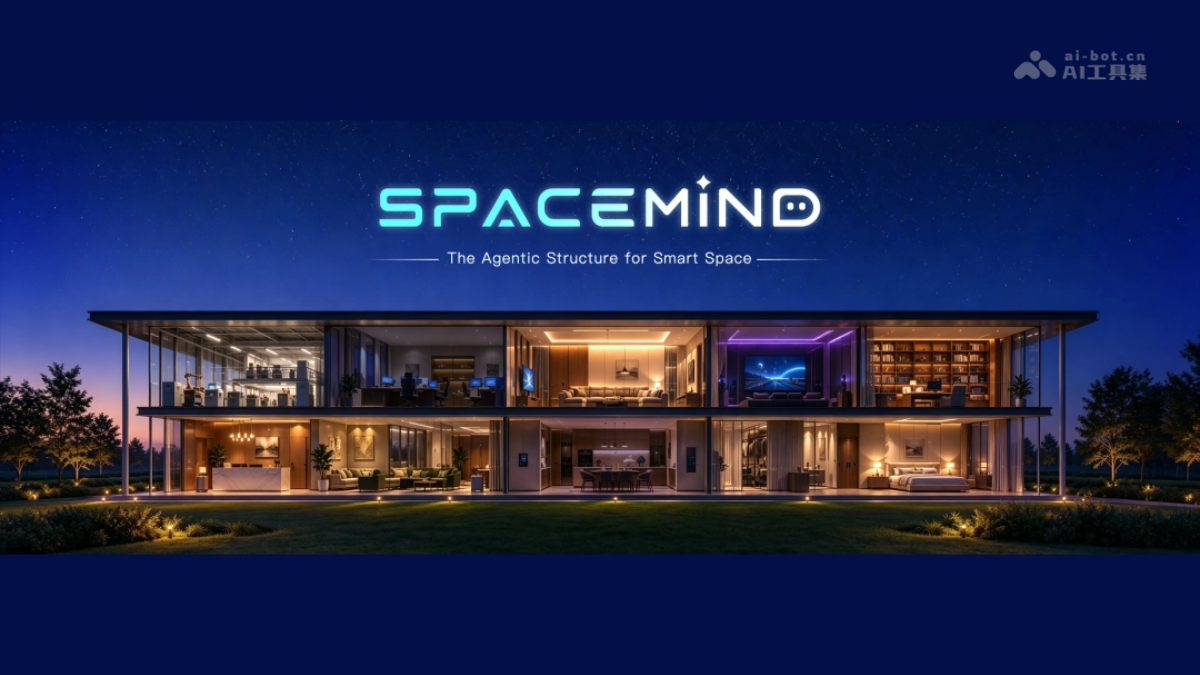
SpaceMind is a smart space Agentic architecture launched by iFlytek, upgrading spaces into L2.5-stage proactive intelligent agents with perception, understanding, memory, decision-making, and execution capabilities. The system adopts millimeter-wave radar privacy perception and a dual-routing architecture, achieving device response within 700ms separated from complex reasoning, and through collaboration between a local semantic model and a cloud-based large model, it enables spaces to proactively serve based on people's location, status, and habits. SpaceMind has been deployed in high-end residential and hotel scenarios in the Middle East, Latin America, Southeast Asia, and other regions.
Main Features of SpaceMind
-
Instant Voice Control: Adjust light color and brightness, curtain opening and closing, and music playback precisely with a single sentence.
-
Visual Object Finding: Locate a lost remote control via camera and mark its specific position on the screen.
-
Semantic Scene Linkage: Understand complex semantics such as "a bit warmer and cozy, suitable for chatting" and simultaneously link lighting, curtains, screen, and audio.
-
Long-Term Preference Memory: Automatically accumulate user preferences for scenarios such as rest, movie watching, and music, and proactively restore immersive environments.
-
Seamless Proactive Protection: At night, sense when a person gets up, automatically turn on soft path lights, and avoid disturbing family members with strong light.
-
Multi-Protocol Compatibility: Natively supports Matter, Thread, and mainstream ecosystems such as Apple Home, Google Home, and Amazon Alexa.
Technical Principles of SpaceMind
- Millimeter-Wave Radar Privacy Perception: SpaceMind uses millimeter-wave radar as its core perception source, collecting no images and recording no faces. It can achieve 3D spatial positioning accurate to 5 centimeters and breathing-level micro-motion detection, and can continuously identify the number of people in complex environments such as darkness and smoke, distinguish people from pets, and determine states such as stationary, moving, and falling, resolving the contradiction between privacy protection and reliable perception.
- Dual-Routing Decoupled Architecture: The system adopts a design that separates the primary control channel from the secondary reasoning channel. The primary channel directly executes device control instructions locally, with model inference of about 200 milliseconds and overall end-to-end response controlled within 700 milliseconds, achieving 100% faster speed and 30% higher stability; the secondary channel delegates complex semantic understanding, task planning, and Agent tasks to the cloud-based large model, balancing real-time performance and deep reasoning.
- Dual-Model Collaboration System: The local home semantic model is trained on real household data, adopts a native multilingual design, and undergoes SFT supervised fine-tuning. It is responsible for understanding high-frequency simple instructions and device function calls; the cloud-based reasoning large model handles complex tasks requiring context and planning judgment, such as long-term memory, schedule management, conflict detection, and proactive reminders.
- Multi-Agent Collaboration and Persistent Memory: Multiple Agents respectively understand room status, manage lighting, control air conditioning, or handle schedules, and collaborate around user goals; the system continuously accumulates family members, spatial structure, scene preferences, and long-term interaction history, gradually forming long-term cognition belonging to the home space and realizing the transformation from passive response to proactive prediction.
How to Use SpaceMind
-
Hardware Integration: Connect existing KNX, Zigbee, Matter, and other devices in the home to the SpaceMind network via Gateway Lite or Gateway Pro, with no need to replace existing hardware.
-
Perception Deployment: Install millimeter-wave radar sensors and NOVA series native hardware to build a spatial perception layer covering the entire home.
-
Voice Wake-Up: After waking the system, issue natural language commands to quickly complete device control such as light adjustment, curtain opening and closing, or music playback.
-
Scene Experience: Put forward complex semantic requests such as "make the space a bit warmer," and the system automatically coordinates lights, curtains, screens, and audio for collaborative adjustment.
-
Seamless Service: Without manual commands, the system proactively executes services based on perception, memory, and multi-Agent collaboration, such as automatically turning on soft pathway lights when getting up at night.
SpaceMind's Core Advantages
-
Privacy and Security: The millimeter-wave radar solution achieves precise perception without a camera, completely avoiding visual privacy leaks.
-
Ultra-Fast Response: The dual-router architecture keeps end-to-end latency for device control within 700ms, improving stability by 30%.
-
Proactive Intelligence: Based on persistent memory and state perception, the space can proactively complete predictive services before the user speaks.
-
Multi-Agent Collaboration: Breaks down device silos, allowing whole-home devices to be scheduled uniformly around human intent rather than each acting on its own.
-
Global Ecosystem Compatibility: Supports multi-protocol and multi-platform integration, lowering the barrier to global deployment.
Comparison of SpaceMind with Similar Competitors
| Dimension | SpaceMind | Apple HomeKit |
|---|---|---|
| Perception Method | Millimeter-wave radar, no visual privacy concerns, 5cm positioning | Mainly relies on cameras and sensors, vision-centric |
| Intelligence Level | L2.5 Agentic architecture, proactive intelligence + persistent memory | Mainly rule-based automation and voice command responses |
| Response Architecture | Dual-router decoupling, control <700ms, inference in the cloud | Primarily cloud-based processing, higher latency for complex commands |
| Collaboration Capability | Multi-Agent collaboration, devices scheduled uniformly around intent | Devices linked by preset scenes, lacking proactive prediction |
| Memory Capability | Long-term household memory, continuously accumulating preferences and habits | Based on user manual settings and home hub rules |
| Ecosystem Compatibility | Compatible with Matter/Thread and the Apple/Google/Amazon ecosystems | Closed Apple ecosystem, limited third-party compatibility |
SpaceMind's Application Scenarios
-
High-End Residences: The whole home proactively perceives the environment and automatically adjusts lights, curtains, and audio to provide personalized scene services.
-
Smart Hotels: Cross-region automated guest room management, creating an immersive check-in and seamless interaction experience for guests.
-
Commercial Spaces: Through KNX art panels linked with smart lighting, it enables intelligent aesthetic control of exhibition halls and office environments.
-
Elderly Care: Uses millimeter-wave radar to detect falls and abnormal conditions without visual privacy concerns, providing timely warnings to safeguard safety.
-
Child Companionship: At night, it senses when a child gets up, automatically turns on soft pathway lighting, and avoids disturbing family members with strong light or noise.