
What is SocioVerse
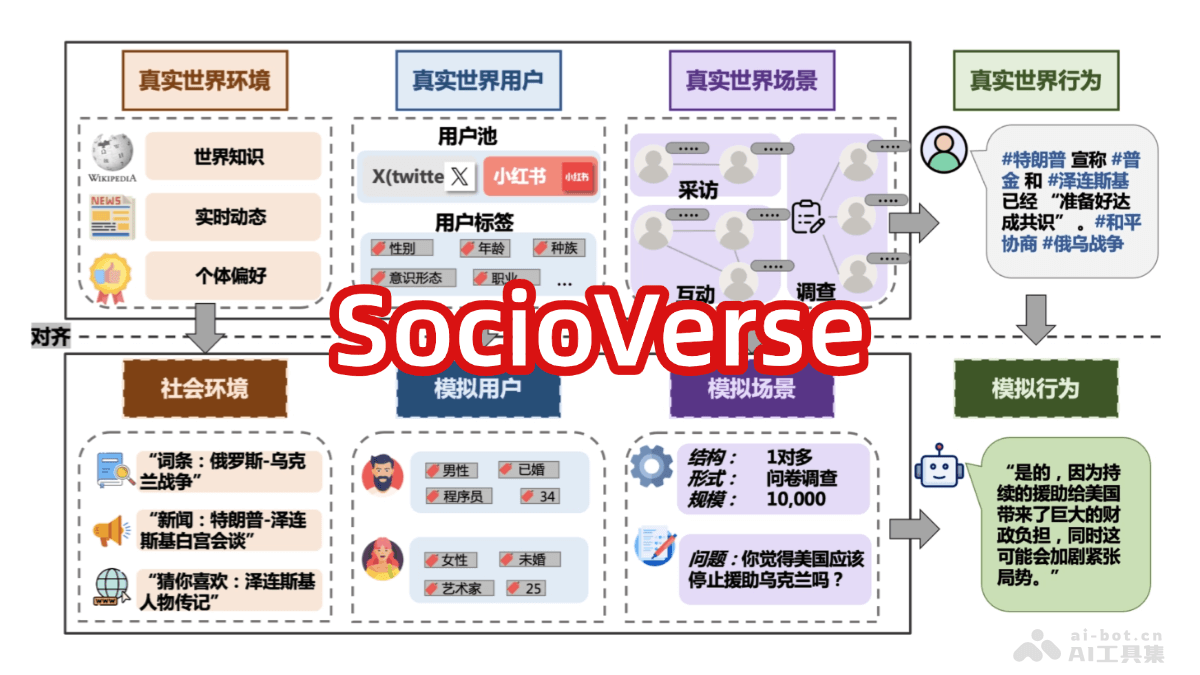
SocioVerse is a social simulation world model jointly launched by Fudan University, Shanghai Innovation Institute, the University of Rochester, and Xiaohongshu. Based on LLM-driven agents and a data pool containing 10 million real users, it builds a large-scale social simulation framework "aligned" with the real world. The model is based on four modules: the social environment, user engine, scenario engine, and behavior engine, enabling modeling of the behavioral patterns of target groups, prediction of the evolutionary trends of group events, and support for major decisions. SocioVerse has demonstrated high-precision alignment effects in multiple scenarios such as news hotspot dissemination and socioeconomic surveys, providing a powerful tool for interdisciplinary research in computational social science.
SocioVerse's Main Features
- High-Precision Social Simulation: Builds a simulation environment aligned with the real world, simulates large-scale group behavior, and predicts the evolutionary trends of social events.
- Multi-Scenario Applications: Supports various social research scenarios, such as news dissemination, socioeconomic surveys, and political election forecasting, helping researchers and decision-makers gain insights into group behavior.
- User Persona and Behavior Generation: Builds complex target user personas and generates behavior patterns consistent with user characteristics based on agents.
- Dynamic Environment Updates: Based on real-time updates of social events, social statistics, and personalized content, keeps the simulation environment synchronized with the real world.
SocioVerse's Technical Principles
- Social Environment Module: Provides the latest social background information for simulation, including real-time events, social statistics, and personalized content. Event updates build a timestamped news event library for agents to retrieve and cite. Social statistics provide structured data such as population distribution and urban structure, making agent behavior more consistent with group characteristics. Preference content pushes personalized content to agents based on recommendation systems, improving the diversity and personalization of behavior generation.
- User Engine: Builds target user personas based on real user data, ensuring that the population characteristics of simulated agents are consistent with real-world distributions. The user pool contains data from 10 million users across multiple social media platforms. User tags combine hard tags (such as gender and age) and soft representation vectors, generating high-precision user personas based on LLM annotation and manual verification.
- Scenario Engine: Aligns simulation scenarios with real scenarios, designs corresponding interaction structures, and scales them to large-scale groups according to population distribution. Questionnaire surveys are based on a one-to-many single-round structure to collect opinions from large-scale samples. In-depth interviews use one-to-one multi-round interaction to uncover respondents' attitudes and motivations. Behavioral experiments are based on one-to-many or many-to-many structures to observe individual and group decision-making behavior. Social media interaction is based on many-to-many dynamic posting and commenting, simulating information diffusion and network influence.
- Behavior Engine: Combines user personas, scenario structures, and social background to drive agents to generate reasonable simulation behavior. LLM agents include general-purpose LLMs (such as GPT and Qwen), expert LLMs (fine-tuned for specific domains), and domain LLMs (for complex tasks). Traditional modeling agents are based on rules or mathematical models, suitable for modeling low-influence marginal users, and have computational efficiency advantages.
SocioVerse's Project Address
- Project Official Website:http://www.fudan-disc.com/socioverse/
- GitHub Repository:https://github.com/FudanDISC/SocioVerse
- HuggingFace Model Library:https://huggingface.co/datasets/Lishi0905/SocioVerse
- arXiv Technical Paper:https://arxiv.org/pdf/2504.10157
Application Scenarios of SocioVerse
- Political Election Prediction: Simulate the election process, predict candidate support rates and election outcomes, and provide data support for political campaign strategies.
- Breaking News Feedback Analysis: Simulate public reactions to major news events, help assess public attitudes in advance, and formulate response strategies.
- National Economic Survey: Simulate residents' consumption behavior and economic decisions, and provide reference basis for economic policy making and market research.
- Social Policy Evaluation: Predict the implementation effects of social policies and public reactions, and help optimize policy design.
- Information Dissemination and Public Opinion Analysis: Simulate the dissemination of information in social networks and the evolution of public opinion, and provide analytical tools for public opinion management and information governance.