
What is SmolVLM
SmolVLM is a lightweight vision-language model released by Hugging Face, designed specifically for on-device inference. With 2 billion parameters, it achieves efficient memory usage and fast processing speed. SmolVLM offers three versions to meet different needs: SmolVLM-Base: suitable for fine-tuning on downstream tasks. SmolVLM-Synthetic: fine-tuned based on synthetic data. SmolVLM-Instruct: an instruction fine-tuned version that can be directly applied to interactive applications. The model draws on the ideas of Idefics3, uses SmolLM2 1.7B as the language backbone, and improves the efficiency of visual information compression through pixel shuffle technology. Trained on the Cauldron and Docmatix datasets, it optimizes image encoding and text processing capabilities.
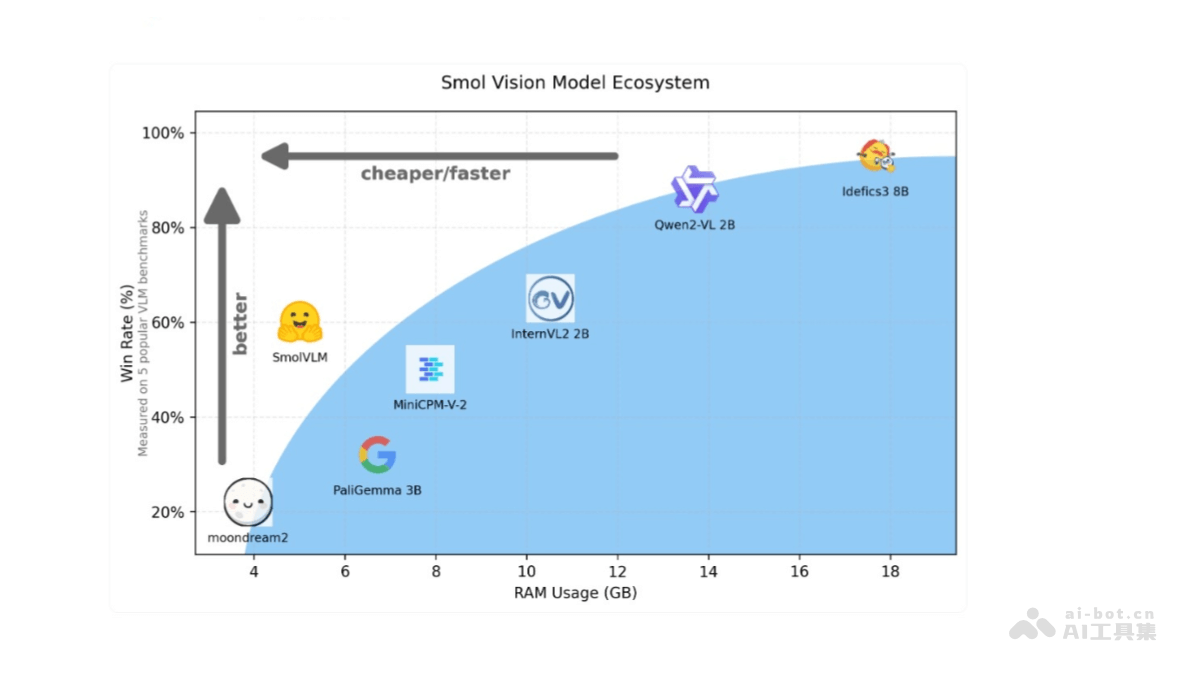
Main features of SmolVLM
- On-device inference: SmolVLM is designed specifically for on-device inference and can run effectively in resource-limited environments such as laptops, consumer-grade GPUs, or mobile devices.
- Fine-tuning capability: The model offers three versions to meet different needs:
- SmolVLM-Base is used for fine-tuning on downstream tasks;
- SmolVLM-Synthetic is fine-tuned based on synthetic data;
- SmolVLM-Instruct is an instruction fine-tuned version that can be directly applied to interactive applications.
- Optimized architecture design: Drawing on the ideas of Idefics3, it uses SmolLM2 1.7B as the language backbone and improves the compression rate of visual information through a pixel shuffle strategy, achieving more efficient visual information processing.
- Handling long texts and multiple images: The training datasets include Cauldron and Docmatix, and SmolLM2 is context-extended, enabling it to handle longer text sequences and multiple images.
- Low memory usage: SmolVLM encodes a 384×384 pixel image patch into 81 tokens, compared with Qwen2-VL, which requires 16,000 tokens, significantly reducing memory usage.
- High throughput: In multiple benchmark tests, SmolVLM's prefill throughput is 3.3 to 4.5 times faster than Qwen2-VL, and its generation throughput is 7.5 to 16 times faster.
- Open-source model: SmolVLM is fully open source, with all model checkpoints, VLM datasets, training recipes, and tools released under the Apache 2.0 license.
- Training datasets: SmolVLM covers Cauldron and Docmatix, and SmolLM2 has been context-extended, enabling it to handle longer text sequences and multiple images.
SmolVLM project address
- Github repository:https://github.com/huggingface/blog/blob/main/smolvlm.md
- HuggingFace model library:https://huggingface.co/blog/smolvlm
- Online experience Demo:https://huggingface.co/spaces/HuggingFaceTB/SmolVLM
- Complete dataset list:https://huggingface.co/HuggingFaceTB/SmolVLM-Instruct/blob/main/smolvlm-data.pdf
Application scenarios of SmolVLM
- Video analysis: SmolVLM has shown potential as a basic video analysis task under limited computing resources. In the CinePile benchmark test, SmolVLM achieved a score of 27.14%, demonstrating competitiveness in video understanding capability.
- Vision-language processing: SmolVLM provides developers and researchers with a powerful tool for vision-language processing without the need for high hardware costs.
- Local deployment: The small model supports local deployment in browsers or on edge devices, reducing inference costs and supporting user customization.
- AI popularization: The development of SmolVLM is expected to expand the scope of use of vision-language models, making complex AI systems more widespread and accessible, and providing powerful machine learning capabilities to a broader audience.