
What is SmartEraser
SmartEraser is an image editing technology introduced by the University of Science and Technology of China and Microsoft Research Asia, specifically designed to remove user-specified objects from images. SmartEraser is based on the innovative "Masked-Region Guidance" paradigm. Unlike traditional "mask-and-inpaint" methods, SmartEraser retains the masked region as guidance for the removal process, enabling more accurate identification and removal of target objects while effectively preserving the surrounding context. SmartEraser is trained on the large-scale, high-quality Syn4Removal dataset, introduces mask augmentation techniques and CLIP-based visual guidance, and demonstrates outstanding performance in object removal tasks.
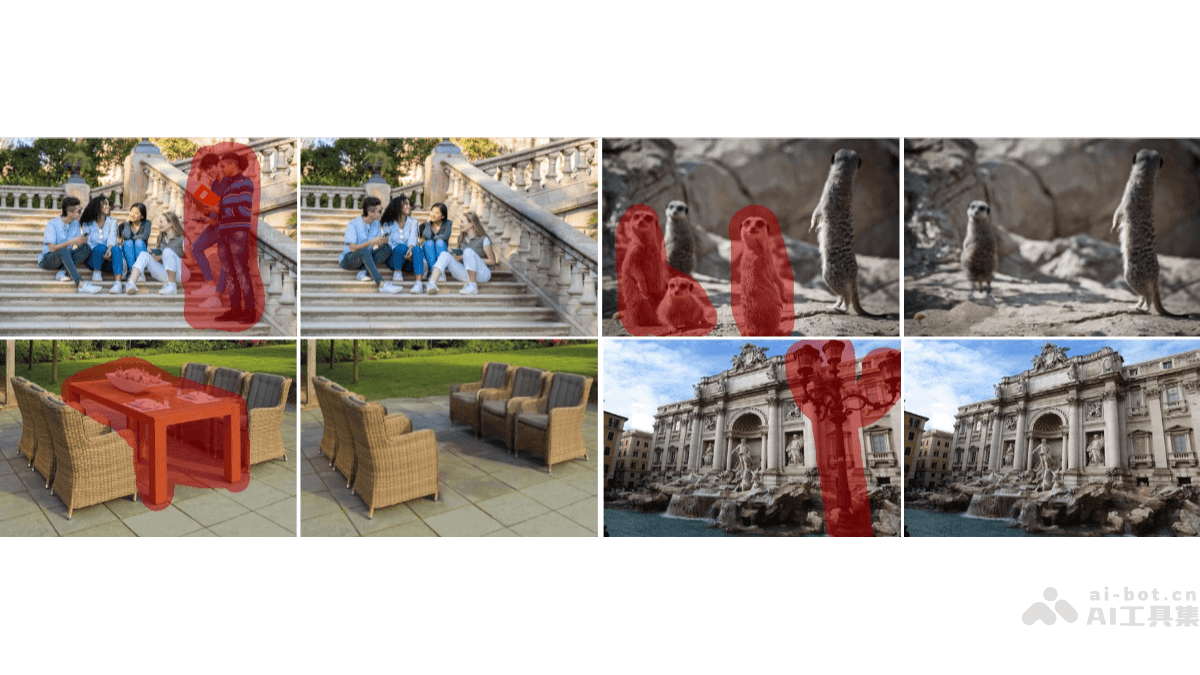
Main Features of SmartEraser
- Target Object Identification and Removal: Accurately identifies the target object specified by the user based on the mask and removes it from the image.
- Context Preservation: While removing the target object, preserves the details and structure of the surrounding environment, ensuring the visual coherence of the image.
- High-Quality Image Generation: The generated image remains visually consistent with the original image, without obvious distortion or artifacts.
- Robustness: Has high robustness to masks of different shapes and sizes provided by users, adapting to various input conditions.
- Suitable for Complex Scenes: Effectively removes target objects in complex scenes, such as images containing multiple objects and complex backgrounds.
Technical Principles of SmartEraser
- Masked-Region Guidance Paradigm:
- Retaining the Masked Region: Unlike traditional "mask-and-inpaint" methods, SmartEraser retains the position of the masked region in the input and uses it as guidance for the removal process. The model can accurately identify the object to be removed, reducing the risk of regenerating the object in the masked region.
- Contextual Information: User-defined masks usually extend beyond the target object itself, which helps the model preserve the surrounding context in the final result, making the generated image more natural and realistic.
- Syn4Removal Dataset:
- Synthetic Data Generation: To train models that conform to the new paradigm, training data is constructed using a synthetic method. This method involves pasting object instances from different images onto different background images to form input images. The mask of the pasted object is used as the input mask, and the original background image is used as the ground truth.
- Large-Scale Dataset: The Syn4Removal dataset contains 1 million image triplets, covering diverse scenes and object types, providing rich data support for model training.
- Framework Based on Text-to-Image Diffusion Models:
- Mask Augmentation: To enhance the model's robustness to different mask shapes input by users, various mask deformation methods are applied during training to simulate the shapes of user-input masks. These methods include original masks, eroded masks, dilated masks, convex hull masks, ellipse masks, and bounding box with Bezier curve masks.
- CLIP-Based Visual Guidance: Uses a pretrained CLIP model to extract visual features of the removal target and map them into the feature space of the text encoder.
- Loss Function: The model's training loss function is based on the standard diffusion process, optimizing the model parameters by minimizing the difference between the predicted noise and the actual noise.
SmartEraser's project address
- Project website:https://longtaojiang.github.io/smarteraser
- GitHub repository:https://github.com/longtaojiang/SmartEraser
- arXiv technical paper:https://arxiv.org/pdf/2501.08279
SmartEraser's application scenarios
- Personal photo editing: Used to remove passersby from travel photos, unwanted people or objects from family photos, and clean up the background of ID photos and social media avatars.
- Professional image processing: In advertising and marketing, remove distracting elements from product photography and optimize the background of advertising designs.
- Graphic design: Assist graphic designers in highlighting the focal point in posters and cover designs, and remove unnecessary background elements.
- Cultural relic restoration: In cultural relic restoration, such as the restoration of ancient paintings, remove stains and damage.
- Medical and scientific research: In medical imaging processing, such as X-ray and CT images, remove equipment artifacts and markers; in scientific research image processing, such as microscope and satellite images, clean up background noise and interference to improve the value of image analysis.