
What is SleepFM
SleepFM is an open-source multimodal sleep analysis model from Stanford University, based on 100,000 hours of sleep data from over 14,000 participants, providing comprehensive sleep health assessment by fusing brain activity, electrocardiogram, and respiratory signals. It aims to improve the efficiency and accuracy of sleep analysis. The model uses contrastive learning techniques to optimize the accuracy of sleep stage classification and sleep-disordered breathing detection. SleepFM can assist clinical diagnosis and research, and can be integrated into wearable devices for personal sleep health management. Its open-source nature provides a powerful research and application platform for the field of sleep medicine.
Main Features of SleepFM
- Sleep Stage Classification: Automatically analyzes and classifies an individual's sleep stages, including wakefulness, light sleep, deep sleep, and REM sleep.
- Sleep-Disordered Breathing Detection: Identifies respiratory abnormalities during sleep, such as apnea and hypopnea.
- Demographic Attribute Prediction: Predicts an individual's age and sex from physiological signals.
- Data Retrieval: Retrieves corresponding other-modality signals through one type of physiological signal.
- Clinical Assistance: Assists clinicians in analyzing sleep monitoring data and improves diagnostic efficiency.
- Health Management: Integrated into wearable devices for monitoring and managing personal sleep health.
- Research and Drug Development: Supports sleep-related clinical research and monitoring of drug effects.
Technical Principles of SleepFM
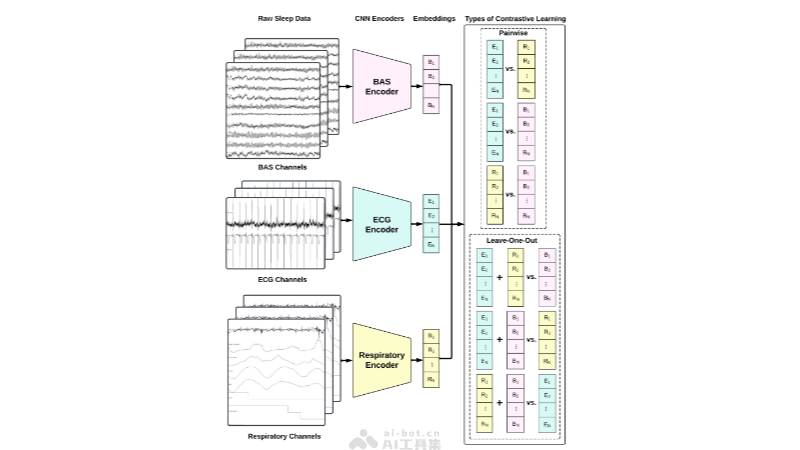
- Multimodal Data Fusion: Combines BAS, ECG, and respiratory signals; the signals come from the brain, heart, and lungs respectively, covering 19 data channels.
- Contrastive Learning Framework: SleepFM explores two contrastive learning frameworks, namely pairwise contrastive learning (pairwise CL) and leave-one-out contrastive learning (leave-one-out CL). Pairwise contrastive learning brings positively matched pairs from different modalities closer in the latent space while pushing negatively matched pairs apart. Leave-one-out contrastive learning, when constructing contrastive learning samples, pairs two inputs with the remaining input, thereby constructing three sample pairs from one segment.
- Self-Supervised Pre-training: Through self-supervised learning methods, SleepFM does not rely on labeled data during the pre-training stage, and learns data representations through designed data augmentation strategies and contrastive loss functions.
- Improved Downstream Task Performance: The representations obtained from pre-training are used for various downstream tasks, such as sleep stage classification and sleep-disordered breathing (SDB) detection. SleepFM's performance exceeds that of traditional end-to-end trained convolutional neural networks (CNNs).
Project Address of SleepFM
- GitHub Repository:https://github.com/rthapa84/sleepfm-codebase
- arXiv Technical Paper:https://export.arxiv.org/pdf/2405.17766
Application Scenarios of SleepFM
- Clinical Diagnosis: Assists doctors and sleep specialists in quickly and accurately analyzing sleep monitoring data, improving diagnostic efficiency and accuracy.
- Sleep Research: In sleep medicine research, analyzes clinical trial data and monitors drug effects, as well as studies sleep patterns and sleep disorders.
- Health Management: Integrated into wearable devices or smart home systems to help individuals monitor and improve sleep quality.
- Drug Development: In new drug development and clinical trials, used to evaluate the impact of drugs on sleep quality.
- Education and training: In medical education, as a teaching tool to help students and professionals learn sleep physiology and the identification of sleep disorders.
- Telemedicine: In telemedicine settings, to provide sleep monitoring and analysis services for patients far from medical centers.