
What is Sketch2Sound
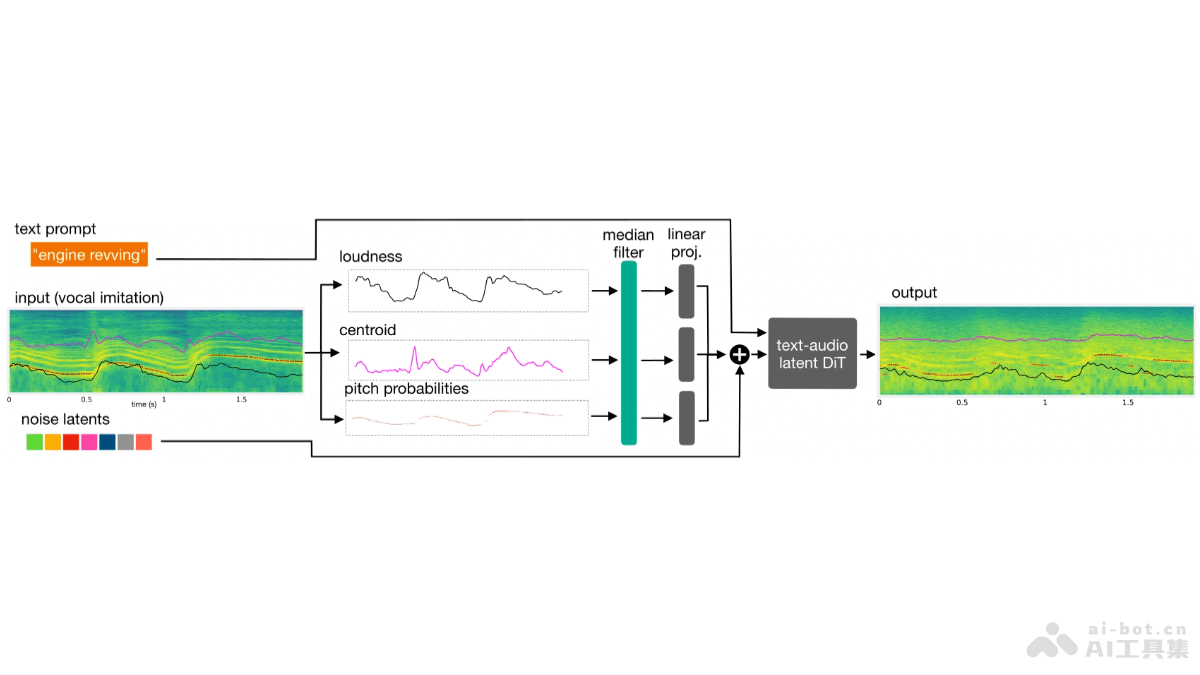
Sketch2Sound is an AI audio generation technology launched by Adobe Research and Northwestern University, capable of generating high-quality sound effects based on vocal imitation and text prompts. Sketch2Sound extracts three control signals from vocal imitation: loudness, brightness, and pitch, encodes the control signals, and uses them in a conditional text-to-sound generation system. Sketch2Sound is lightweight and can be implemented on various text-to-audio models with only a small number of fine-tuning steps and a single-layer linear adaptation. Sketch2Sound provides sound designers with a tool that combines the semantic flexibility of text prompts and the precision of vocal imitation, enhancing the expressiveness and controllability of sound creation.
Main Features of Sketch2Sound
- Combination of vocal imitation and text prompts: Sketch2Sound can understand vocal imitation (such as oral imitation) and text prompts, and generate high-quality sound effects consistent with both.
- Extract control signals: Extract three key control signals from any input vocal imitation: loudness, brightness (spectral centroid), and pitch probabilities.
- Generate any sound: Use the extracted control signals and text prompts to synthesize any sound, including imitating specific sounds or creating new sound effects.
- Lightweight implementation: Can be implemented on any text-to-audio latent diffusion transformer (DiT), requiring only 40,000 steps of fine-tuning and a separate linear layer for each control signal.
Technical Principles of Sketch2Sound
- Control signal extraction: Use audio signal processing techniques to extract loudness, brightness, and pitch probabilities from input vocal imitation.
- Latent diffusion model: Based on a pre-trained text-to-sound latent diffusion transformer (DiT), the model includes a variational autoencoder (VAE) and a transformer decoder, compresses audio into a continuous vector sequence, and then generates a new latent vector sequence to synthesize audio.
- Conditional generation: Add a linear projection layer in the latent diffusion model to directly add the control signals to the model's noisy latent variables, achieving conditioning of the model.
- Fine-tuning and adaptation: Fine-tune the pre-trained text-to-audio model so that it can handle time-varying control signals, achieving self-supervised fine-tuning.
- Inference-time control: At inference time, users choose median filters of different sizes to adjust the temporal details of the control signals, thereby trading off between the precision of vocal imitation and the quality of generated audio.
- Semantic flexibility and expressiveness: Combine the semantic flexibility of text prompts and the expressiveness of vocal imitation to provide users with a natural and intuitive method of sound creation.
Project Address of Sketch2Sound
- Project official website:hugofloresgarcia.art/sketch2sound
- arXiv technical paper:https://arxiv.org/pdf/2412.08550
Application Scenarios of Sketch2Sound
- Film and video production: In film and video post-production, generate sound effects synchronized with the picture, such as simulating sound effects of specific environments (such as forests, cities, battlefields, etc.).
- Game development: Design realistic sound effects and ambient sounds for video games, enhancing the immersion and interactivity of the game.
- Music production: Music producers create new musical elements or simulate the sounds of specific instruments.
- Sound design education: In the teaching of sound design, it serves as a tool to help students understand the composition of sound and the basic methods of manipulating sound.
- Interactive media and installation art: In interactive art projects, generate corresponding sound feedback based on the audience's behavior or input.