
What is Lexcat
Lexcat is an AI legal assistant for lawyers, law firms, and corporate legal teams, offering core functions such as legal research, document and contract drafting, case material organization, client consultations, moot court simulations, and material redaction. The platform consolidates high-frequency casework into a reusable AI toolchain, enabling a one-stop closed loop from information retrieval to document delivery, helping legal professionals reduce repetitive work and improve case-handling efficiency.
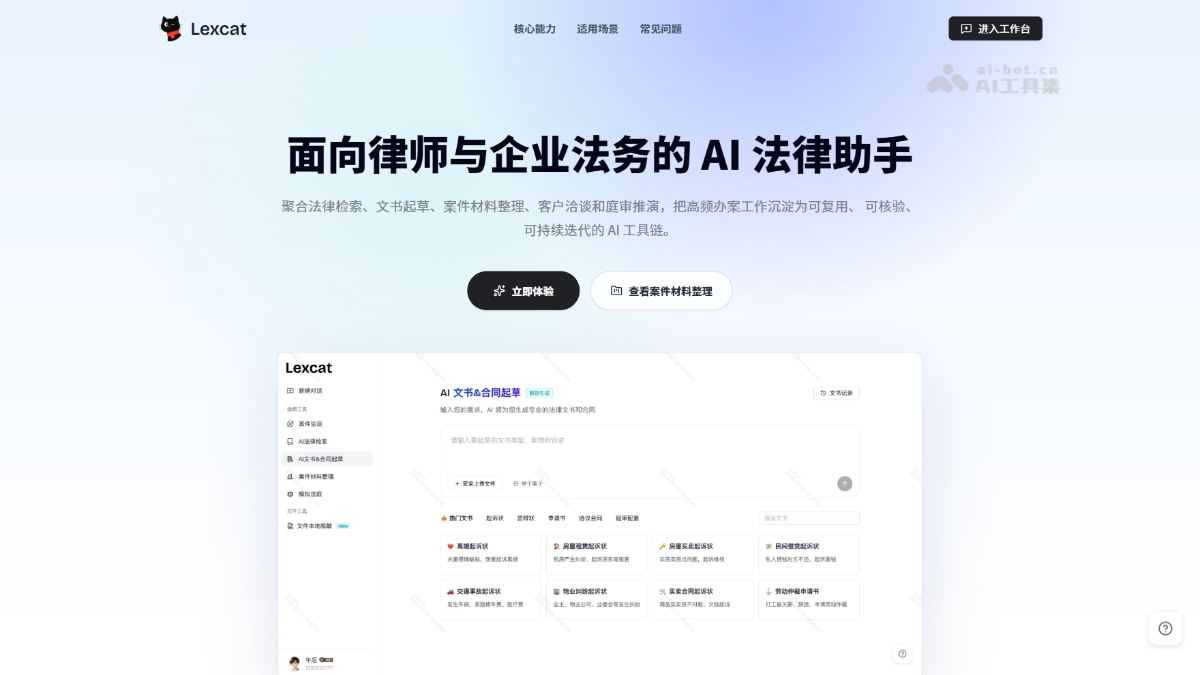
Lexcat's main features
-
AI legal research: Quickly locate usable authorities around legal issues, regulations, case numbers, and similar-case leads.
-
AI document and contract drafting: Generate complaints, statements of defense, lawyer's letters, and contract drafts based on case facts and claims.
-
Case material organization: After uploading case files, automatically parse them, sort out the facts, summarize evidence, and flag materials still needed.
-
AI case consultation: Generate must-ask checklists by cause of action and organize interview notes in real time, making communication more structured.
-
AI moot court: Simulate courtroom offense and defense around issues in dispute, evidence, and defense paths, helping teams rehearse in advance.
-
Material privacy processing: Identify and redact sensitive information in cases, reducing risks in external collaboration and model use.
How to use Lexcat
- Visit the official website: Visit the Lexcat official website https://www.lexcat.cn/ to complete account registration and login.
- Legal research: In the legal research module, enter a legal issue, regulation name, or case number, and the system will quickly locate relevant usable authorities.
- Document drafting: In the document drafting module, select the required document type and enter the case facts and claims, and AI will generate an editable draft.
- Case organization: Upload case files to the case organization module, and AI will automatically parse the content, sort out the facts, and summarize relevant evidence.
- Client consultation: In the client consultation module, select the cause of action, and the system will generate a must-ask checklist and organize interview notes in real time.
- Moot court: In the moot court module, enter the issues in dispute and evidence of the case to simulate courtroom offense and defense strategies.
- Privacy redaction: Upload materials containing sensitive information to the privacy redaction module, and after one-click identification and redaction, you can collaborate externally safely.
- Manual verification: Perform manual verification by combining the original materials with professional judgment, and use them only after confirming they are correct.
Lexcat's core advantages
-
One-stop closed loop: Integrates research, documents, material organization, consultations, and trial simulation to achieve a complete closed loop from information retrieval to document delivery.
-
Coverage of high-frequency scenarios: Covers 5+ core legal workflows and 10+ high-frequency case-handling entry points, meeting the diverse needs of law firms, independent lawyers, and corporate legal teams.
-
Privacy and security protection: Built-in material anonymization can identify and handle sensitive information, reducing privacy risks in external collaboration and model use.
-
Verifiable results: All search, document, and deduction results are annotated with source evidence, making it easy to conduct professional review in combination with factual materials.
-
Reduce repetitive work: Automates high-frequency repetitive work such as organizing filing materials and summarizing evidence, significantly reducing manual input by assistants.
-
Clear professional boundaries: All output must be verified by a professional lawyer before use.
Comparison of Lexcat with similar competitors
| Comparison dimension | Lexcat | Tongyi Falü |
|---|---|---|
| Product positioning | One-stop AI legal workflow platform, focused on a closed loop across the entire case-handling process | General-purpose legal AI assistant, focused on legal consultation and document generation |
| Core functions | Legal search, document drafting, case material organization, client consultation, moot court, material anonymization | Legal consultation dialogue, document generation, statute and case search |
| Target users | Practicing lawyers, law firm teams, corporate legal teams | Small and medium-sized law firms, corporate legal teams, legal beginners |
| Search capability | Searches based on legal issues, statute names, case numbers, and similar-case leads, emphasizing verifiable results | Based on the Tongyi Qianwen model, with fast response speed, covering laws and cases across multiple domains |
| Document generation | Generates drafts such as complaints, statements of defense, lawyer's letters, and contracts based on case facts and claims | Rich document templates, zero-threshold onboarding, suitable for rapid generation of standardized documents |
| Case management | Supports OCR parsing of case files, fact organization, evidence summarization, and prompts for materials still needed | No dedicated module for organizing case materials |
| Client consultation | Generates required question lists by cause of action and continuously organizes interview notes | No such function |
| Court hearing simulation | Supports AI moot court, simulating offense and defense around disputed issues, evidence, and defense paths | No such function |
| Privacy and security | Built-in material anonymization can identify and handle sensitive information | Does not emphasize a dedicated material anonymization function |
| Professional depth | Oriented toward practice scenarios, emphasizing that results need to be reviewed in combination with original materials and professional judgment | Limited professional depth, insufficient support for complex cases |
| Learning curve | Login to the workspace required; many functional modules and a certain learning curve | Zero barrier, conversational interaction, easy to get started |
Lexcat use cases
-
End-to-end handling of litigation cases: From legal research and similar-case analysis after taking on a case, to drafting complaints/defense statements and organizing evidence materials, and then to mock court simulations before trial, delivering a one-stop closed-loop case handling.
-
Corporate contract and compliance review: Legal teams can quickly search relevant regulations and precedents, generate draft contracts or review opinions, and collaborate with external lawyers after desensitizing confidential contracts.
-
Client consultation and case intake discussions: Lawyers use the AI consultation assistant to generate a must-ask checklist by cause of action, organize interview minutes in real time, quickly form a case summary, and connect to subsequent document work.
-
Law firm team collaboration and knowledge accumulation: Teams uniformly circulate case files, chat records, and case-handling processes within the workspace, distilling high-frequency case-handling steps into reusable and verifiable standardized processes.
-
Secure handling of sensitive materials and external delivery: AI identifies and desensitizes case materials containing personal information or trade secrets, reducing the risk of privacy leaks when uploading to the cloud or collaborating externally.
Lexcat FAQs
Q1: Which users is Lexcat suitable for?
A1:Lexcat is aimed at lawyers, law firm teams, and corporate legal departments, and is suitable for handling high-frequency work such as legal research, document drafting, case material organization, client interview records, and trial preparation.
Q2: What legal work can Lexcat assist with?
A2:It currently covers scenarios such as regulation and case research, drafts of litigation and contract documents, OCR and information organization of case files, client consultation records, material desensitization, and mock court simulations.
Q3: Can AI-generated results be used directly as legal opinions?
A3:No. Lexcat provides legal work assistance results and does not constitute legal opinions or professional advice. Regulations, cases, factual judgments, and document content still need to be verified by personnel with the corresponding professional capabilities in combination with the original materials.
Q4: What should be noted before using case materials?
A4:Case materials may contain personal information, trade secrets, or other sensitive information. Before uploading or processing, you should confirm that you have lawful authorization and choose an appropriate handling method based on the privacy policy, business permissions, and the sensitivity of the materials.
Q5: Can I view the product before logging in?
A5:Yes. The homepage allows you to directly learn about Lexcat's core capabilities and applicable scenarios; to access complete workspace features such as legal research, document drafting, and case management, you need to log in according to the page prompts.