

What is Juyun
Juyun is a cloud-based AI intelligent platform focused on Chinese scriptwriting, providing screenwriters, directors, and film and television teams with a full-process creative solution from idea conception to final draft delivery. Juyun integrates beat cards, story outlines, character settings, scene-by-scene outlines, a professional script editor, and an AI assistant screenwriter, supporting novel/story import and adaptation, intelligent script doctor diagnosis, and two-way Word format compatibility, deeply aligned with the creative habits of Chinese short dramas, web dramas, and traditional film and television projects. Through cloud collaboration, version management, and full-chain data encryption, it meets the efficient creative needs of individual screenwriters and also supports unified materials and progress synchronization for team projects.
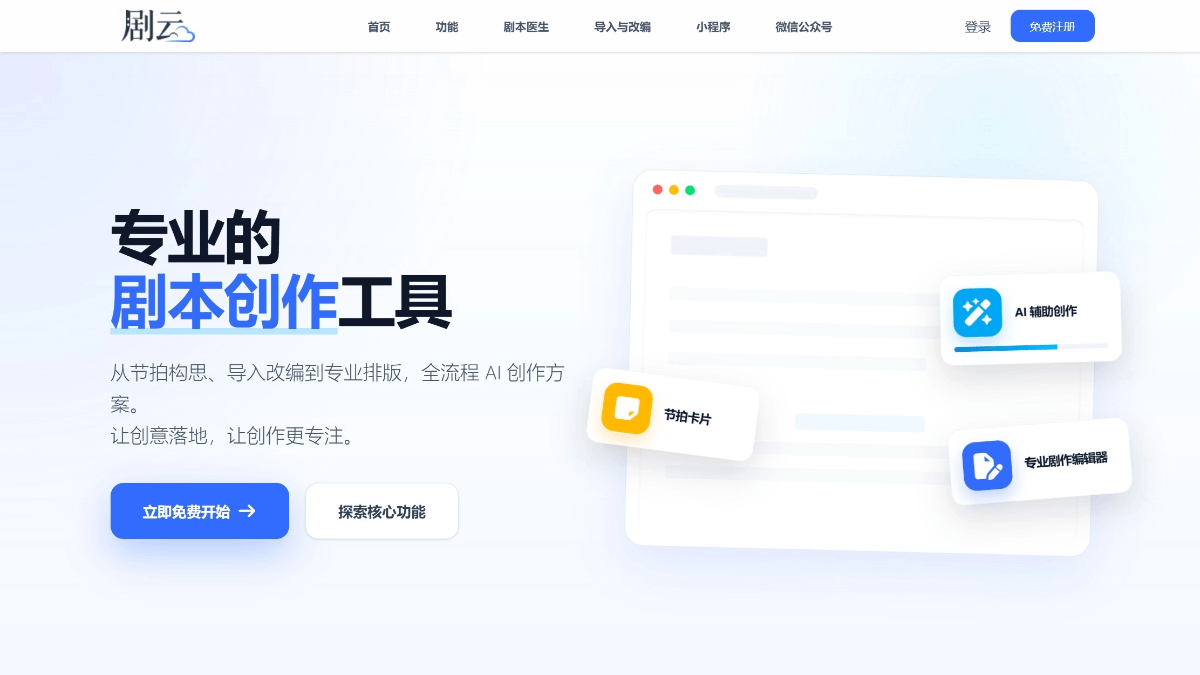
Main features of Juyun
-
Online scriptwriting: Provides a professional Chinese script editor, supporting standard paragraph types such as scenes, descriptions, characters, dialogue, parentheses, and transitions. The auxiliary panel on the right allows real-time viewing of materials such as story synopsis, outline, and character settings without frequently switching pages.
-
Beat cards: Records scattered ideas, scenes, lines, foreshadowing, reversals, and character thoughts in card form, organizing story rhythm through timelines, time blocks, freeform canvases, and relationship connections, suitable for high-density scene management in short dramas.
-
Story synopsis and story outline: Helps creators develop from "one idea" into an executable story structure, supporting manual writing or AI-assisted generation, expansion, and polishing, with visual drag-and-drop adjustment of plot.
-
Scene-by-scene outline: Breaks down the story outline into a single-scene writing checklist, recording elements such as title, episode number, location, time, interior/exterior, and characters appearing, serving as the key bridge from story outline into the script body.
-
Character settings: Integrates character biographies, character profiles, character canvases, and character relationship charts, supporting the recording of personality, backstory, core desires, and character arcs, and sorting out complex relationships such as kinship, romance, interests, and factions through relationship charts.
-
Import and adaptation: Supports uploading long-form text materials such as external scripts, novels, stories, and oral drafts, assisting in generating story synopses, outlines, character settings, scene-by-scene outlines, and script body drafts, enabling the film and television transformation of non-script materials.
-
Script doctor: Outputs structured diagnostic reports and revision suggestions for existing scripts around dimensions such as story structure, character motivation, pacing arrangement, plot logic, dialogue expression, and genre fit.
-
AI assistant screenwriter: Polishes, expands, condenses, and rewrites selected descriptions or dialogue in the editor, strengthening visual imagery, tightening action pacing, and enhancing subtext; combines project context to assist in continuing scenes and backfilling materials.
-
Word import and export: Supports two-way import and export of commonly used Word document formats, compatible with common document circulation methods in the film and television industry, reducing the cost of migrating from traditional writing to an online platform.
How to use Juyun
-
Register and create a project: Visit the Juyun official website https://www.jucloud.com , register an account and log in, click to create a new project, name the script, and select the project type (such as short drama, web drama, film, etc.).
-
Collect creative materials: After entering the project, first open the "Beat Cards" module, record the scattered ideas, scenes, dialogue, foreshadowing, and character ideas in your mind as cards, and use the timeline or free canvas to initially arrange the story rhythm.
-
Build the Story Skeleton: In "Story Synopsis", clarify the protagonist, goal, core conflict, and ending direction; then in "Story Outline", further break down the story structure, key events, turning points, and episode progression, which can be written manually or generated and polished with AI assistance.
-
Establish the Character System: Use the "Character Settings" feature to create a profile for each character, recording name, identity, personality, backstory, core desire, and character arc; use the "Character Relationship Chart" to sort out kinship, emotional, interest-based, or conflict relationships between characters, ensuring the team has a consistent understanding of the characters.
-
Break Down Scene-by-Scene Tasks: In "Scene Outline", break down the story outline by scene, marking for each scene the title, episode number, location, time, interior/exterior, characters appearing, and the core content of the scene, forming a clear writing task list.
-
Write the Script Body: Enter the "Script Editor" and write scene by scene in standard Chinese script format (scene, description, character, dialogue, parentheses, transition); while writing, use the right auxiliary panel to view the synopsis, outline, character settings, and other materials at any time, reducing page switching.
-
AI-Assisted Refinement: Select the passages that need optimization and call on the "AI Assistant Screenwriter" for polishing, expansion, condensing, or rewriting; you can also let the AI continue writing scenes based on context, strengthen visual imagery, or adjust dialogue to sound more colloquial.
-
Diagnosis and Delivery: After the first draft is complete, use "Script Doctor" to generate a diagnostic report from dimensions such as structure, characters, pacing, and dialogue; based on the revision suggestions, return to the corresponding modules to adjust, and finally export as Word or PDF for submission.
-
Import the Old Draft: Upload an existing Word-format script document to Juyun, and the system will automatically recognize and import the body content.
-
Verify the Recognition Results: Check whether the system's recognition of the body structure, character appearances, and outline is accurate, and manually correct any recognition deviations to ensure the project materials are complete.
-
Edit and Revise Online: Enter the script editor to add, delete, or modify the existing manuscript, using cloud auto-save and version history features to avoid the risk of local file loss or overwriting.
-
Structured Diagnosis: Run "Script Doctor" to conduct a comprehensive analysis of the full manuscript and obtain a diagnostic report on story structure, character motivation, pacing arrangement, plot logic, and other aspects.
-
Iterative Optimization: Based on the diagnostic report, locate the problems and return to "Character Settings", "Story Outline", "Scene Outline", or "Script Body" for targeted revisions, forming a closed loop for draft revision.
-
Upload the Original Material: Upload a novel, story, article, or long-text material to Juyun, and select the "Import and Adaptation" task type.
-
AI-Assisted Breakdown: The system automatically analyzes the material and assists in generating "Story Synopsis", "Character Settings", and "Story Outline", transforming narrative text into film and television creation materials.
-
Build the Scene Structure: Based on the generated outline, in the "Scene Outline," organize the locations, time, characters, and core actions required for shooting by scene, and clarify the shootability of each scene.
-
Generate or manually write the main text: In the script editor, you can choose to have AI generate a draft of the script's main text based on the scene outline, or write manually based on the existing structure, ensuring that dialogue and descriptions conform to film and television expression conventions.
-
Continuously refine into a final draft: Use the "AI Assistant Screenwriter" to optimize dialogue and visual descriptions, regularly use the "Script Doctor" to check whether the adapted script's structure is complete and its pacing is tight, and iterate repeatedly until the final draft.
Juyun's Core Advantages
-
Deep Chinese Localization: Designed specifically for Chinese scriptwriting workflows, deeply adapted to local format standards and creative habits such as mainland Chinese dramas and short dramas, supporting local workflows such as WeChat group communication, character setting sheets, and episode outlines, rather than simply porting overseas tools.
-
Full-Process Creative Pipeline: Covers the complete creative cycle from beat conception, story synopsis, outline planning, character setting, scene breakdown, and main text writing to script diagnosis, achieving "managing all creative materials within one project."
-
AI Intelligent Assistance System: Integrates the AI Assistant Screenwriter (polishing, expansion, continuation, dialogue optimization) and the Script Doctor (diagnosis of structure, characters, pacing, and shootability), forming a "writing + diagnosis" dual engine that lowers the threshold for creation and revision.
-
Project-Level Structured Material Management: Brings character relationship maps, beat cards, scene outlines, adaptation materials, historical versions, and more into the same project system, solving the problems of fragmented team collaboration documents and missing context.
-
Seamless Word Compatibility: Supports two-way import and export in Word format, preserves professional scene format, is compatible with the traditional document submission and circulation methods of the film and television industry, and lowers migration costs.
-
Cloud Collaboration and Version Security: Supports multi-role online collaboration, real-time comments, and version history tracing, combined with full-link encrypted transmission, automatic saving, and exception recovery, ensuring the security of creative assets.
-
Adapted for Short Dramas and Adaptation Needs: For emerging scenarios such as high-density short drama pacing and novel IP adaptation, it provides dedicated tools such as beat cards and import adaptation, quickly handling tropes, pleasure points, and conflict reversals.
-
Permanently Free Basic Version: Provides a permanently free version that meets daily creative needs, lowering the barrier to use for individual screenwriters and students, while the professional version targets teams and advanced AI feature needs.
Comparison of Juyun with Similar Competitors
| Comparison Dimension | Juyun | WriterDuet | Fade In |
|---|---|---|---|
| Core Positioning | Full-process management platform for Chinese scriptwriting | Cloud collaboration scriptwriting tool | Professional desktop scriptwriting software |
| Strongest Advantage | Structured management of Chinese project materials, covering the complete process from conception to diagnosis | Multi-person real-time collaboration, co-writing, comments, and version tracking | Mature script format control, revision management, production reports, and local writing experience |
| Typical Applicable Scenarios | Managing a Chinese script project from materials and structure to main text together | Several screenwriters writing the same script together | Complete script available; requires professional formatting, local revisions, and production process reports |
| Collaboration logic | First unify materials such as characters, outline, and scene breakdown, then proceed to the main text; emphasizes "material unification before collaboration" | Real-time co-writing, comment feedback, and cloud synchronization around a single script document | Primarily local desktop writing, with weak collaboration capabilities |
| Featured functions | Beat cards, story synopsis/outline, scene breakdown outline, character settings and relationship charts, import and adaptation, script doctor, AI assistant screenwriter, Word two-way compatibility | Real-time co-writing, comments and annotations, revision tracking, cross-device synchronization | Format control, navigation organization, revision management, multi-format import and export, production reports |
| Chinese localization | Deeply tailored to Chinese short drama and web drama creation habits, adapted to local Word workflows and project communication methods | General-purpose collaboration tool, not specifically targeted at Chinese script workflows | General-purpose professional software, not specifically targeted at Chinese script workflows |
| AI capabilities | Integrated AI assistant screenwriter and script doctor, supporting generation, polishing, and diagnosis | Basic collaboration features, no native AI creation assistance | No native AI-assisted creation features |
| Deployment method | Online cloud platform (Web + mobile) | Online cloud platform | Desktop software (local installation) |
Application scenarios of Juyun
-
Long-form script creation from scratch: Starting from creative inspiration, the screenwriter collects material through beat cards, gradually builds the story synopsis, outline, and scene breakdown structure, and ultimately completes the professional script text for a film, TV series, or web drama, managing all creative materials within one project throughout the process.
-
Short drama and series story development: Targeting the characteristics of short dramas with high-density segments, satisfying moments, conflicts, and reversals, using beat cards to quickly record and organize segments, and managing rhythm through a timeline, suitable for short drama creation workflows that require rapid iteration and strong plot progression.
-
Revision and iteration of existing scripts: Creators import existing Word-format script documents into Juyun, use the script doctor for structured diagnosis to locate issues in structure, characters, rhythm, dialogue, and other aspects, then return to the editor or corresponding modules for targeted revisions.
-
Adapting novels/IP into film and television scripts: Upload non-script materials such as novels, stories, and long articles, use the import and adaptation function to assist in generating story synopses, character settings, outlines, and scene breakdown lists, then convert them into standard script format, lowering the threshold for cross-genre creation.
-
Multi-person team collaborative creation: Roles such as screenwriters, directors, producers, and literary coordinators collaborate online around the same project, unifying character settings, story direction, and scene breakdown tasks before entering main text writing, avoiding the fragmentation of materials and lack of context caused by traditional WeChat group communication.
-
Management of series with complex character relationships: For projects such as ensemble dramas, family dramas, and power-struggle dramas with many characters and complex relationships, uniformly manage character materials, motive clues, and faction relationships through character canvases and relationship maps, reducing inconsistencies in character motives or missing clues during writing.


