

What is Omma
Omma is an AI-driven intelligent 3D content creation platform launched by Spline that can automatically generate 3D interactive web pages, games, and applications through natural language descriptions. Omma adopts a multi-AI Agent parallel architecture that collaboratively completes tasks such as code generation, 3D modeling, and image creation. It supports importing various files such as Blender, CSV, and JSON, and can convert flat content into 3D scenes with one click. Users do not need to master professional skills and can quickly create publishable interactive experiences, greatly lowering the barrier to 3D development.
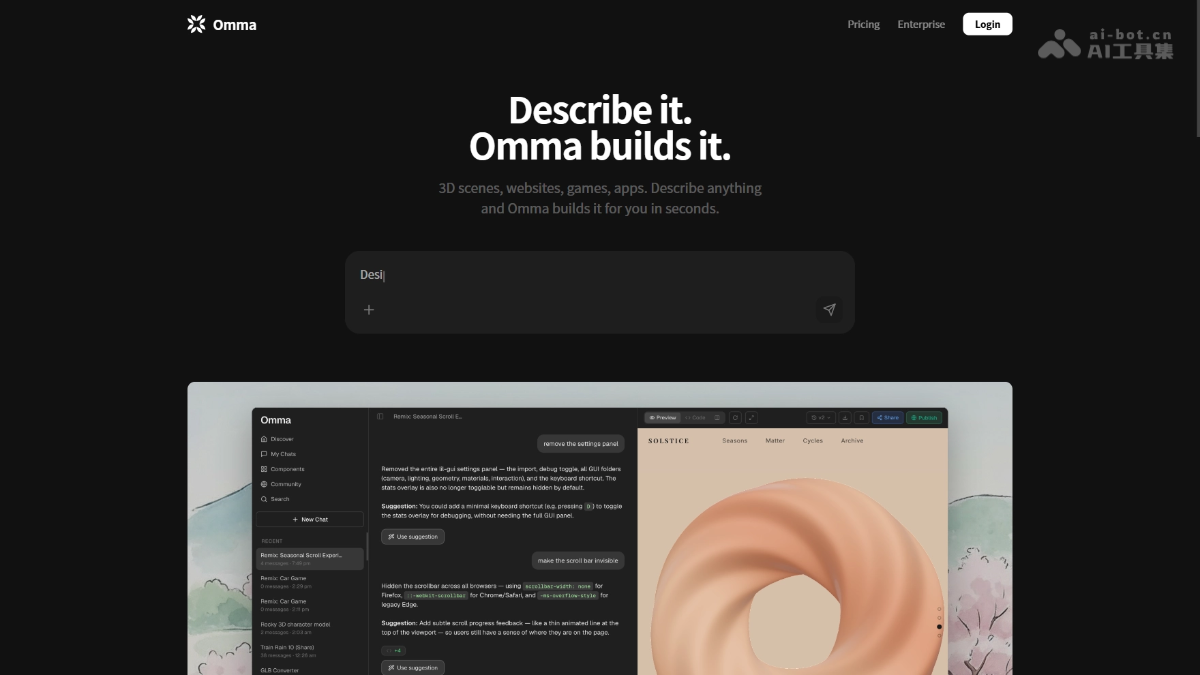
Omma's main features
- Multimodal file import: Supports 3D files such as Blender, GLB, and OBJ, as well as multiple formats such as CSV, JSON, images, videos, audio, and URLs.
- Generate 3D content from a single sentence: Automatically generates 3D interactive official websites, mini-games (such as racing and trains), scenes, and animations through natural language descriptions.
- Flat-to-3D conversion: Use the
/3dcommand to directly convert flat images or descriptions into 3D models and place them into the scene. - Interactive web development: The platform can create flat interactive web pages such as data visualization charts and dashboards, and supports CSV import and real-time preview.
- Multi-Agent parallel execution: Supports multiple AI Agents simultaneously handling tasks such as code generation, image creation, and 3D modeling, completing them in seconds.
- Code export and publishing: You can view and copy the source code, and it supports one-click sharing, downloading, and publishing.
Omma's key information and usage requirements
-
Developer: Spline (a leading 3D company)
-
Core technology: Multi-AI Agent parallel architecture
-
Supported formats: More than 50 types including Blender, GLB, OBJ, CSV, JSON, images, and videos
-
Generation types: 3D websites, games, applications, and data visualization
-
Usage requirements: No programming background is required; content can be created through natural language descriptions, and an account must be registered before use.
Omma's core advantages
-
Zero-barrier creation: No need to master 3D technologies such as WebGL or Three.js; natural language descriptions can generate professional-grade interactive content.
-
Multi-Agent parallelism: Multiple AI agents simultaneously handle tasks such as code, modeling, and images, with efficiency far exceeding traditional single-threaded tools.
-
3D-native support: Unlike ordinary web page generation tools, the platform can directly output true 3D scenes, games, and applications rather than pseudo-3D effects.
-
Full-format compatibility: Supports import of more than 50 types of files such as Blender, GLB, CSV, JSON, and audio/video, connecting real data with creation.
-
End-to-end closed loop: Completes everything from description, generation, and debugging to publishing in one stop, allowing interactive works to go online without switching tools.
How to use Omma
- Register and log in: Visit the Omma official website https://omma.build/ to complete account registration.
- Describe requirements: In the input box, describe in text what you want to create, or upload materials such as 3D files, images, CSV, etc.
- Choose a template: Select a preset type based on the scenario, such as a website, data dashboard, or game.
- Generate a preview: Multiple AI Agents collaborate in parallel, automatically generating an interactive preview in seconds.
- Adjust and optimize: Iteratively modify details through conversational instructions, such as adjusting colors, adding animations, etc.
- Publish and go live: Export the source code, or directly share, download, and publish with one click.
Comparison of Omma's similar competitors
| Dimension | Omma | Lovable | Figma AI |
|---|---|---|---|
| Product type | AI creative development platform | AI full-stack app builder | Native AI design tool |
| Core positioning | 3D/motion/interactive content generation | Full-stack web application development | UI/UX design collaboration |
| Parent company | Spline | – | Adobe |
| Main users | 3D designers, creative developers, marketers | Product managers, non-technical founders, developers | UI/UX designers, product teams |
| Design stage coverage | Concept → generation → deployment | Requirements → code → launch | Design → prototype → delivery to development |
Omma's application scenarios
- 3D website building: Users can quickly generate product showcase pages or brand websites with 3D models through natural language, creating an immersive browsing experience.
- Game development: Developers can generate interactive 3D mini-games with a single sentence, for prototype validation or direct publishing.
- Data visualization: The platform supports importing real data such as CSV, and automatically generates interactive 3D charts and real-time data dashboards.
- Creative expression: Designers can create 3D art installations, particle animations, and shader effects without code, and quickly validate visual concepts.
- Educational display: Teachers can create 3D teaching models such as molecular structures and historical scenes, allowing students to intuitively understand complex knowledge through interaction.


