

What is Ruixin Paper AI Detection
Ruixin Paper AI Detection is a one-stop academic integrity detection system launched by Zhongke Ruijian, focusing on AIGC (AI-generated content) detection and academic misconduct identification. The platform integrates dual-dimension detection capabilities for text and academic images, and can accurately identify paper content generated by mainstream large models such as ChatGPT, Ernie Bot, Doubao, and more. It also supports AI generation trace identification and tampering detection for academic images such as experimental images and data charts. Ruixin Paper Detection provides deeply interpretable reports, including AI-rate weighted results, risk grading, paragraph-level localization, and revision suggestions, helping university teachers and students conduct advance "self-checks to avoid pitfalls".
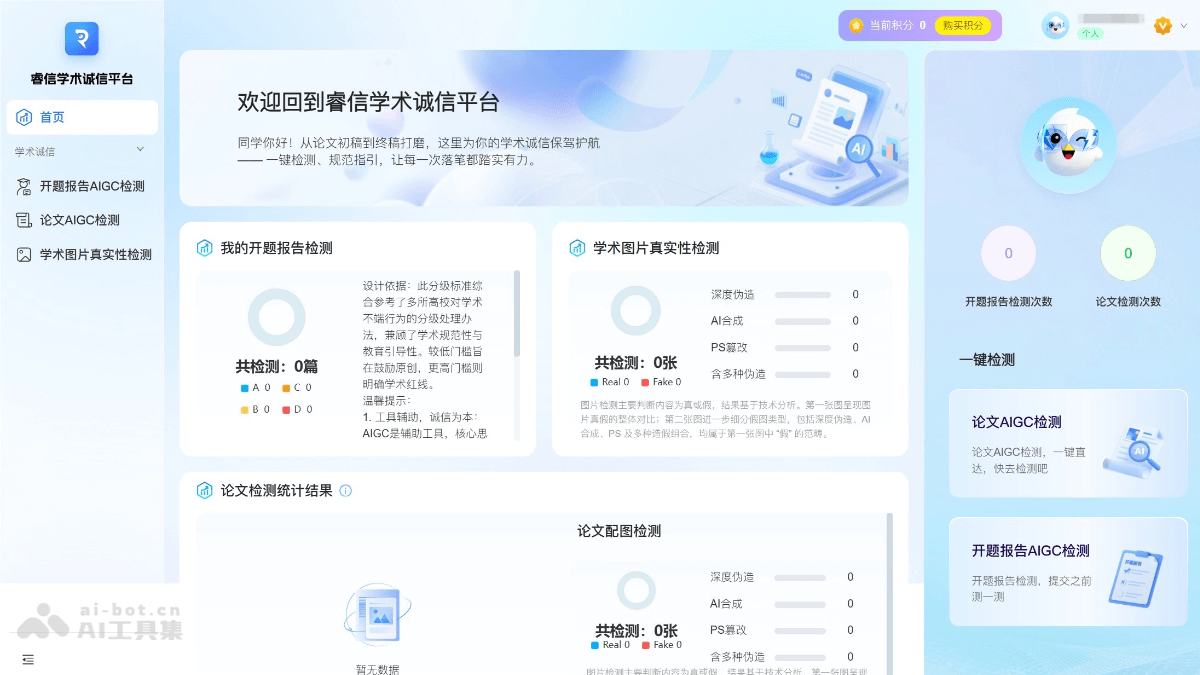
Main Features of Ruixin Paper AI Detection
-
AI Text Detection: Accurately identifies paper content generated by mainstream large models such as ChatGPT, Ernie Bot, Doubao, and DeepSeek, and highlights high-risk paragraphs.
-
Academic Image Authentication: Exclusive support for AI generation trace identification and tampering detection in academic images such as experimental images, data charts, and statistical graphics.
-
Batch Detection Processing: The teacher portal supports batch upload and batch detection for undergraduate, master's, and doctoral dissertations as well as course assignments.
-
Multi-format Compatibility: Supports mainstream formats such as DOCX, PDF, and JPG, and can process complex documents with mixed text and images.
-
Intelligent Risk Report: Provides an overall "originality/AI risk" index, grades risks from A to D, locates risk fragments, and gives specific revision suggestions.
-
Management Backend System: Institutional administrators can obtain multi-dimensional data statistical analysis reports through the backend to gain a macro understanding of academic integrity conditions.
-
Multi-platform Interconnection: The PC official website and the "Ruijian AI" WeChat Mini Program share account interconnection, requiring no repeated registration and enabling detection anytime, anywhere.
-
Data Security Assurance: Detection data is encrypted during transmission and storage, supports private deployment, and original papers can be set to automatically destroy on a schedule.
How to Use Ruixin Paper AI Detection
-
Register and Log In: Visit the Ruixin Paper AI Detection official website ruijianai.com , register with a mobile phone number + verification code, or log in with one click by scanning the WeChat QR code.
-
Identity Verification: Complete institutional verification (select your institution) and role verification (teacher/student). The teacher portal supports account-password login, and schools can configure accounts uniformly.
-
Submit for Detection: Upload the paper file (supports DOCX and PDF formats) and select the detection type (text detection/image detection/comprehensive detection).
-
View Report: The system automatically generates a detection report, allowing online viewing of AI-rate weighted results, risk grading (A-D), highlighted risk paragraphs, and revision suggestions.
-
Export Report: Supports exporting the detection report as a PDF file for archiving or submission to a supervisor for review.
-
Batch Operations (Teacher Portal): Teachers can batch upload student papers and complete AI detection of multiple documents with one click, greatly improving review efficiency.
-
Mini Program Usage: Search for the "Ruijian AI" Mini Program on WeChat. It shares account interconnection with the PC end, allowing you to view detection progress and report results anytime, anywhere.
Core Advantages of Ruixin Paper AI Detection
-
Leading Technical Authority: Leveraging over 20 years of technical accumulation at the Institute of Computing Technology, Chinese Academy of Sciences, it holds 53 invention patents and 34 software copyrights, and has won 2 National Natural Science Second Prizes and 1 Beijing Science and Technology Progress First Prize.
-
Comprehensive Detection Dimensions: The only platform in China that simultaneously supports AI text detection + academic image authenticity verification, covering multimodal content such as paper text, experimental images, and data charts.
-
High Detection Accuracy: Detection accuracy in key scenarios exceeds 90%, supporting recognition of 200+ mainstream generative models such as DeepSeek, ChatGPT, ERNIE Bot, and Doubao.
-
Ultra-Fast Detection Experience: Leveraging heterogeneous software-hardware collaborative acceleration technology, it delivers results in milliseconds for long texts of ten thousand words, with no long waiting required.
-
In-Depth Interpretable Reports: Provides weighted AI rate results, A-D four-level risk grading, paragraph-level risk localization, and specific revision suggestions, rather than a simple "pass/fail".
-
Controllable Data Security: Detection data is encrypted throughout transmission and storage, supports private deployment, and original papers can be set to automatically destroy on a schedule, with a commitment to never leak or use them for other purposes.
-
Seamless Multi-Platform Interoperability: The PC official website and the "Ruijian AI" WeChat mini-program share account interoperability, requiring no repeated registration and enabling detection anytime, anywhere.
-
Flexible Deployment Modes: Supports multiple cooperation methods such as API integration, private deployment, and white-label customization to meet the personalized needs of different institutions.
Application Scenarios of Ruixin Paper AI Detection
-
Self-Check for Graduation Theses: Undergraduate, master's, and doctoral students conduct self-detection before submitting their degree theses to identify AI-generated risks in advance and avoid findings of academic misconduct.
-
Proposal Report Review: Graduate students conduct AI detection before submitting proposal reports to ensure the originality of their research plans and comply with academic standards.
-
Course Assignment Detection: Students self-check before submitting course papers and final assignments, while teachers batch-review student assignments to quickly locate traces of AI generation.
-
Teacher Paper Review: When supervisors guide multiple student papers, they can batch-detect and obtain risk-grading reports, accurately locate problematic paragraphs, and improve guidance efficiency.
-
Academic Journal Submission: Researchers detect the originality of papers before submission to ensure compliance with journals' disclosure requirements for AI-generated content.
-
Institutional Academic Management: Academic affairs offices and graduate schools obtain multi-dimensional data statistical analysis reports through the management backend to gain a macro-level understanding of academic integrity across the institution.


