What is Neural4D
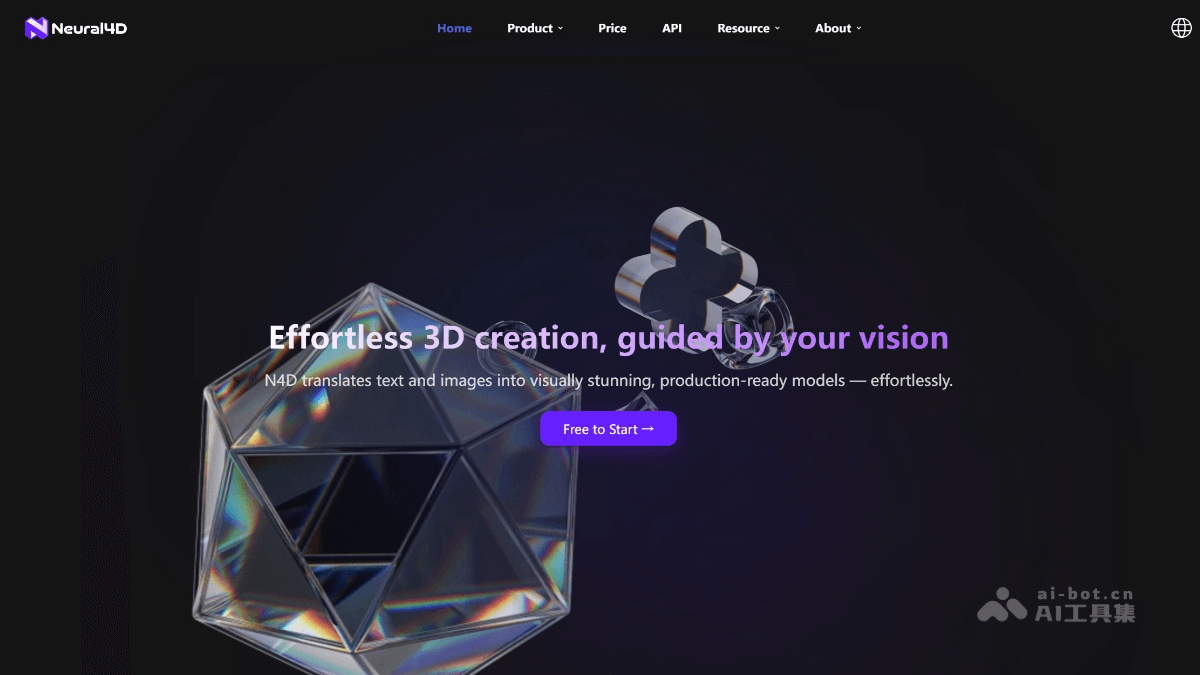
Neural4D is an AI 3D model generation platformlaunched by the DreamTech team (bringing together research talents from top universities such as the University of Oxford and Nanjing University). Based on the world-leading Neural4D-2.5 large model, it can quickly generate high-quality 3D models and animations through text descriptions or image inputs. It supports tens of millions of faces in fineness, is the first to achieve 3D model generation with 1 million tokens, and can complete high-precision model inference in 1.5 minutes, with extremely high efficiency. Neural4D has native 3D texture generation capabilities and strong generalization capabilities, supports regular images, and can handle expressive intents such as memes and stick figures, with generation results leading major European and American companies in multi-scenario evaluations.
Main Features of Neural4D
-
High-precision 3D model generation: Supports tens of millions of faces in fineness, is the first to achieve 3D model generation with 1 million tokens, and can complete high-precision model inference in 1.5 minutes, suitable for complex scenarios and high-detail requirements.
-
Multimodal interaction: Users can generate 3D models through text descriptions or uploading images. The platform supports natural language dialogue interaction and real-time fine-tuning of the details of generated models, such as changing colors and adjusting proportions.
-
Native 3D texture generation: Avoids the spatial inconsistency problems of traditional 2D textures, achieves optimal 3D geometry and texture effects, and improves the realism and visual quality of models.
-
Strong generalization capability: Supports regular images, can handle expressive intents such as memes, stick figures, and fluffy scattered particles, generates high-quality 3D models, and adapts to multiple input styles.
-
Production optimization: Optimizes geometric algorithms for 3D printing and CNC engraving, solves physical production pain points such as manifold thickening and structural smoothing, and the generated models can be directly used for physical manufacturing.
-
High cost-effectiveness: API call cost is low, about 0.51 yuan per call, and the computing power requirement is only 1/5 of traditional models, greatly lowering the hardware threshold, suitable for individual and professional users.
-
Multi-scenario applications: The generated 3D models support multiple mainstream formats (such as OBJ, GLB, STL), and can be directly used in 3D printing, game engines (Unity/Unreal), Blender, and other software, widely applied in game development, film and television production, education, industrial design, and other fields.
How to Use Neural4D
-
Register and log in: Visit the Neural4D official website https://www.neural4d.com/ , click "Start" to register an account. New users will receive 600 credits after registration, which can be used to generate 10 models.
-
Choose generation method: After entering the platform, choose modes such as "Text-to-3D" or "Image-to-3D".
-
Text-to-3D: Enter a description in the "Magic Prompt" box (for example: "A cute cartoon dragon with wings spread").
-
Image-to-3D: Upload a reference image (supports formats such as JPG and PNG).
-
Neural4D-2.5: Multimodal large model, supports text and image input, and enables real-time interactive editing, generation, and modification of models based on natural language.
-
-
Click Generate: After input is complete, click the "Generate" button. Depending on model complexity, generation time is usually between 30 seconds and 2 minutes. A high-precision model with 1 million tokens takes about 1.5 minutes.
-
Adjust the model: After the model is generated, you can use the toolbar provided by the platform to adjust the model's details, materials, or colors, or fine-tune it through natural language dialogue commands, such as "make the horns sharper."
-
Export Model: Once you are satisfied with the adjustments, the model can be exported in mainstream 3D formats such as OBJ, GLB, and STL, and can be used in 3D printing, game engines (such as Unity/Unreal), or software such as Blender.
-
Preview and Application: Supports logging in via the mobile web page and using VR features to place the generated 3D model in a real environment for preview, allowing users to intuitively experience the model's effect.
Neural4D Application Scenarios
-
Game Development: Quickly generate characters, scenes, and props in games, shorten the time for producing art assets, and accelerate the game development process.
-
Film and Animation Production: Generate high-quality 3D models and animations through text descriptions or images, for use in special effects production or previews, reducing live-action costs and the difficulty of post-production compositing.
-
3D Printing: Optimized geometry algorithms ensure that the generated models are suitable for 3D printing, and users can directly export STL format for physical manufacturing.
-
Industrial Design and Architectural Visualization: Quickly generate 3D models of products or simulation scenes of building sunlight and pedestrian flow, assisting design evaluation and client communication.
-
Education and Scientific Research: Help students and teachers better understand complex structures, for use in teaching demonstrations or scientific research simulations.
-
Virtual Reality (VR) and Augmented Reality (AR): Create immersive virtual spaces and dynamic elements to enhance the user experience.
Frequently Asked Questions (FAQ)
Q: How much does it cost to generate a model?
A: By experiencing it through the official website, new users receive credits upon registration and can generate for free. The API call cost is about 1 yuan per use, offering leading cost-effectiveness among most AI 3D tools.
Q: What types of image input are supported?
A: It supports the vast majority of image types, including photos, illustrations, design drafts, and even memes and simple sketches. It has special optimization for "freehand" style images (such as fur and scattered particles).
Q: Can the generated models be used directly for 3D printing?
A: Yes. Neural4D has specifically optimized geometry algorithms for 3D printing, ensuring that models are manifold and have uniform thickness, and after exporting in STL format they can be sent directly to slicing software.
Q: What is the generation speed?
A: Depending on model complexity, it usually takes 30 seconds to 2 minutes. A high-precision model with 1 million tokens takes about 1.5 minutes.
Q: Is model modification supported?
A: Yes. The Neural4D-2o version can be fine-tuned through natural language dialogue interaction, such as changing colors, adjusting proportions, and adding details.
Q: Is there a mobile version?
A: It supports logging in via the mobile web page, and you can use VR features to place the generated 3D model in a real environment for preview.
Q: How can I get more credits or discounts?
A: Follow the official social media accounts, where there are often limited-time events that give away credits. Fans of collaborating creators can use exclusive redemption codes to receive an additional 500 credits.
Experience Suggestions:You can start by trying simple memes or clear photos of objects to experience its fast generation and high fidelity. It is suitable for 3D printing enthusiasts, game developers, animators, and all users who want to lower the barrier to 3D creation.