

What is Doclingo
Doclingo is a powerful AI document translation tool that supports direct upload and translation of multiple document formats (such as PDF, Word, Excel, PPT, TXT, Epub, etc.). It can accurately and efficiently process image and text content while preserving the original formatting. Doclingo offers a choice of multiple AI engines, allowing users to select the most suitable translation engine according to their needs, with some advanced engines requiring payment. Doclingo provides a rich set of auxiliary tools, such as terminology database management, online document editing, AI proofreading, and bilingual merged download, helping users improve translation accuracy and efficiency. It also offers a variety of document widgets, including document format conversion, PDF merging/splitting, encryption/decryption, adding watermarks, image extraction, etc., meeting users' diverse needs in document processing.
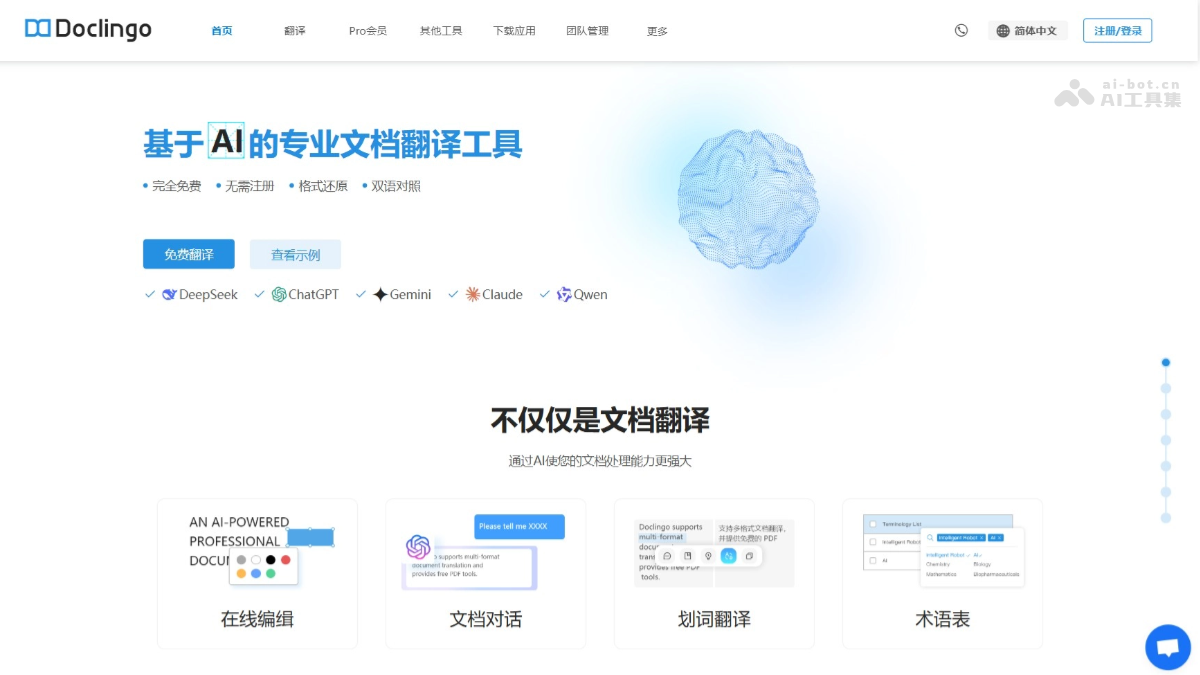
Doclingo's main features
-
Multi-format document AI translation: Supports direct upload and translation of multiple document formats such as PDF, TXT, Epub, Png, and the Office series, preserves the original formatting, provides a choice of multiple AI engines, accurately and efficiently processes image and text content, requires no format conversion, and completes cross-language document processing in one click.
-
arXiv paper translation: Users can upload the URL of a paper on arXiv to perform cross-language processing on the specified article, helping users read professional documents more efficiently and accurately.
-
Text AI translation: Based on deep learning technology, it provides high-accuracy instant translation in multiple languages, maintains the semantics and style of the original text, and is suitable for cross-language conversion of various everyday content.
-
Terminology database: Supports import/export of custom terminology documents, uniformly manages specialized vocabulary, ensures a high degree of consistency in translated content in actual application scenarios, and improves the accuracy of translation of literature in specialized fields.
-
Online document editing: Translated documents support real-time online editing of text and images, making it convenient for users to perform secondary proofreading and content re-layout of documents.
-
Document AI chat: Provides a chat function for translated documents, allowing users to use message-based dialogue to have the AI engine perform operations such as summarizing the current document and generating a mind map of the content.
-
Document AI proofreading: After document translation is completed, users can use the AI proofreading function to re-verify the correctness of the current translated document. The proofreading results will mark incorrect translations and their locations in specified content such as grammar, punctuation, and data in the translation, helping users conveniently and quickly optimize and adjust the document content.
-
Bilingual merged download: Supports document download of bilingual (original/translated) merged PDF and Office series documents, and provides both horizontal and vertical merged layout formats.
-
Document format conversion: Helps users convert PDF documents into documents in other formats. Currently supports conversion from PDF format to Word and TXT formats.
-
PDF document merging/splitting: Parses user-uploaded PDF documents, splits the documents in a specific way (such as single or double pages, etc.), and generates documents separately in a new format.
-
PDF document encryption/decryption: Sets an access password for unencrypted documents and removes the access password for encrypted documents.
-
Add watermarks to PDF documents: Adds watermark content with a specified style, specified content, and specified density to the pages of the source document, and generates a new document with the watermark effect.
-
PDF document image extraction: Extract and separate the image content used in the source document, and package the separated image content for users to download.
-
Other PDF document tools: Currently, it also supports practical small tools such as PDF compression, PDF overlay, PDF page reordering, and PDF page rotation, to meet the diverse PDF document processing needs of users.
How to use Doclingo
-
Visit the official website: Log in to the Doclingo official website https://doclingo.cn/ , register and log in to your account.
-
Upload document: Click the designated area on the official website page, select the document to be translated and open it, and the upload operation will be completed automatically.
-
Select language: After the document upload is complete, select the source language and target language to be translated in the language field. If full-text translation is needed, the source language can remain at the default "Auto Detect" option.
-
Select translation engine: Select the translation engine to be used in the translation engine field. Some engines require payment for use.
-
Select glossary: Select More Settings, and in the glossary field in the pop-up window, select the glossary document that has been added. If none has been added, this field will be empty.
-
Set image translation: Determine whether to translate the image content in the document. It is selected by default. If there is no need to translate the image content, you can deselect it.
-
Start translation: After the document upload is complete and all required items are confirmed and filled in, click the Start Translation button to translate the document using the selected items.
-
AI proofreading: Click the AI Proofreading button in the bottom menu of the document comparison page, complete the selection operation in the pop-up window as prompted, and perform proofreading on the current document.
-
Download translated document: After document translation is complete, the document can be downloaded on both the comparison page and the translation records page. If you need to change the merged layout style of the bilingual document, you can go to the account information page to reset it. The changed settings will only take effect for documents translated after the change.
Doclingo application scenarios
-
Academic research: It can translate foreign-language papers, academic reports, e-books, etc., helping researchers quickly obtain cutting-edge international knowledge and facilitating academic exchange and cooperation.
-
Business office: It is suitable for enterprises to translate contracts, quotations, business emails, and other documents, eliminating language barriers in business communication and improving work efficiency.
-
Personal learning: It is convenient for students to translate study materials, textbooks, extracurricular reading materials, etc., broadening their knowledge and improving their language learning ability.
-
Technical development: Engineers can translate technical documents, product manuals, design drawings, etc., making it easier to understand and apply advanced foreign technologies and promoting technical exchange.
-
Cultural exchange: It is used to translate literary works, cultural reports, travel guides, etc., promoting mutual understanding and exchange between different cultures.
-
Education and training: Teachers can translate teaching resources, courseware, etc., enriching teaching content; students can translate assignments, research reports, etc., improving learning outcomes.

