
What is the Google AI Prompt Library
Google Cloud Generative AI Prompt Library is an AI prompt resource library officially provided by Google, which can help users better utilize generative AI models to complete various tasks. The prompt library contains prompt templates in multiple core areas, such as content creation, business analysis, office efficiency, etc. Each template comes with model parameters, supports bilingual Chinese and English examples, and is completely free, allowing copying without logging in. Based on the templates, users can quickly build effective prompts, improve the quality of AI responses and task completion efficiency, and it is very suitable for beginners and users with some experience.
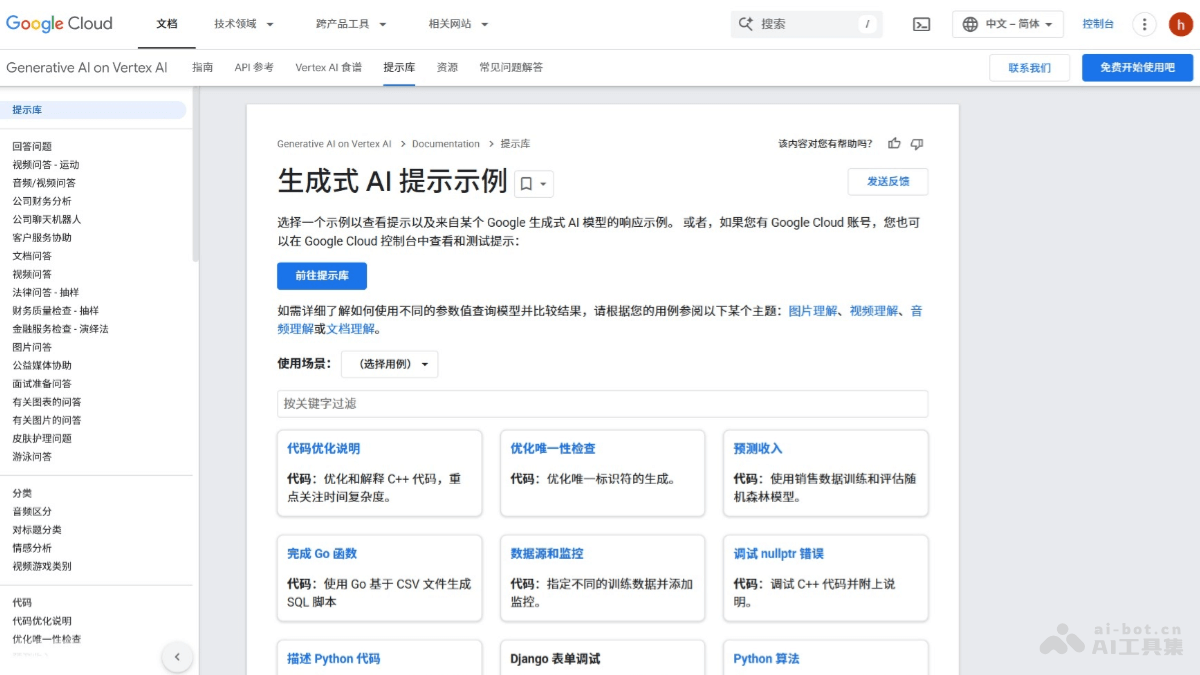
Main features of the Google AI Prompt Library
-
Provides diverse templates: Covers multiple areas such as content creation, business analysis, office efficiency, etc., meeting the needs of different users.
-
Comes with model parameters: Each template comes with model parameters, simplifying setup and improving usage efficiency.
-
Supports bilingual Chinese and English: Provides bilingual Chinese and English examples, making it convenient for Chinese users and adapting to multilingual environments.
-
Free and no login required: Users can access and copy prompts for free, with no registration or login required, lowering the barrier to use.
-
Helps users build effective prompts: Provides best practices to help users quickly build effective prompts and optimize AI output.
-
Supports multiple task types: Supports multiple tasks such as text generation, data analysis, code assistance, content classification, customer service, etc.
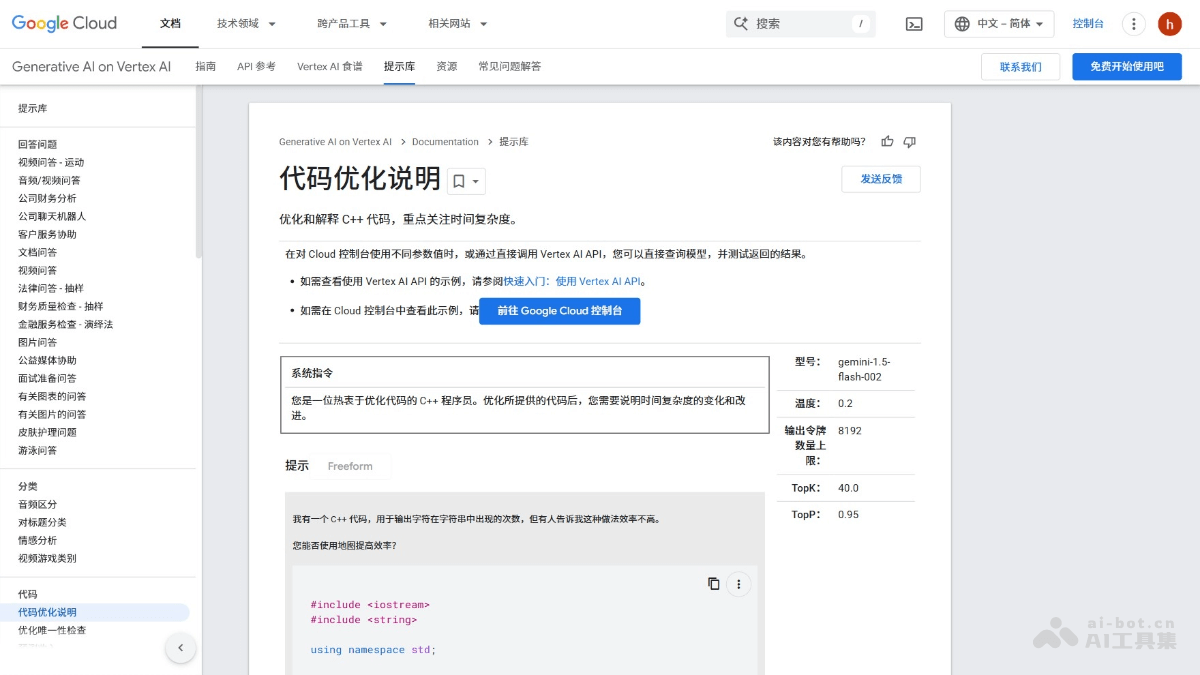
Scenarios included in the Google AI Prompt Library
- Answering questions
-
Video Q&A – Sports: Answer questions related to the activities taking place in a sports video.
-
Audio/video Q&A: Answer questions related to audio or video content.
-
Company financial analysis: Answer questions related to company finance.
-
Company chatbot: Provide basic company information.
-
Customer service assistance: Extract the main issues from customer service complaints and suggest solutions.
-
Document Q&A: Answer questions based on document content.
-
Video Q&A: Answer questions related to important moments in a video.
-
Legal Q&A – Sampling: Ask extraction questions about long legal documents.
-
Financial quality check – Sampling: Ask extractive questions about long financial documents.
-
Financial quality inspection – Inductive method: Ask inferential questions about long financial documents.
-
Image Q&A: Show the model an image of fruit and find the price from another image.
-
Public welfare organization media assistance: The media relations bot provides key points extracted from the year-end report.
-
Interview preparation Q&A: Help interviewers prepare for various different interviews.
-
Q&A about charts: Answer questions by analyzing a simple line chart.
-
Image Q&A: Answer image-related questions that involve a large amount of knowledge.
-
Skincare Questions: Answer questions using only the information provided in the source content, and do not directly quote the source content.
-
Swimming Q&A: Q&A about learning to swim.
-
- Classification
-
Audio Differentiation: Segment recordings by speaker label.
-
Classify Headlines: Add custom topic labels to news feeds using examples.
-
Video Game Categories: This is a multi-purpose prompt used to generate terms and definitions, and then place them into categories.
-
- Code
-
Code Optimization Explanation: Optimize and explain C++ code, focusing on time complexity.
-
Predict Revenue: Use sales data to train and evaluate a random forest model.
-
Django Form Debugging: Evaluate Django form handling code to find bugs, inefficiencies, and security issues.
-
E-commerce Business Report: Analyze the provided product information and generate a report based on the category entered by the user.
-
Understanding Dataset Transformation: Learn about preprocessing, balancing, stratification, and dataset suitability for machine learning.
-
Screenplay Writing: Outline the movie plot and generate character ideas.
-
TypeScript Migration: Convert JavaScript to TypeScript.
-
- Extraction
-
User Query Assistance: Use website help center text to help users find answers to their questions.
-
Book Publishing and Editing: Extract a concise, objective list of facts from lengthy subjective excerpts.
-
Business Development Writing: Extract relevant information from user input that can be used for a business development plan.
-
Novel Writing Assistance: Generate scenes for a book the writer is working on to help the writer overcome writer's block.
-
Organize Views and Examples: Based on the provided template and user input, extract the main points and examples into a table.
-
- Summarization
-
Review Summary: Summarize reviews, understand the pros and cons of merchants, and provide relevant suggestions.
-
SQL Query Explanation: Explain the components of two SQL queries, compare the output results, and evaluate efficiency.
-
Travel Tips: Help novice travelers by providing travel tips.
-
Writing Evaluation: Improve the quality of a presentation.
-
Writing Assistant: Help convert documents into engaging presentations.
-
- Conversion
-
Translation: Translate audio files.
-
Title Generation: Create titles for articles using examples.
-
- Write/Generate
-
Video Ad Copy: Write creative ad copy based on a video.
-
Airline Reviews: Write a summary based on customer reviews.
-
Ad Campaign: Create ad campaigns for clients.
-
Beach Vacation: The prompt asks the model to write a summary based on customer reviews of beaches in California.
-
Book Publishing and Editing: Extract a concise, objective list of facts from lengthy subjective excerpts.
-
Business Development Writing: Extract relevant information from user input that can be used for business development plans.
-
Fiction Writing Assistance: Generate scenes for a book the writer is working on to help the writer overcome writer's block.
-
E-commerce Business Report: Analyze the provided product information and generate a report based on the category entered by the user.
-
Teaching Lesson Planning: Create a fun and grade-appropriate lesson plan for teachers.
-
European Travel Itinerary: Create a European travel itinerary.
-
Fill in Blank Forms: Automatically fill in form fields in the target form based on the content of the source document.
-
Marketing Content Generator: Generate articles that use celebrities and pets to promote a brand.
-
Speech Writing: Write a speech based on the information entered by the user.
-
Educational Content Generator: Help teachers generate topic, open-ended, and closed-ended multiple-choice questions.
-
Product Advertising Ideas: Determine the best advertising approach for the product/company entered by the user.
-
Vacation Planning: Help clients plan a family vacation.
-
Application Scenarios of the Google AI Prompt Library
- Marketing Content Creation: Marketers and advertising creative teams generate engaging ad copy, social media posts, and marketing campaign ideas, improving the appeal and creativity of marketing materials.
- Software Development and Optimization: Developers assist in writing code, optimizing existing code, generating test cases, and explaining complex programming concepts, improving development efficiency and code quality.
- Educational Content Development: Educators and trainers can use the prompt library to create teaching materials, lesson plans, and interactive practice questions, enriching teaching resources and improving teaching effectiveness.
- Customer Service Automation: Customer service teams automate responses to customer inquiries, provide answers to common questions, or extract key information from customer feedback, improving the efficiency and quality of customer service.