
What is Copyleaks
Copyleaks is an AI-basedplagiarism detection toolthat can identify and verify original content. It supports more than 100 languages and is suitable for many fields such as education, publishing, and law, helping users detect plagiarism in text, code, and images. Through deep learning and natural language processing technology, Copyleaks can identify semantic similarity and complex forms of plagiarism. It provides API integration and multi-platform support to ensure the originality and compliance of content.
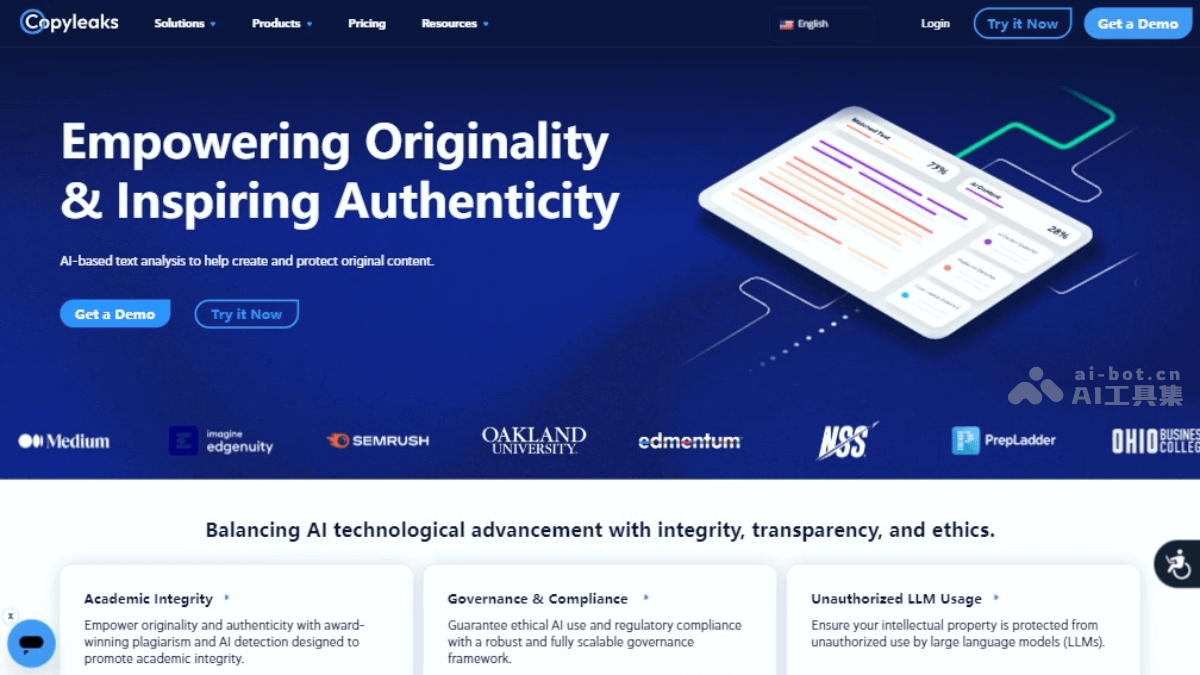
Copyleaks' main features
- AI-based text analysis: Copyleaks is based on advanced natural language processing technology and machine learning algorithms, conducting extensive searches across the internet and various databases to identify potential plagiarism, multiple forms of paraphrasing, copyright infringement, and source code plagiarism.
- Plagiarism detection: The platform can scan documents and compare them with a vast database of online and offline resources to identify similarities.
- Multilingual support: Copyleaks supports more than 100 languages and dialects, and can perform cross-language comparisons between different languages to discover potential translation plagiarism.
- Support for multiple file formats: The platform supports a variety of file formats, including Word, PDF, HTML, TXT, etc., and can detect text in images and compare it with online databases.
- LMS integration: Copyleaks integrates seamlessly with popular learning management systems such as Moodle, Canvas, and Blackboard, making it easy to implement in educational environments.
- API access: Provides API access for customization, allowing users to integrate Copyleaks' plagiarism detection service into custom applications.
- Writing assistant: Provides suggestions for sentence structure, grammar, and word choice to improve writing quality and ensure error-free content.
- Codeleaks: Detects plagiarism and AI-generated code in multiple programming languages to ensure the originality of software development.
- Detailed reports: Copyleaks provides detailed reports that highlight areas in documents flagged as plagiarism, and supports users in downloading and sharing the findings reports.
Copyleaks' official product website
- Official product website:copyleaks.com
Copyleaks' product pricing
- AI + Plagiarism Detection(AI + plagiarism detection):$13.99/month (annual subscription, save $3.00/month)
- Up to 1,200 credits
- Pause the account at any time
- Multilingual detection
- Multiple paraphrase detection
- Detects popular AI models (ChatGPT, Gemini, Claude, etc.) with over 99% accuracy
- Includes two users
- Plagiarism Detector(Plagiarism detector): $8.99/month (annual subscription, save $2.00/month)
- Up to 1,200 credits
- Pause the account at any time
- Multilingual detection
- Multiple paraphrase detection
- Includes two users
- AI Detector(AI detector): $7.99/month (annual subscription, save $2.00/month)
- Up to 1,200 credits
- Pause the account at any time
- Supports detection in more than 30 languages
- Detects popular AI models (ChatGPT, Gemini, Claude, etc.) with over 99% accuracy
- Includes two users
Copyleaks' use cases
- Academic integrity: Educational institutions use Copyleaks to check student-submitted assignments and papers, ensuring originality and preventing plagiarism.
- Content creation: Publishers and content creators use Copyleaks to verify the originality of articles, blogs, and marketing copy, ensuring that the content does not infringe on others' copyrights and protecting their own intellectual property.
- Software development: Developers use Copyleaks' Codeleaks feature to inspect source code, ensuring the originality of the code, identifying potential plagiarism and license violations, and maintaining code compliance.
- Enterprise content review: When enterprises publish marketing materials, reports, and other documents, they use Copyleaks to ensure the originality of the content and avoid legal risks and copyright issues.
- Artificial intelligence model training: AI companies use Copyleaks to verify the source of training datasets, ensuring that the data is created by humans rather than generated by AI, and improving the accuracy and reliability of models.