

What is Exa AI
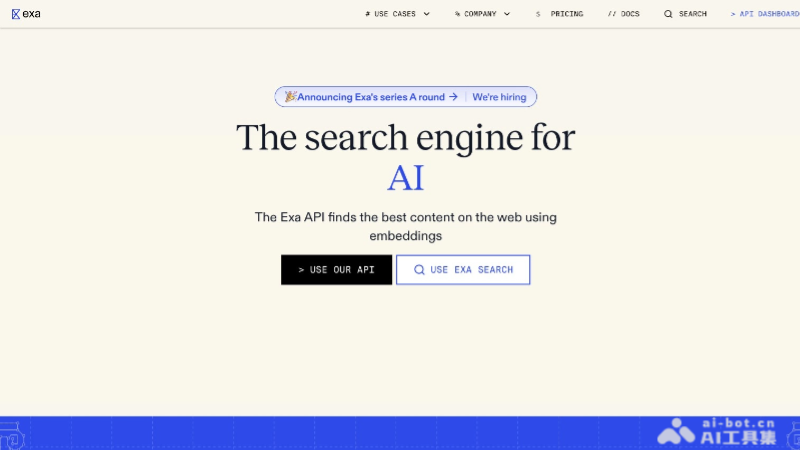
Exa AI is a search engine platform designed specifically for AI models. A search engine built for AI, not a new search engine built for humans, that is, Google for AI. It uses advanced vector database and embedding model technology to achieve deep semantic search, going beyond keyword matching to directly predict and provide relevant links. Exa AI's search engine is optimized through an end-to-end Transformer architecture, filters out SEO noise, provides AI agents with accurate, real-time access to internet information, supports large-scale data retrieval, and empowers AI decision support and deep learning. The company has completed $22 million in financing, with investors including NVIDIA and others, and is committed to integrating world knowledge to serve the future of AI.
Main features of Exa AI
- Semantic search: Exa AI can understand the deep semantics of a query, not just surface keywords, providing more accurate search results.
- Vector database and embedding models: Uses these technologies to predict and recommend the next relevant link rather than the next word, helping process and understand link datasets.
- Content scraping: Can scrape complete, cleaned content from any webpage, providing high-quality data input for AI.
- Similarity search: Finds similar results through URLs or long text snippets, enhancing search precision.
- Large-scale data processing: Exa AI can process a large number of search results, up to 1 million, meeting AI's need for large-scale data processing.
- Real-time updates: Ensures the search engine's data stays up to date by continuously crawling new URLs.
- Powerful filtering capabilities: Provides a highly customizable search experience, allowing users to search by domain, date range, or data category.
- Simple API integration: Exa AI provides a simple and easy-to-use API, enabling developers to easily integrate and use its search functionality.
- Serving AI: Exa AI's search engine is designed specifically for AI and is embedded into various AI services through API interfaces, such as AI chatbots, large dataset search, and more.
How to use Exa AI
- Get an API key: First, you need to register and obtain an API key from Exa AI's official website.
- Read the documentation: Learn about Exa AI's API documentation, including supported search types, request parameters, response formats, and more.
- Install the client library(if available): Exa AI provides client libraries, such as Python's
exa_py, which can be installed through a package management tool (such aspip).pip install exa_pyWrite code: Use the provided API key and client library to write code that initiates search requests.
from exa_py import Exa # 初始化Exa对象 exa = Exa("YOUR_EXA_API_KEY") # 发起搜索请求 results = exa.search("your search query") - Send a search request: Send a search request through the API, where you can specify the search query, filter conditions, and more.
- Process the response: Exa AI will return search results, and you need to process these results to meet your needs, such as parsing JSON response data.
- Customized search: Use the filtering features provided by Exa AI to customize your search requests, such as specifying the date range, data category, and more for search results.
- Integrate into an application: Integrate Exa AI's search capabilities into your application or service to start using Exa AI's search capabilities.
Who Exa AI is for
- AI developers and engineers: Integrate advanced search capabilities into their AI applications to improve the accuracy and efficiency of information retrieval.
- Data scientists: When searching for and processing large datasets, Exa AI can help them quickly find the data resources they need.
- Enterprise users: Enterprises use Exa AI to enhance their business processes, such as market research, customer insights, or competitive analysis.
- Research institutions and academia: Researchers and scholars use Exa AI to obtain in-depth information and academic resources in specific fields.
- AI platform and chatbot developers: Use Exa AI's search API to improve chatbots' information retrieval capabilities and the accuracy of conversations.


