

What is ChatLaw
ChatLaw is open-sourced by a team at Peking UniversityAI legallarge language model (LLM). By combining legal domain-specific datasets and external knowledge bases, it aims to improve the accuracy and efficiency of handling legal issues. The model leverages advanced natural language processing technology to understand and generate legal-related consultations and answers, while reducing the model hallucination problem in legal data filtering. The design of ChatLaw takes into account the complexity of legal language and the rapid updating of legal knowledge, striving to provide high-quality legal information services for legal professionals and ordinary users.
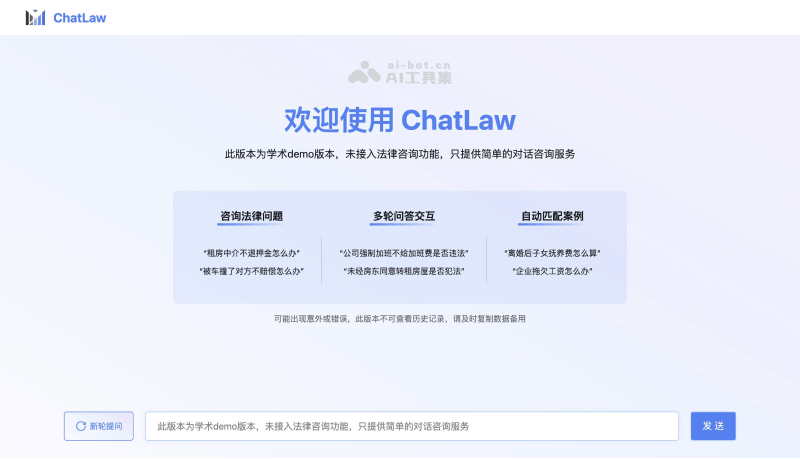
Main features of ChatLaw
- Legal consultation and answers: ChatLaw can understand users' legal questions and provide corresponding answers and suggestions.
- Legal text analysis: The model can analyze legal documents and cases to help users understand the content of legal texts.
- Legal provision content search: Users can search relevant legal provisions and judicial interpretations through ChatLaw.
- Legal case matching: Using the 930,000 legal cases in the training dataset, ChatLaw can match similar cases and provide references for users' questions.
- Legal exam assistance: ChatLaw has designed a dedicated dataset that can help users prepare for the legal professional qualification examination.
- Legal document generation: Based on facts and legal knowledge, ChatLaw can assist in generating legal documents and suggestions.
- Reducing model hallucination: By combining vector database retrieval with keyword retrieval, ChatLaw reduces errors in legal data filtering.
- Self-improvement and learning: ChatLaw adopts a self-attention mechanism, enhancing the model's ability to learn from reference data.
- Multi-task processing: ChatLaw can handle a variety of legal-related tasks, such as question answering, keyword extraction, and logical reasoning.
Who ChatLaw is for
- Legal professionals: Lawyers, judges, prosecutors, and others can use ChatLaw to assist with case analysis, legal research, and document drafting.
- Law students and researchers: ChatLaw can serve as a tool for studying and researching law, helping them understand complex legal concepts and cases.
- Corporate legal personnel: Legal teams in enterprises can use ChatLaw to help resolve legal issues in business transactions, conduct risk assessments, and perform compliance checks.
- Legal service providers: Including online legal consultation platforms and legal technology companies, they can integrate ChatLaw to improve the quality and efficiency of their services.
- Technical developers: Developers interested in artificial intelligence and legal technology can use ChatLaw's open-source resources for research and to develop new applications.

