
What is SimpleFold
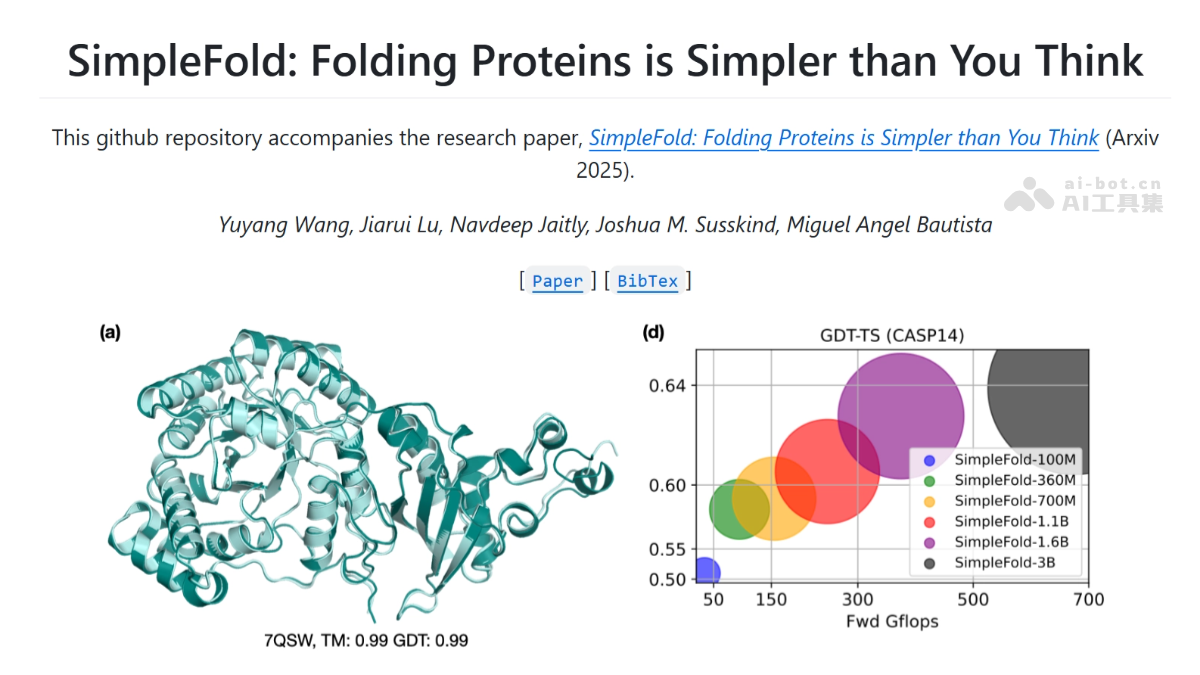
SimpleFold is a lightweight protein folding prediction AI model released by Apple. The model is based on Flow Matching technology, skips complex modules such as multiple sequence alignment (MSA), and directly generates the three-dimensional structure of proteins from random noise, greatly reducing computational cost. In authoritative benchmark tests such as CAMEO22 and CASP14, SimpleFold performs excellently. Without the need for expensive multiple sequence alignment and triangle attention mechanisms, it can achieve performance comparable to top models (such as AlphaFold2 and RoseTTAFold2), and small-scale versions (such as SimpleFold-100M) are also highly efficient and competitive.
SimpleFold's Main Features
-
Efficient prediction of protein three-dimensional structures: Rapidly generate the three-dimensional structure of proteins from amino acid sequences.
-
Reduce computational cost: Compared with traditional models (such as AlphaFold2), greatly reduce computational resource consumption.
-
Support scientific research and applications: Facilitate efficient research in fields such as drug development and new material exploration.
SimpleFold's Technical Principles
- Flow Matching Model (Flow Matching): The Flow Matching model is the core of SimpleFold. By learning a smooth path from random noise to target data, it directly generates the three-dimensional structure of proteins. Based on continuous-time stochastic differential equations (SDE), it can significantly reduce computational steps and resource consumption, and is more efficient than traditional diffusion models.
- Does not rely on complex modules: SimpleFold does not rely on complex modules commonly used in traditional protein folding models, such as multiple sequence alignment (MSA), pairwise interaction maps, and triangle updates. The simplified design reduces computational complexity, making the model more flexible and easier to extend.
- General-purpose architecture modules: Based on a general neural network architecture, it is not a complex architecture customized for protein folding tasks. This makes the model more flexible and able to adapt to different protein structure prediction tasks. At the same time, by increasing the model's parameter scale and the amount of training data, SimpleFold's performance can be further improved.
SimpleFold's Project Address
- GitHub repository:https://github.com/apple/ml-simplefold
- arXiv technical paper:https://arxiv.org/pdf/2509.18480v1
SimpleFold's Application Scenarios
-
Drug development: By rapidly and accurately predicting protein structures, accelerate the drug design and screening process and reduce research and development costs.
-
Disease research: Help scientists understand the role of proteins in diseases and provide a basis for developing treatment methods.
-
New material development: Predict the three-dimensional structure of proteins and provide support for innovation in biomaterials and nanotechnology.
-
Basic scientific research: Simplify the protein folding research process and help the academic community further explore the structure and function of biological molecules.
-
Biotechnology applications: In fields such as enzyme engineering and vaccine design, use SimpleFold to improve efficiency and precision.