
In today's flourishing development of artificial intelligence, machine learning is constantly breaking through the limitations of traditional data dependence. Zero-shot Learning and Few-shot Learning, as emerging frontier technologies, endow AI with a human-like ability to "infer broadly from one instance," enabling it to quickly learn new knowledge and adapt to new tasks in scenarios where data is scarce. These two learning approaches not only expand the application boundaries of AI, but also drive the transformation of artificial intelligence from data-driven to knowledge-driven, providing entirely new ideas and methods for solving complex problems in the real world.
Core Concepts
In the development of artificial intelligence (AI), how to enable machines to possess the ability to quickly learn and adapt to new environments like humans has always been a core goal pursued by researchers. Although traditional machine learning models, especially deep learning, have achieved performance surpassing humans on many tasks, this is built on the foundation of massive amounts of labeled data. This kind of "greedy" demand for data greatly limits the application of AI in scenarios where data is scarce or acquisition costs are high. To break this bottleneck, Zero-shot Learning (ZSL) and Few-shot Learning (FSL) emerged. They free AI models from dependence on large-scale labeled data, allowing them to quickly master new tasks and recognize new categories using only a very small number of samples or even zero samples. These two learning approaches endow AI with a human-like ability to "infer broadly from one instance," enabling it to respond more flexibly and efficiently to the complex and ever-changing real world.
Zero-shot Learning
- Definition
Zero-shot learning is a highly challenging task in the field of machine learning. It requires a model to still be able to recognize and classify without having seen any samples of the target category. For example, a child who has never seen a zebra, if told that "a zebra is an animal that looks like a horse and has black and white stripes," can accurately recognize a zebra the next time he sees one at the zoo. The core idea of zero-shot learning is precisely to imitate the human way of learning, by introducing additional auxiliary information (such as text descriptions, attribute labels, etc.), enabling the model to "understand" the concept of a new category and achieve recognition of new categories.
- Implementation Mechanism
Technically speaking, zero-shot learning is defined as a special case of transfer learning. In traditional supervised learning, the training set and test set of a model share the same category label space. In zero-shot learning, the category label spaces of the training set and test set are completely disjoint, that is, the model has never seen the categories that need to be recognized in the test phase during the training phase. To achieve this goal, zero-shot learning models use auxiliary information to establish connections between known categories and unknown categories. Auxiliary information exists in the form of semantic embeddings.
For example, through word vector models (such as Word2Vec), category names (such as "horse," "tiger," "panda") are mapped into a high-dimensional vector space, and the vectors can capture the semantic relationships between categories. When a new category (such as "zebra") needs to be recognized, the model uses the text description of "zebra" (such as "like a horse," "has stripes," "black and white") to generate a semantic embedding, matches it with image features, and completes classification.
Few-shot Learning
- Definition
If zero-shot learning is an expert who "figures things out without being taught," then few-shot learning is a smart student who "gets it with just a hint," enabling an AI model to quickly master a new task or recognize a new category using only a very small number (usually 1 to 5) of labeled samples. This way of learning is very similar to the human learning process. When humans learn new knowledge, they often do not need massive numbers of examples; through a few typical cases, they can grasp the core patterns and apply them to new situations.
For example, a child only needs to have seen a few photos of different breeds of dogs to accurately recognize a dog the next time they see one they have never seen before. The goal of few-shot learning is to give AI the ability to learn quickly and generalize.
- Implementation Mechanism
Few-shot learning is a branch of machine learning that focuses on solving the problem of model generalization in data-scarce scenarios. In the setting of few-shot learning, the model is required to classify or complete other tasks on new, unseen samples (i.e., the query set) with only a small number of labeled samples (i.e., the support set). For example, in a 5-way 1-shot classification task, the model needs to learn to distinguish 5 entirely new categories, with only 1 labeled sample per category. Using these 5 samples, the model learns the features that distinguish these 5 categories and correctly classifies the samples in the query set. The core challenge of this learning approach is how to extract effective information from a very small number of samples and avoid overfitting (i.e., the model merely memorizes these few samples without learning generalizable patterns).
The Core Difference Between Zero-shot Learning and Few-shot Learning
The most core difference between zero-shot learning and few-shot learning is whether examples need to be provided when the model recognizes new categories. Zero-shot learning requires no labeled samples of the new category at all and relies entirely on auxiliary information (such as text descriptions) for inference. Few-shot learning requires providing a very small number (usually 1 to 5) of labeled samples of the new category, and the model learns the features of the new category from the samples and generalizes.
| Feature | Zero-shot Learning | Few-shot Learning |
| Required Data | No labeled samples of the new category are needed | 1-5 labeled samples of the new category are needed |
| Learning Method | Inference through auxiliary information (such as text descriptions) | Learning patterns through a small number of examples |
| Prior Knowledge | Heavily relies on pre-learned semantic relationships and knowledge | Uses prior knowledge but adjusts according to examples |
| Adaptability | Can quickly generalize to entirely new, never-before-seen tasks | Quickly adapts to a specific new task, usually with higher accuracy |
| Example | Identify spam based on the definition of "emails containing suspicious links" | After seeing a few labeled conversations, learn to recognize new customer intents |
Comparison with Traditional Supervised Learning
Traditional supervised learning is the most common and most mature method in machine learning, achieving tremendous success on many tasks. Its dependence on data has also become its biggest bottleneck.
- Traditional Supervised Learning: Requires a large amount of labeled data
The core idea of traditional supervised learning is to learn a mapping function from input to output through a large amount of labeled training data. For example, in an image classification task, the model needs to see thousands of images labeled "cat" and thousands of images labeled "dog" to learn to distinguish between cats and dogs. The process requires a large amount of time and manpower for data annotation, and the cost is very high. For some rare categories (such as a certain rare disease), it is simply impossible to obtain a sufficient number of labeled samples.
- Zero-Shot and Few-Shot Learning: Reducing Dependence on Data Volume
The emergence of zero-shot learning and few-shot learning has solved the problem of traditional supervised learning's excessive dependence on data volume. By introducing mechanisms such as prior knowledge, auxiliary information, or meta-learning, the demand for labeled data is greatly reduced.
| Learning Method | Amount of Labeled Data Required | Core Idea | Advantages | Disadvantages |
| Traditional Supervised Learning | Large (thousands to millions) | Learn a mapping function from data | High accuracy, mature technology | High cost of data annotation, difficult to handle rare categories |
| Few-Shot Learning | Very few (1-5) | Learn how to learn, quickly adapt to new tasks | Small data requirement, strong adaptability | Prone to overfitting, high requirements for model generalization ability |
| Zero-Shot Learning | Zero | Use auxiliary information for reasoning | No labeled data required, highest flexibility | Relatively lower accuracy, depends on the quality of auxiliary information |
Implementation Methods
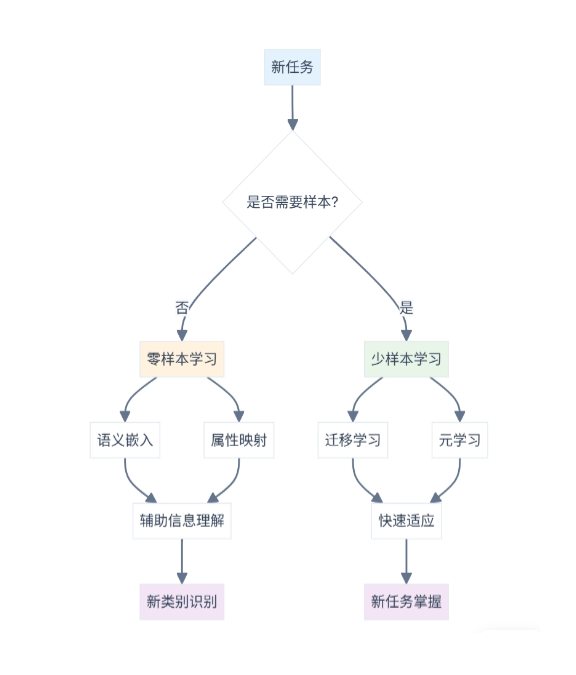
Although zero-shot learning and few-shot learning have similar goals, their implementation methods are quite different.
Zero-shot learning is more like a theoretician, mastering new knowledge through "reading" and "understanding";
Few-shot learning is more like a practitioner, quickly getting started through "observation" and "imitation."
Implementation of Zero-Shot Learning
The core of zero-shot learning lies in how to enable a model to understand the "concept" of a new category without having seen any samples of it. To achieve this goal, researchers have proposed a variety of methods, among which the most important are semantic embedding and attribute mapping.
- Semantic Embedding: Converting category descriptions into a language AI can understand
Semantic Embedding is one of the most commonly used techniques in zero-shot learning. The basic idea is to map category names or text descriptions into a high-dimensional vector space, which is called the "semantic space." In this space, categories that are semantically similar have corresponding vectors that are closer in distance. For example, the vector distance between "cat" and "dog" will be closer than the vector distance between "cat" and "car." In this way, the model "understands" the semantic relationships between categories in a mathematical way.
There are many methods for implementing semantic embedding, and the most commonly used is to utilize pre-trained language models, such as BERT or the GPT series of models. The models are trained on massive amounts of text data to generate word vectors rich in semantic information. For example, input the text description of "zebra," "an animal that looks like a horse and has black and white stripes on its body," into the BERT model to obtain a vector representing the concept of "zebra." The model matches this vector with image features to achieve zebra recognition.
- Attribute mapping:Infer unknown categories through known attributes
Attribute Mapping is another important method for achieving zero-shot learning. The core idea is to describe each category with a set of attributes. Attributes are shared across categories; for example, for an animal classification task, we define attributes such as "has stripes," "has wings," and "can swim." Each category is represented by an attribute vector; for example, the attribute vector for "tiger" might be [has stripes=yes, has wings=no, can swim=no].
During the training phase, the model learns how to predict these attributes from image features. During the testing phase, when encountering a new category (such as "zebra"), only the attribute description needs to be provided (such as "has stripes=yes, has wings=no, can swim=no"), and the model matches it with known categories based on the attributes to identify "zebra." The advantage of this method is that it decomposes the complex problem of category recognition into the simpler problem of attribute recognition, improving the model's generalization ability.
Implementation of Few-Shot Learning
Unlike zero-shot learning, the implementation of few-shot learning focuses more on how to enable a model to quickly learn and generalize from very few samples. To achieve this goal, researchers mainly adopt two strategies: transfer learning and meta-learning.
- Transfer Learning
Transfer Learning is the foundation of few-shot learning. Its core idea is to transfer a model pretrained on a large-scale dataset (such as ImageNet), usually a deep neural network, to a new task. A pretrained model is like a "giant" that has already learned rich, general feature extraction capabilities, for example, being able to recognize basic features in images such as edges, textures, and colors. When facing a new task with very little data, there is no need to train a model from scratch; it is only necessary to fine-tune it based on the pretrained model.
- Meta-Learning
Meta-learning, known as "learning to learn," is the core of few-shot learning. Its goal is to enable a model to learn a general learning strategy that can quickly adapt to various different new tasks. The training process of meta-learning is carried out on a large number of different "tasks." Each task is an independent few-shot learning problem, for example, a 5-way 1-shot classification task. The model is trained on these tasks, learning how to quickly extract effective information from a support set and apply it to a query set.
- Support Set and Query Set
In few-shot learning, data is organized into the form of a support set and a query set. The support set is the small number of labeled samples provided to the model, and the model needs to grasp the patterns of the new categories by learning from the samples. The query set consists of unlabeled samples that the model needs to predict. For example, in a 5-way 1-shot task, the support set contains 5 categories, each with 1 sample, for a total of 5 samples. The query set contains multiple samples belonging to these 5 categories, and the model needs to classify them correctly.
Core Principles
Zero-shot learning and few-shot learning can give AI the ability to "draw inferences from one instance," and behind this lies profound principles. The core of the principles is to enable the model to make better use of existing knowledge and understand and adapt to new, unknown situations.
Principles of Zero-Shot Learning
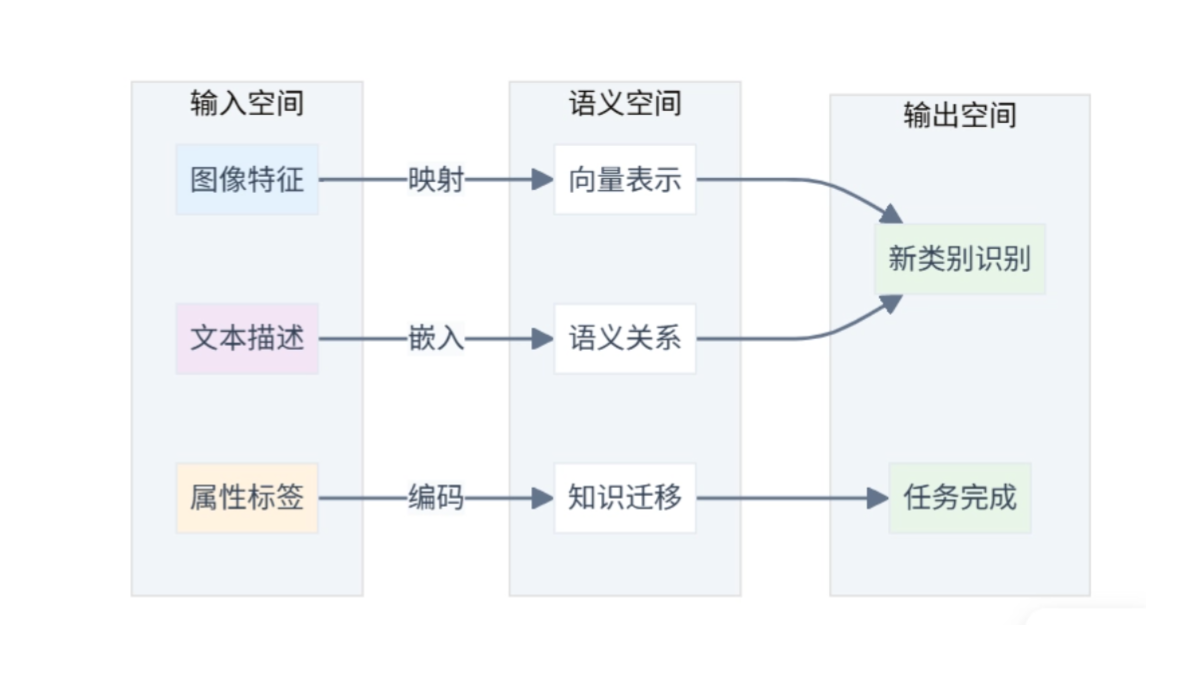
The principle of zero-shot learning can be summarized as the combination of "knowledge transfer" and "semantic space." By mapping information from different modalities (such as images and text) into a shared semantic space, connections are established between known classes and unknown classes.
- Knowledge Transfer: Applying knowledge of known classes to unknown classes
Knowledge Transfer is one of the core principles of zero-shot learning. The basic idea is to transfer the knowledge learned on known classes to unknown classes. The "knowledge" here can be the model's feature extraction capability, or the semantic relationships between classes. For example, when recognizing known classes such as "horse," "tiger," and "panda," the model learns how to extract features such as the shape, color, and texture of animals. When it needs to recognize the unknown class "zebra," the model uses its existing feature extraction capability to analyze the image of the zebra and match it with the text description of "zebra."
- Semantic Space: Establishing connections between known and unknown in the semantic space
Semantic Space is the key to achieving knowledge transfer in zero-shot learning. It is a high-dimensional vector space in which information from different modalities (such as image features and text descriptions) is mapped into the same space. In this way, the model directly compares and matches images and text in the same space. The model establishes connections between known classes (through text descriptions) and unknown classes (through image features), enabling recognition of unknown classes.
The Principle of Few-Shot Learning
The principle of few-shot learning can be summarized as "fast adaptation" and "similarity metric." By enabling the model to learn the ability to quickly adapt to new tasks, as well as an effective similarity measurement method, it learns from an extremely small number of samples.
- Fast Adaptation: Quickly adjusting the model through a small number of samples
Fast Adaptation is the core goal of few-shot learning. In each task, the model needs to quickly learn from a small number of samples to complete classification or other tasks. In this way, the model learns general learning strategies that enable it to quickly adapt to various different new tasks. The ability to "learn how to learn" is the key to the fast adaptation of few-shot learning.
- Similarity Metric: Learning the similarity between samples
Similarity Metric is the key to achieving classification in few-shot learning. In few-shot learning, the model learns a method for measuring the similarity between samples. For example, Prototypical Networks are a typical few-shot learning method based on similarity measurement. Its basic idea is to compute a "prototype" for each class, which is the center point of all support set samples of that class in the feature space. For each sample in the query set, the model calculates the distance to the prototype of each class and classifies it into the class to which the nearest prototype belongs.
Application Domains
The emergence of zero-shot learning and few-shot learning has greatly expanded the application boundaries of artificial intelligence. It enables AI to enter domains that traditional methods cannot reach, providing new ideas and methods for solving various difficult problems in the real world. From computer vision to natural language processing, and further to professional fields such as healthcare and finance, zero-shot and few-shot learning have demonstrated enormous application potential.
Computer Vision
- Image Classification: Recognizing rare objects
Image classification is one of the most fundamental tasks in computer vision. In traditional image classification tasks, the model needs to identify which predefined category the object in the image belongs to. In the real world, the categories of objects are infinite, and we cannot collect large amounts of annotated data for all categories. Zero-shot learning and few-shot learning provide effective ways to solve this problem. For example, in the field of wildlife conservation, researchers use zero-shot learning to automatically identify elephants from a large number of camera trap photos by inputting a textual description such as "a huge gray animal with a long trunk," even if there are no images of elephants in the training set.
Similarly, in few-shot learning, only a few photos of a newly discovered species need to be provided, and the model can learn to recognize that species, which is of great significance for biodiversity research and conservation.
- Object Detection:Detecting newly appearing objects
Object detection is a more complex task than image classification. It not only needs to identify objects in an image, but also needs to determine their locations (usually represented by bounding boxes). Zero-shot and few-shot learning techniques are also widely used in object detection tasks to address the challenge of detecting objects of new categories. For example, in the field of autonomous driving, vehicles may encounter obstacles that have never appeared in the training data, such as fallen cargo, animals crossing the road, and so on. With zero-shot learning, the system detects newly appearing obstacles on the road that are not included in the training set through a description such as "a square, metallic object."
Similarly, few-shot learning helps the system quickly learn to recognize new types of vehicles or traffic signs, improving the safety and robustness of autonomous driving systems.
- Image Generation:Generating new images
Zero-shot and few-shot learning also show great potential in the field of image generation. For example, through zero-shot learning, a model generates a completely new image that has never been seen before based on a text description (such as "a cat wearing an astronaut helmet walking on the moon"). This technology is called Text-to-Image Generation and has broad application prospects in fields such as artistic creation, game design, and advertising.
Few-shot learning can be used in tasks such as style transfer. For example, by providing only a few works by a certain painter, the model can learn that painter's painting style and apply it to other images to generate new works with that style.
Natural Language Processing
- Text Classification:Classifying new topics
In text classification tasks, zero-shot and few-shot learning help models quickly adapt to new topics or domains. For example, in news classification, when an entirely new news category appears (such as "metaverse"), a zero-shot learning model identifies related news articles through a description of that category (such as "news about virtual reality, blockchain, and digital assets") without retraining the model.
Similarly, in sentiment analysis, few-shot learning helps a model quickly adapt to reviews of new products or services. By providing only a small number of labeled review samples, the model can learn to determine users' sentiment tendencies toward new products.
- Question Answering Systems:Answering questions never seen before
Question answering systems are an important application in the field of NLP. Zero-shot and few-shot learning help question answering systems answer questions they have never seen before. For example, through zero-shot learning, the model generates an answer based on a description of a question (such as "Who was the first president of the United States?"), even if that question has not appeared in the training data.
Few-shot learning can help models quickly adapt to new question-answering domains. For example, in medical question answering, only a small number of question-answer pairs about a certain disease need to be provided, and the model can learn to answer common questions about that disease.
- Machine translation:Translate new languages
Machine translation is one of the most challenging tasks in the field of NLP. Zero-shot and few-shot learning play an important role in machine translation. For example, zero-shot machine translation can achieve translation between two languages that have never appeared in a parallel corpus. By using translation data between these two languages and other languages, as well as the semantic similarity between languages, the model can achieve zero-shot translation. This is of great significance for protecting endangered languages and promoting cross-cultural communication.
Other domains
- Medical diagnosis:Assist in diagnosing rare diseases
In the medical field, case data for rare diseases is very scarce, and traditional supervised learning methods are difficult to use to train effective diagnostic models. Zero-shot and few-shot learning provide new ideas for solving this problem. For example, through zero-shot learning, the model identifies relevant medical images based on a description of a certain rare disease (such as "a genetic disease mainly manifested as white patches on the skin, whitening of the hair, and vision problems").
Few-shot learning uses a small number of cases of rare diseases to help the model learn the characteristics of the disease and assist doctors in diagnosis.
- Financial risk control:Identify new fraud patterns
In the financial field, fraud methods are constantly being renewed, and traditional risk control models are difficult to cope with new fraud patterns. Zero-shot and few-shot learning can help financial institutions quickly identify new types of fraudulent behavior. For example, through zero-shot learning, the model identifies relevant transaction records based on a description of a new fraud pattern (such as "using false identity information to apply for a loan").
Few-shot learning uses a small number of known fraud cases to help the model learn the characteristics of new fraud and improve the accuracy and timeliness of the risk control system.
- Autonomous driving:Cope with new traffic scenarios
Autonomous driving is an important application area of AI technology. In complex traffic environments, vehicles encounter various scenarios they have never seen before, such as new traffic signs, new road conditions, etc. Zero-shot and few-shot learning can help autonomous driving systems quickly adapt to new scenarios. For example, through zero-shot learning, the system identifies a new traffic sign based on a description of it (such as "a blue, circular sign with a white arrow in the middle").
Few-shot learning uses a small amount of data from new scenarios to help the system learn how to cope with these scenarios and improve the safety and reliability of autonomous driving.
Value and advantages
The emergence of zero-shot learning and few-shot learning has brought revolutionary changes to the development of artificial intelligence. It not only solves the dilemma of traditional machine learning methods in scenarios with scarce data, but more importantly, it endows AI with learning and cognitive abilities closer to those of humans, bringing huge value and advantages.
Reduce data dependence
- Reduce data annotation costs
Data annotation is time-consuming, labor-intensive, and costly. In many fields, such as healthcare, finance, and law, data annotation requires the participation of domain experts, making the cost even higher. Zero-shot learning reduces the cost of data annotation to zero by completely eliminating dependence on samples of new categories. Few-shot learning reduces the number of required samples from tens of thousands to single digits, greatly lowering the cost of data annotation. This enables AI technology to be applied to more scenarios with limited resources and promotes the democratization of AI technology.
- Solving the data scarcity problem
In many real-world scenarios, obtaining large-scale annotated data is almost impossible. For example, in the healthcare field, case data for rare diseases is very scarce; in industrial manufacturing, defect samples for new products are almost nonexistent in the early stages. Zero-shot and few-shot learning provide effective solutions to these problems.
Improving learning efficiency
- Accelerating model deployment
Traditional supervised learning models need to go through a lengthy process of data collection, annotation, model training, and tuning when deployed to new tasks. Zero-shot and few-shot learning models can skip or simplify these steps. Zero-shot learning models directly use descriptions of new categories for inference without any training process. Few-shot learning models quickly adapt to new tasks through a small number of samples, greatly shortening the time required for model deployment. This rapid deployment capability enables AI systems to respond more flexibly to dynamically changing environments.
- Quickly adapting to new tasks
Tasks in the real world are constantly changing, and AI systems need the ability to quickly adapt to new tasks. Zero-shot and few-shot learning are designed precisely to meet this need. They enable AI models to quickly master new skills like humans, through very few examples or even just descriptions. This ability to adapt quickly is crucial for AI systems that need continuous learning and evolution, for example, in areas such as personalized recommendations, intelligent customer service, and online education.
Challenges and limitations
Accuracy issues
- The accuracy of zero-shot learning needs improvement
Zero-shot learning models rely entirely on auxiliary information for inference, and their accuracy depends to a large extent on the quality of the auxiliary information and the model's semantic understanding ability. In the real world, auxiliary information is often vague, incomplete, or even biased. When the model matches visual features with semantic features, deviations are likely to occur. The accuracy of zero-shot learning models is lower than that of traditional supervised learning models, especially in complex visual tasks. How to improve the accuracy of zero-shot learning so that it can match or even surpass supervised learning is an urgent problem to be solved.
- Few-shot learning is prone to overfitting
One of the core challenges of few-shot learning is how to avoid overfitting. Because the model is exposed to only a very small number of samples, it can easily "memorize" the specific features of these samples without learning patterns with generalization ability. When encountering new samples that differ slightly from the training samples, the model may make incorrect judgments. This phenomenon is called overfitting. Although techniques such as meta-learning have alleviated the overfitting problem to some extent, it is still a major bottleneck limiting the performance of few-shot learning.
Data quality issues
- A small number of samples may carry bias
In few-shot learning, due to the extremely small number of samples, the samples may not represent the true distribution of the entire category. For example, when recognizing the category "dog," if the few provided images are all of white, fluffy dogs, the model may think that all dogs should be white and fluffy, and misclassify dogs of other colors. Sample bias can severely affect the model's generalization ability.
- Data noise has a large impact on model performance
In zero-shot learning, auxiliary information is obtained through manual annotation or automatically from the internet, and it contains a large amount of noise and errors. For example, the description of a category may be inaccurate, or may contain information unrelated to that category. Data noise can mislead the model, causing it to learn incorrect knowledge and reducing the model's performance.
Generalization ability issues
- The model's generalization ability on unseen categories is limited
The goal of zero-shot and few-shot learning is to enable models to generalize to categories they have never seen before. In practical applications, the generalization ability of models is often limited. For example, zero-shot learning models can only generalize to unseen categories that are semantically similar to known categories; for unseen categories that differ greatly from known categories, model performance drops sharply. Few-shot learning models can also only generalize to samples similar to the training samples; for samples with large differences, model performance is affected.
- Cross-domain transfer ability needs improvement
At present, most zero-shot and few-shot learning models are researched and evaluated in specific domains (such as image classification). In the real world, AI systems need to have cross-domain transfer ability. For example, a zero-shot learning model that performs well in the image domain cannot be directly applied to the natural language processing domain. How to improve a model's cross-domain transfer ability so that knowledge learned in one domain can be applied to other domains is a challenging research direction.
Future outlook
With the continuous advancement of large models and multimodal technologies, AI will be able to better understand and process complex information and achieve more powerful zero-shot and few-shot learning capabilities. Applications in open-world scenarios will drive AI's continuous learning and adaptability, enabling it to better meet the challenges of the real world. The application of emerging technologies such as diffusion models and prompt engineering will bring more innovation and breakthroughs to zero-shot and few-shot learning. It can be foreseen that future AI will be more intelligent, efficient, and universal, better able to serve human society and provide powerful support for solving various complex problems.