
What is SGLang
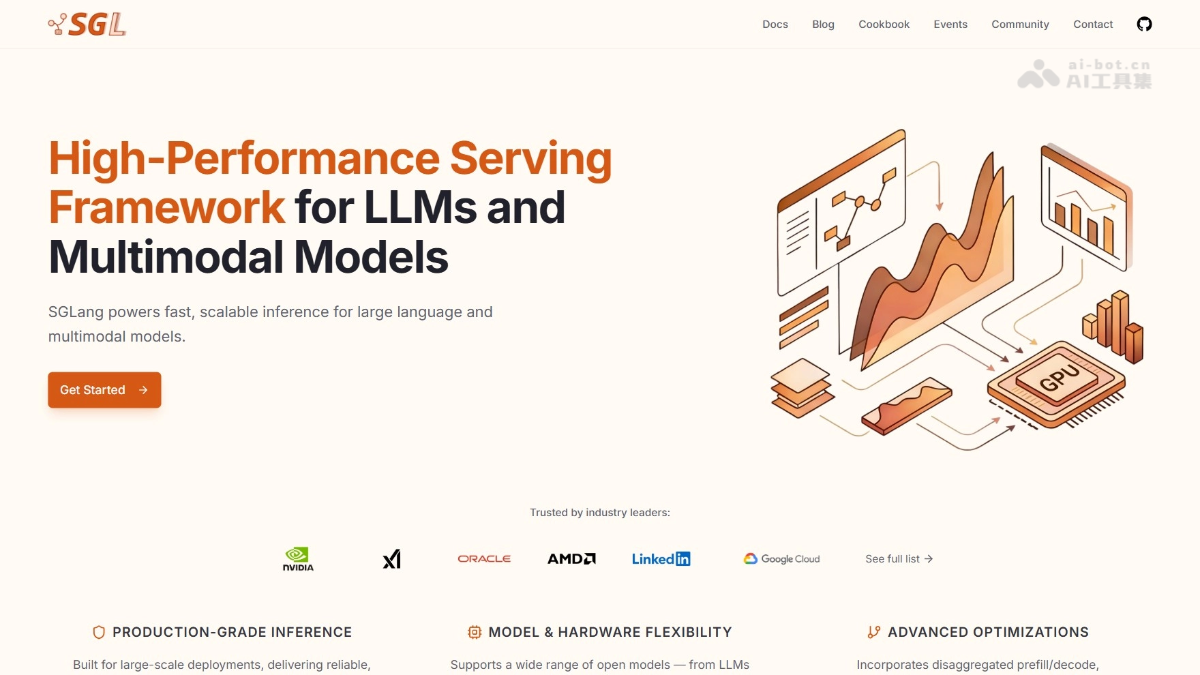
SGLang is an open-source high-performance inference framework for large language models and multimodal models. The framework provides low-latency, high-throughput inference services and supports deployment from a single GPU to large-scale distributed clusters. SGLang supports a variety of models (such as Llama, Qwen, DeepSeek, etc.) and hardware (including NVIDIA, AMD GPUs, CPU, TPU, etc.). SGLang has active community support, continuously promotes technological innovation and the establishment of industry standards, and helps language models achieve efficient implementation in practical applications.
Main features of SGLang
-
Efficient inference performance: SGLang provides low-latency, high-throughput inference services, supports deployment from a single GPU to large-scale distributed clusters, and uses multiple optimization techniques to improve efficiency.
-
Broad model support: Compatible with a variety of large language models and multimodal models, such as Llama, Qwen, DeepSeek, etc., supports Hugging Face models and the OpenAI API, and makes it easy to extend to new models.
-
Multi-hardware platform compatibility: Supports multiple hardware types such as NVIDIA, AMD, Intel, and Google TPU, ensuring efficient operation on different platforms and providing flexible deployment options.
-
Advanced optimization techniques: The framework uses optimization strategies such as prefix caching, decode disaggregation, speculative decoding, and paged attention, and supports quantization techniques to further improve inference performance.
How to use SGLang
-
Install SGLang: Install via pip (
pip install --upgrade pip; pip install uv; uv pip install "sglang") or use Docker (docker pull sglang/sglang:latest; docker run -it sglang/sglang:latest), and make sure CUDA is configured before installation (if GPU acceleration is needed). -
Start the service: Run
sglang serve --model-path /path/to/your/modelto start the service, specify the model path, and the service listens on port 8000 by default. -
Query the API: Use
curlor Python'srequestslibrary to send requests tohttp://localhost:8000/v1/chat/completions, and interact with the model in the standard OpenAI-compatible format. -
Reference documentation: Visit the official SGLang documentation to get detailed configuration, model support, hardware optimization, and deployment guides.
SGLang project address
- Project official website:https://www.sglang.io/
- GitHub repository:https://github.com/sgl-project/sglang
Application scenarios of SGLang
-
Large-scale language model inference: SGLang is suitable for scenarios that require efficient processing of large amounts of text data, such as intelligent customer service, chatbots, content generation, etc., and can quickly respond to user requests and generate high-quality text content.
-
Multimodal model deployment: The framework can be used in fields such as creative design, advertising production, and virtual reality to achieve rapid generation from text to images or videos.
-
Enterprise-level applications: In enterprise environments, it is used for tasks such as data analysis, report generation, and intelligent recommendations, helping to improve work efficiency and decision quality.
-
Academic research and development: Provides researchers with an efficient model inference platform, supports a variety of models and hardware, and facilitates large-scale experiments and research work.
-
Cloud computing and edge computing: Can be deployed in the cloud or on edge devices, supports flexible deployment from a single GPU to large-scale distributed clusters, and meets different computing needs.