
What is SepLLM
SepLLM is an efficient framework for accelerating large language models (LLMs) jointly proposed by the University of Hong Kong, Huawei Noah's Ark Lab, and other institutions. By compressing paragraph information and eliminating redundant tokens, it significantly improves the model's inference speed and computational efficiency. The core of SepLLM is to leverage the contribution of separators (such as punctuation marks) to the attention mechanism, compressing paragraph information into these tokens to reduce computational burden. SepLLM performs excellently when processing long sequences (such as 4 million tokens), maintaining low perplexity and high efficiency. It supports multi-node distributed training and integrates various acceleration operations (such as fused rope and fused layer norm).
Main Features of SepLLM
- Long Text Processing Capability: SepLLM can efficiently process long sequences exceeding 4 million tokens, making it suitable for tasks that require maintaining contextual coherence, such as document summarization and long conversations.
- Improved Inference and Memory Efficiency: In the GSM8K-CoT benchmark, SepLLM reduces KV cache usage by more than 50%, while reducing computational cost by 28%, shortening training time by 26%, and significantly improving inference speed.
- Flexible Deployment Across Multiple Scenarios: SepLLM supports various deployment scenarios such as training from scratch, fine-tuning, and streaming applications, and can seamlessly integrate with pre-trained models.
- Support for Multi-Node Distributed Training: SepLLM's codebase supports efficient multi-node distributed training and integrates various operations for accelerating training (such as fused rope, fused layer norm, etc.).
Technical Principles of SepLLM
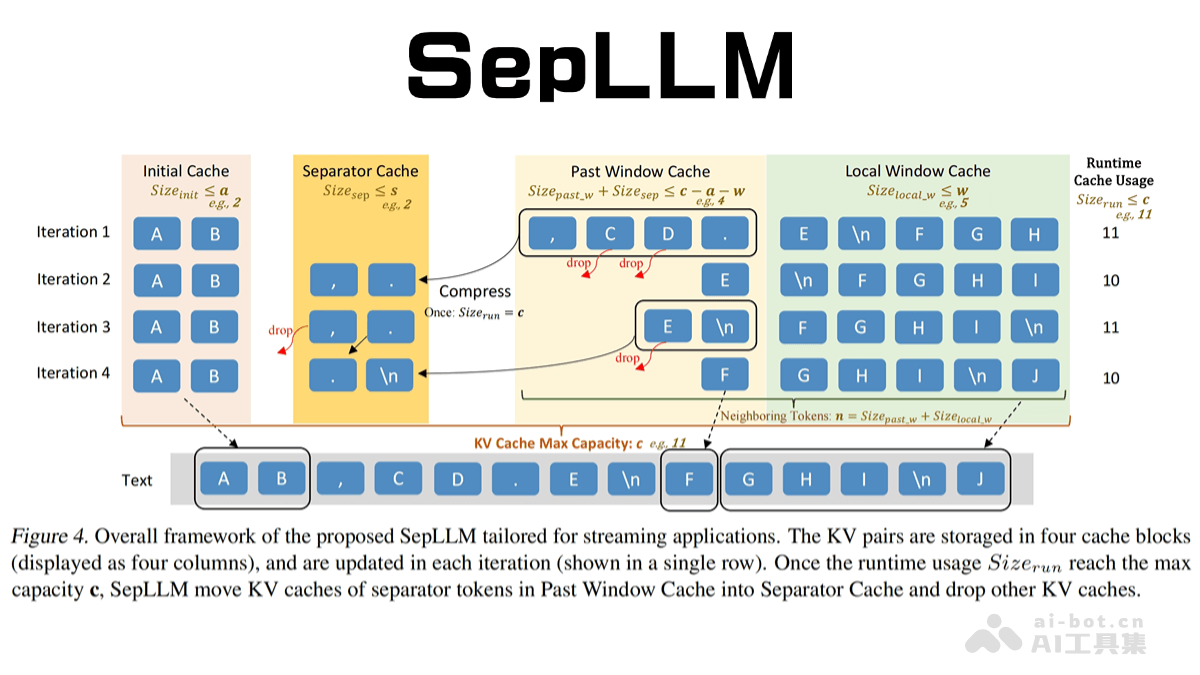
- Sparse Attention Mechanism: SepLLM mainly focuses on three types of tokens: in the self-attention layer, SepLLM uses a mask matrix to limit the scope of attention computation, computing only the attention among the above three types of tokens, thereby achieving sparsification.
- Initial Tokens: The several tokens at the beginning of the sequence, serving as anchors for attention.
- Neighboring Tokens: Tokens near the current token, used to maintain local semantic coherence.
- Separator Tokens: Such as commas, periods, etc., used to compress and store paragraph information.
- Dynamic KV Cache Management: SepLLM designs dedicated cache blocks, including initial cache, separator cache, historical window cache, and local window cache. Through periodic compression and update strategies, SepLLM can efficiently process long sequences while reducing KV cache usage.
SepLLM Project Address
- Project Website:https://sepllm.github.io/
- Github Repository:https://github.com/HKUDS/SepLLM
- arXiv Technical Paper:https://arxiv.org/pdf/2412.12094
Application Scenarios of SepLLM
- Streaming Applications: Used in streaming scenarios such as multi-turn conversations and real-time text generation, supporting unlimited input length and maintaining efficient language modeling capability.
- Inference and Memory Optimization: By reducing KV cache and computational cost, it is suitable for resource-constrained environments (such as edge computing and mobile devices), lowering deployment costs.
- Industrial Applications: In large-scale commercial applications, it reduces deployment costs, improves service efficiency, and supports high-concurrency requests.
- Research and Innovation: It provides new ideas for attention mechanism optimization and supports research directions such as multilingual optimization, domain-specific optimization, and hardware adaptation.