
What is SensorFM
SensorFM is a large sensor foundation model for wearable health data launched by Google Research. It is pretrained on over 1 trillion minutes of unlabeled multimodal sensor data from 5 million participants to learn general physiological representations, can be transferred to 35 health prediction tasks including cardiovascular, metabolic, sleep, and mental health, supports data imputation and label-efficient adaptation, and serves as a grounding tool for personal health agents.
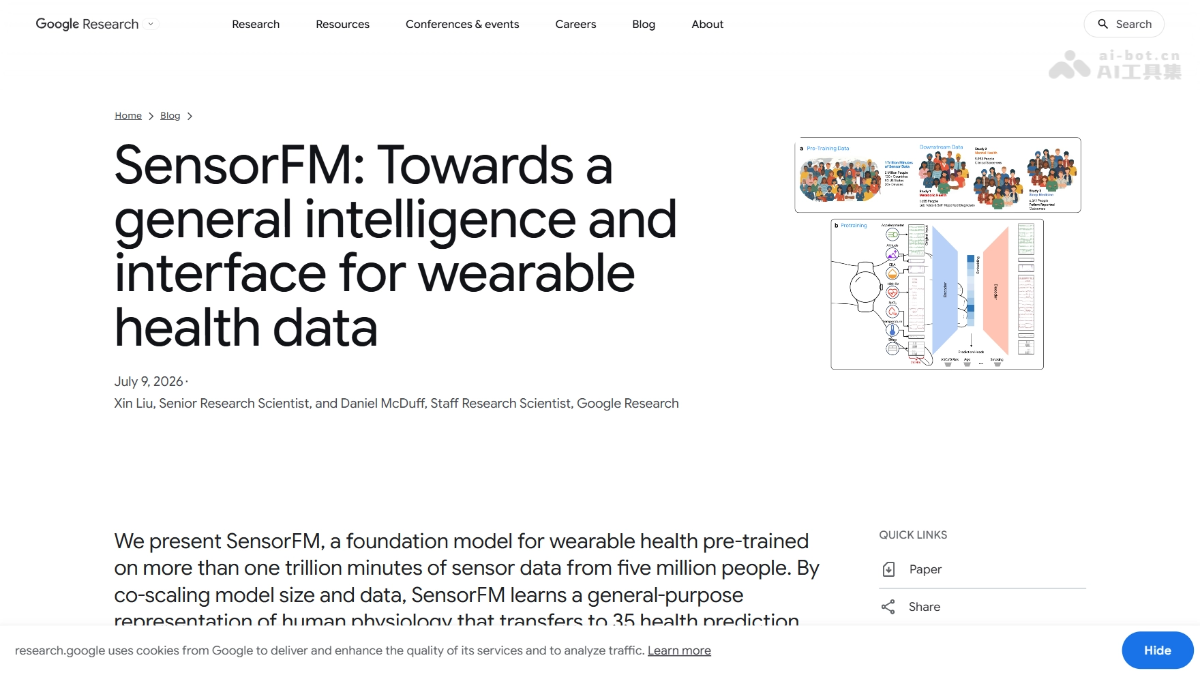
SensorFM's main features
- General physiological representation learning: From five sensor modalities—PPG, accelerometer, EDA, skin temperature, and altimeter—it extracts 34 one-minute-level aggregated features to learn general physiological representations across individuals and devices.
- Multi-domain health prediction: Covers 35 downstream discriminative tasks across six major categories: cardiovascular, metabolic, sleep, mental health, lifestyle, and demographics.
- Missing data imputation: Uses generative pretraining capabilities to perform temporal interpolation and extrapolation on missing segments in sensor data; for example, when 60 minutes of data are missing, it can still maintain 99.7% accuracy for daily step count prediction.
- Label-efficient adaptation: It can quickly adapt to new tasks with only a small number of labeled samples, surpassing fully supervised baselines in data-scarce scenarios.
- Agentic prediction head design: Deploys multiple LLM Agents for collaborative competition, automatically searches for and generates optimal downstream prediction head code, and explores over 30,000 candidate solutions.
- Personal health agent integration: Embeds downstream predictors as tools into personal health agents to improve the contextual awareness, personalization, and safety of LLM health responses.
SensorFM's technical principles
- Self-supervised reconstruction pretraining: SensorFM adopts an LSM-2-based masked autoencoder framework. By minimizing the reconstruction mean squared error of masked regions, it learns the intrinsic structure of physiological signals from trillions of minutes of unlabeled data without relying on expensive health annotations.
- Adaptive and Inherited Masking(AIM): It treats real device missingness and artificial masking as equivalent and learns directly from incomplete records, giving the model innate missingness awareness and avoiding bias from traditional imputation or waste from discarding data.
- Joint scaling of data and model: It systematically validates scaling laws from 100K to 100M parameters and from 2 million to 2 billion sensor hours, finding that when both scale in sync, pretraining loss and downstream performance improve nearly linearly without saturation, and the largest model, SensorFM-B, achieves the best results on 33/35 tasks.
- Linear probing evaluation: It freezes the SensorFM encoder and trains only a lightweight linear head on top to directly probe embedding quality. Results show that it surpasses fully supervised baselines with handcrafted feature engineering on 34/35 tasks, and as model size increases, reliance on demographic features gradually decreases, indicating that large models have implicitly learned physiologically relevant traits.
- LLM Agent automatic optimization: It builds a "classroom"-style multi-agent system in which multiple LLM Agents iteratively generate, test, and optimize prediction head code. The final solutions surpass simple linear probing on 16/20 classification tasks and 12/15 regression tasks, and the stronger the Agent, the better the solutions found.
How to use SensorFM
SensorFM is currently in the technical preview stage and can serve as an academic research reference; it cannot yet be directly experienced or deployed.
SensorFM's core advantages
-
Leading scale: Pretrained on data from 5 million people and 1 trillion minutes, it is currently the largest and most diverse wearable dataset.
-
Strong generality: A single representation simultaneously covers 35 tasks across six major health domains, without the need to build a separate pipeline for each endpoint.
-
Missingness awareness: The AIM mechanism turns missing data into a learning signal rather than noise or a burden.
-
Label efficiency: A small amount of annotation can surpass fully supervised baselines, addressing the pain point of scarce annotation in the medical field.
-
Automated adaptation: The LLM Agent automatically designs prediction heads, lowering the barrier to downstream task development.
-
Clinical validation: Validated through ratings by 1,860 clinicians, responses after integration into a personal health agent showed significant improvements in relevance and safety.
SensorFM project address
- Project website:https://research.google/blog/sensorfm-towards-a-general-intelligence-and-interface-for-wearable-health-data/
- arXiv technical paper:https://arxiv.org/pdf/2605.22759
SensorFM application scenarios
-
Cardiovascular health monitoring: Based on PPG and heart rate variability features, it continuously assesses cardiovascular risks such as arrhythmias and blood pressure trends, enabling early warning.
-
Metabolic risk screening: Through combinations of signals such as sleep, activity level, and skin temperature, it infers metabolic-related risk indicators such as diabetes and obesity.
-
Sleep disorder analysis: Using multimodal sensor fusion, it accurately identifies sleep stages and breathing interruption patterns, assisting in screening for disorders such as sleep apnea.
-
Mental health tracking: It extracts weak signals of mental states such as depression and anxiety from heart rate variability, electrodermal activity, and activity patterns, supporting long-term mood monitoring.