
What Is Seer
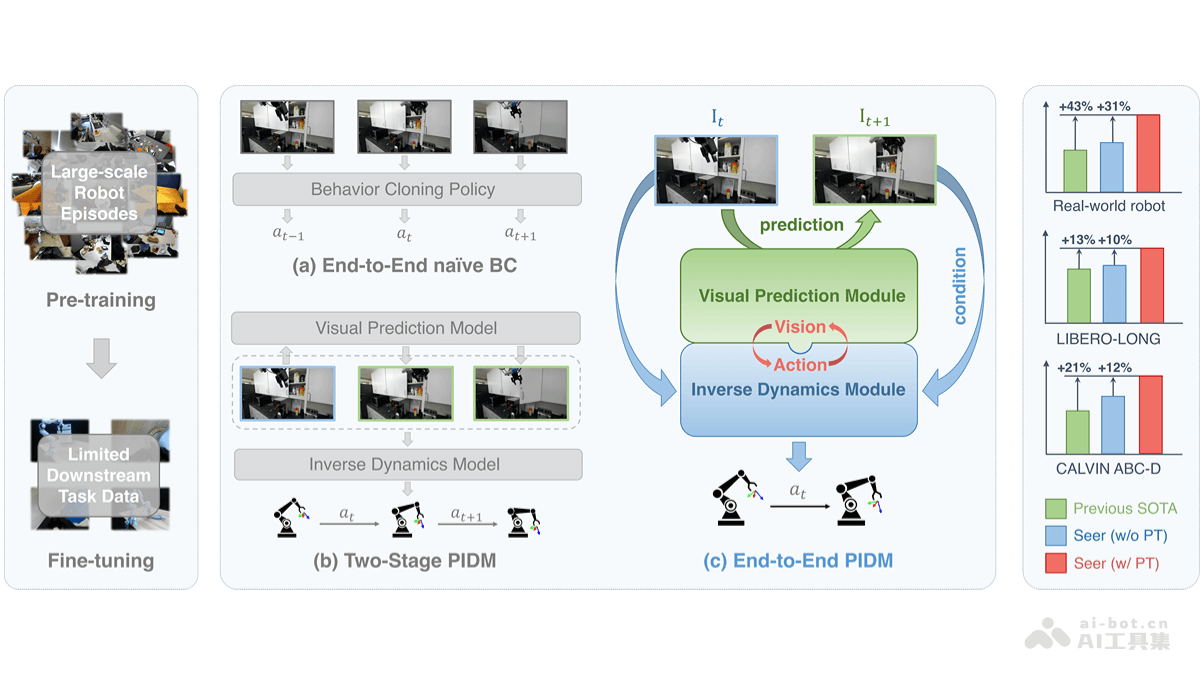
Seer is an end-to-end manipulation model jointly launched by institutions including Shanghai AI Laboratory, the School of Computer Science at Peking University, and the School of Software and Microelectronics at Peking University. It achieves a high degree of coordination between robotic visual prediction and action execution. The model combines historical information and goal signals (such as language instructions) to predict future states and uses an inverse dynamics model to generate action signals. Seer is based on a Transformer architecture, processes multimodal input data, and effectively fuses visual, language, and robot proprioceptive signals. In real robot tasks, Seer's manipulation success rate improves by 43% over the current state of the art, and it demonstrates excellent generalization ability in a variety of complex scenarios. On the CALVIN ABC-D Benchmark, a control algorithm testing benchmark, Seer achieves an average task completion length of 4.28, leading comparable models overall.
Seer's Main Features
- Action Prediction: Based on the current visual state and goal, predict suitable robot actions. Estimate the intermediate action sequence required to achieve the goal using an inverse dynamics model.
- Visual Prediction: Seer has conditional visual prediction capability and can predict RGB images within a certain number of future time steps. This enables the robot to "foresee" future visual states and better plan and adjust actions.
- Multimodal Fusion: Fuse information from multiple modalities such as vision, language, and robot state to understand and execute complex tasks. Based on a multimodal encoder, integrate features from different modalities to provide comprehensive contextual information for action prediction and visual prediction.
- Generalization Ability: After pretraining on large-scale robot datasets, Seer demonstrates strong generalization ability, maintaining stable performance in unseen scenarios, with new objects, under different lighting conditions, and in the face of high-intensity interference.
- Data Efficiency: Seer learns rich prior knowledge from large amounts of data during the pretraining stage, so in downstream tasks it requires only a small amount of fine-tuning data to achieve good performance, reducing the cost of data collection and annotation.
Seer's Technical Principles
- End-to-End Architecture: Based on an end-to-end architecture design, tightly integrates visual prediction and inverse dynamics prediction. During training, the visual prediction module and the inverse dynamics module are optimized collaboratively, enabling the model to make full use of visual and action information and achieve more accurate action prediction.
- Transformer Architecture: Based on the Transformer architecture, processes visual states and action information. Transformer can capture complex dependencies in visual and action sequences, providing the model with powerful feature extraction and representation capabilities.
- Foresight Token and Action Token: Seer introduces the foresight token and the action token. The foresight token predicts future RGB images, and the action token estimates the intermediate actions between the current observation and the predicted future observation. The two tokens are fused with the input RGB images, robot state, and language tokens via the multimodal encoder, using a unidirectional attention mask to achieve deep information integration.
- Unidirectional Attention Mask: Seer designs a special unidirectional attention mask that enables the action token to fully integrate past and future prediction information. This helps the model achieve deeper information fusion across multiple network layers and improves the accuracy and robustness of action prediction.
- Large-Scale Pretraining and Fine-Tuning: Seer is first pre-trained on large-scale robot datasets (such as DROID), learning rich visual and action priors. In downstream tasks, the model is fine-tuned based on a small amount of fine-tuning data to adapt to specific task scenarios and objectives.
Seer's project address
- Project official website:https://nimolty.github.io/Seer
- GitHub repository:https://github.com/OpenRobotLab/Seer
- arXiv technical paper:https://arxiv.org/pdf/2412.15109
Seer's application scenarios
- Industrial automation: Guide robots to precisely install automotive components, improving assembly efficiency and quality.
- Service robots: Help service robots accurately deliver items to guest rooms on demand, enhancing the customer experience.
- Healthcare: As the core of virtual surgical robots, assist medical students in learning and practicing surgical skills.
- Logistics and warehousing: Automated sorting systems quickly and accurately sort packages into designated lanes, improving sorting efficiency.
- Education industry: As a teaching case, help students gain an in-depth understanding of advanced techniques and algorithms in robot programming.