
What is SEED-Story
SEED-Story is a multimodal story generation model launched by Tencent in collaboration with the Hong Kong University of Science and Technology and the Chinese University of Hong Kong. Based on a multimodal large language model (MLLM), it can predict text and visual tokens and generate stylistically consistent images through a visual de-tokenizer. SEED-Story introduces a multimodal attention mechanism and supports the generation of coherent stories up to 25 sequences long. SEED-Story also provides StoryStream, a large-scale high-resolution dataset for model training and evaluation.
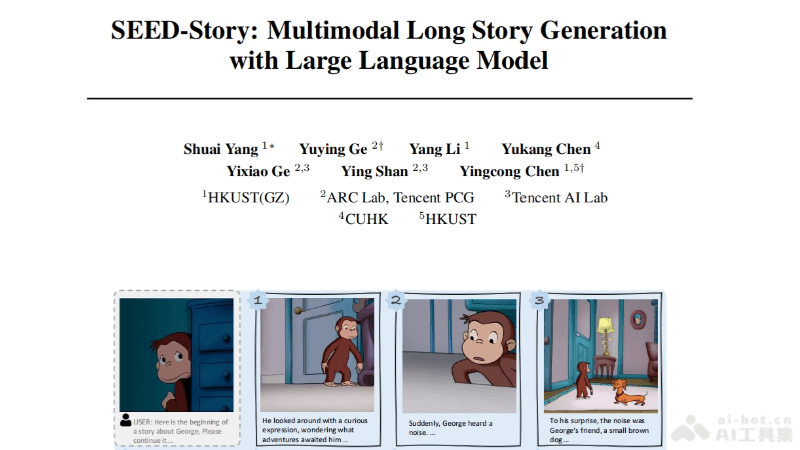
Main features of SEED-Story
- Multimodal story generation: SEED-Story can generate long stories containing coherent narrative text and stylistically consistent images based on a given starting image and text.
- Multimodal attention sink mechanism: SEED-Story proposes a multimodal attention sink mechanism to generate stories in an efficient autoregressive manner, and can generate stories up to 25 sequences long.
- Large-scale dataset : SEED-Story released a large-scale, high-resolution dataset named StoryStream, used to train models and quantitatively evaluate multimodal story generation tasks from different aspects.
- Story instruction tuning: During story generation, SEED-Story fine-tunes the model through an instruction tuning process, enabling it to predict the next image and next sentence of the story.
- Visualization and interaction: SEED-Story also provides visual comparisons, showing that the generated images have higher quality and better consistency compared with other baseline models.
Technical principles of SEED-Story
- Multimodal large language model (MLLM):Uses large language models to understand, generate, and predict text and visual tokens.This type of model can process and generate text data while also understanding and generating visual content.
- Text and visual token prediction:The SEED-Story model can predict text tokens (elements or words in text) and visual tokens (elements in images).
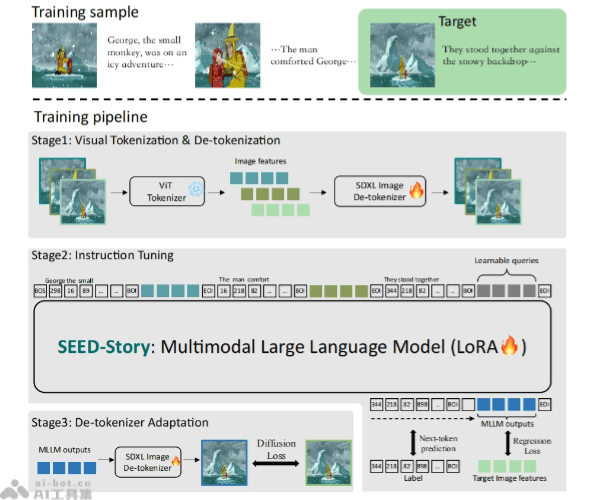
- Visual de-tokenizer:Converts text and visual tokens generated by the language model into images, generating consistent and stylized images through the visual de-tokenizer.
- Multimodal attention mechanism:Introduces a multimodal attention mechanism, enabling the model to focus on the interrelationships between text and images when generating stories.This mechanism allows the model to handle long-sequence generation tasks more effectively.
- Autoregressive generation:The model generates stories in an autoregressive manner, meaning each newly generated token depends on all previously generated tokens, in order to maintain story coherence.
- Long-sequence generation capability:Through the multimodal attention mechanism, SEED-Story can generate story sequences longer than the training sequences.
- StoryStream dataset:Provides a large-scale high-resolution dataset for training models and evaluating multimodal story generation tasks.The dataset contains visually engaging high-resolution images and detailed narrative text.
- Training process:Includes pre-training the de-tokenizer to reconstruct images, sampling interleaved image-text sequences for training, and using the MLLM's regression image features to adjust the generated images.
SEED-Story project address
-
GitHubRepository:https://github.com/TencentARC/SEED-Story
- HuggingFace Model Library:https://huggingface.co/TencentARC/SEED-Story
-
arXivTechnical Paper:https://arxiv.org/abs/2407.08683
Application Scenarios of SEED-Story
- Creative Writing Assistance: Helps writers and content creators generate story outlines, character descriptions, and plot development, inspiring creative inspiration.
- Education and Learning: As a teaching tool, it helps students understand narrative structures and improve their writing and creative thinking abilities.
- Entertainment and Game Development: Generates dynamic storylines and character backgrounds in video games, providing an immersive experience.
- Advertising and Marketing: Quickly generates engaging advertising stories or marketing materials, improving the appeal and personalization of advertising content.
- Film and Animation Production: Assists scriptwriting, generates character dialogue and scene descriptions, and accelerates the production process.