
What Is Seed Diffusion
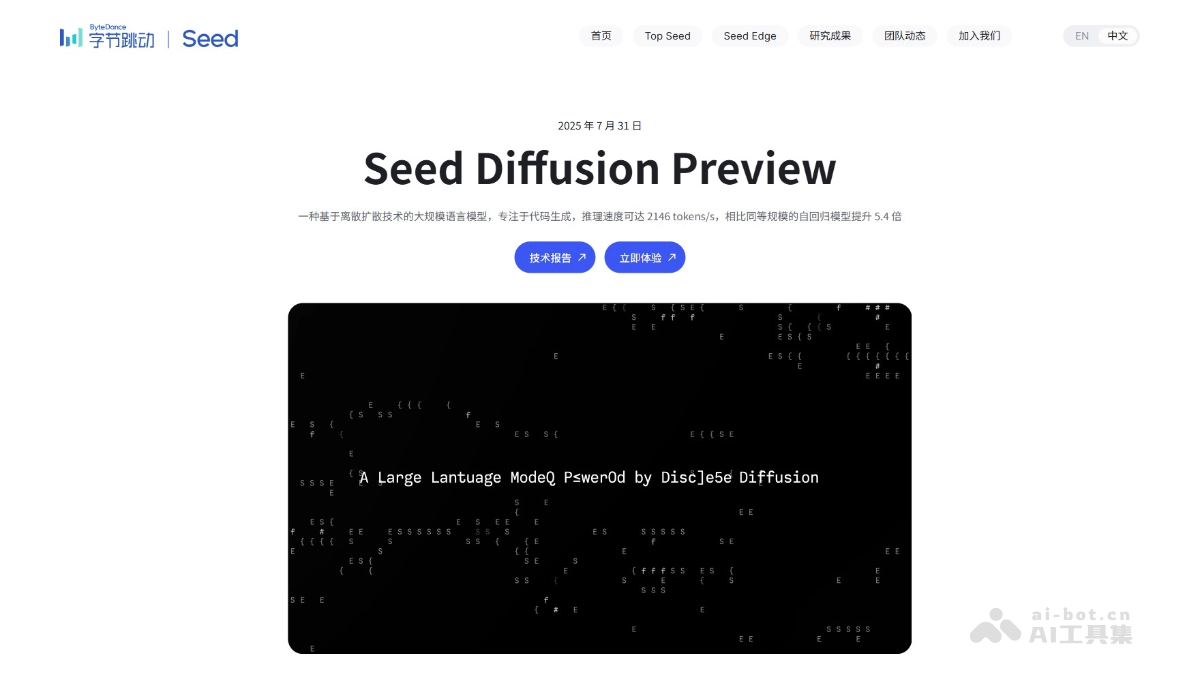
Seed Diffusion is an experimental diffusion language model launched by ByteDance's Seed team, focused on code generation tasks. Through key technologies such as two-stage diffusion training, constrained order learning, and reinforcement of efficient parallel decoding, the model achieves significant inference acceleration. The model's inference speed reaches 2146 tokens/s, 5.4 times faster than autoregressive models of the same scale. It performs comparably to autoregressive models on multiple code benchmarks and surpasses autoregressive models on code editing tasks. Seed Diffusion demonstrates the enormous potential of discrete diffusion models as the foundational framework for next-generation generative models.
Seed Diffusion's Main Features
- Efficient Code Generation: Through a parallel decoding mechanism, it significantly improves the speed of code generation, with inference speeds reaching 2146 tokens/s, a 5.4x improvement over autoregressive models of the same scale.
- High-Quality Code Generation: On multiple code benchmarks, its performance is comparable to autoregressive models, and on code editing tasks it surpasses autoregressive models.
- Code Logic Understanding and Repair: Based on two-stage diffusion training (masking stage and editing stage), it enhances the model's ability to understand and repair code logic.
- Flexible Generation Order: It introduces structural priors of code, enabling the model to better handle the causal dependencies in code.
Seed Diffusion's Technical Principles
- Two-Stage Diffusion Training: In the masking stage, some code tokens are replaced with [MASK] markers based on a dynamic noise schedule, and the model learns the ability to complete local contexts and patterns. The editing stage introduces insertion/deletion operations constrained by edit distance to construct noise, enabling the model to re-examine and correct all tokens, avoiding "spurious correlation dependence" on uncontaminated context.
- Constrained Order Diffusion: By distilling high-quality generation trajectories, it guides the model to master correct dependencies, solving the randomness problem of traditional diffusion models in generation order.
- On-Policy Learning: Based on optimizing the number of generation steps while ensuring output quality, it achieves efficient parallel decoding. It uses a proxy loss function that minimizes the number of generation steps, encouraging the model to converge in a more efficient way.
- Block-Level Parallel Diffusion Sampling: Based on a block-level parallel diffusion sampling scheme, it maintains causal order between blocks and uses KV-caching to reuse information from previously generated blocks, accelerating the generation process.
Seed Diffusion's Project Address
- Project Official Website:https://seed.bytedance.com/zh/seed_diffusion
- Technical Paper:https://lf3-static.bytednsdoc.com/obj/eden-cn/hyvsmeh7uhobf/sdiff_updated.pdf
- Online Experience Demo:https://studio.seed.ai/exp/seed_diffusion/
Seed Diffusion's Application Scenarios
- Automatic Code Generation: The model can quickly generate code prototypes, helping developers efficiently start projects.
- Code Editing and Optimization: The model can automatically detect and fix code errors, optimize code performance, and improve code quality.
- Education and Training: The model can generate example code, assist programming teaching, and help students quickly understand programming concepts.
- Software Development Collaboration: As an auxiliary tool for team development, it provides code completion and suggestions, improving development efficiency.
- Intelligent Programming Assistant: Integrated into IDEs, Seed Diffusion provides intelligent code generation and optimization functions, enhancing the development experience.