
What is Seed-Coder
Seed-Coder is ByteDance's open-source 8B-scale code model series, enhancing code generation and comprehension capabilities. It includes three versions: Base, Instruct, and Reasoning, respectively suitable for code completion, instruction following, and complex reasoning tasks. The model adopts a "model-centric" data processing approach, generating and filtering high-quality data through itself, reducing manual preprocessing workload. The context length reaches 32K, with performance leading among open-source models of the same scale. Seed-Coder uses the permissive MIT open-source license, and the code has been released on Hugging Face, making it convenient for developers to use and research.
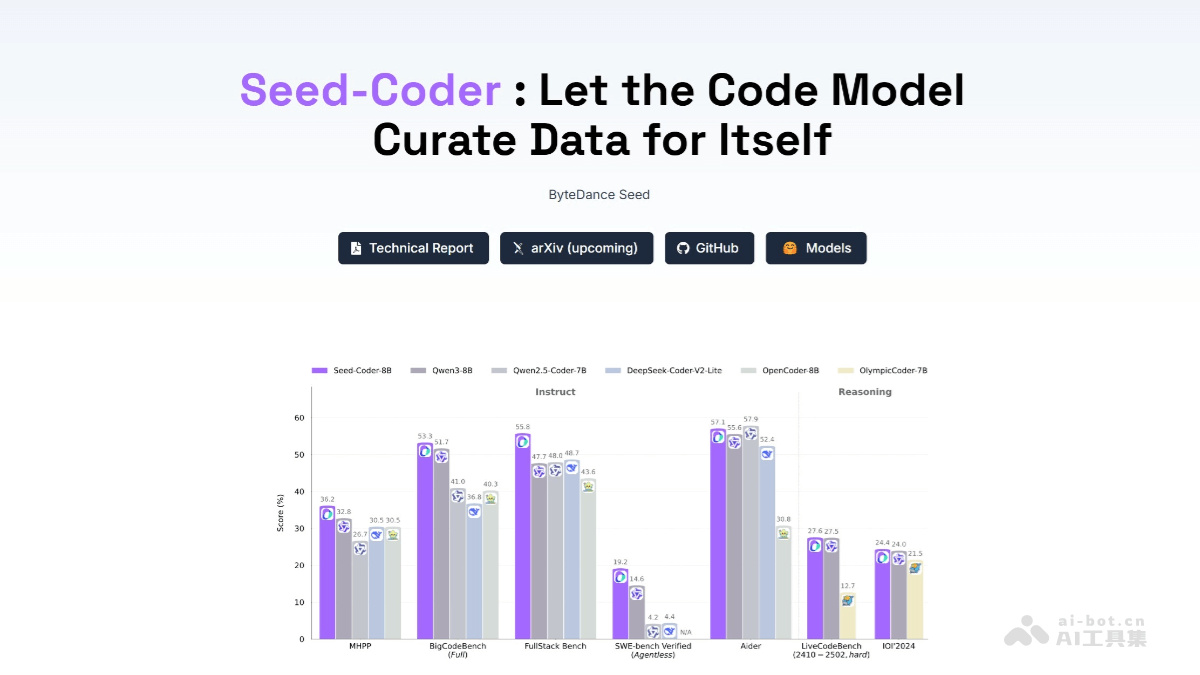
Main Features of Seed-Coder
- Code Completion: The Base version of Seed-Coder can predict subsequent code based on existing code snippets. For example, when writing a function, after inputting part of the function definition such as the function name and some parameters, it can automatically complete the remaining parameters and the initial framework of the function body.
- Code Infilling: For code with missing parts (such as reserved blank areas in a code template), the model can generate appropriate code to fill these blanks. For example, in a code template of a web development framework, it can generate corresponding HTML rendering code snippets or backend logic code snippets based on contextual logic, enabling the code template to work completely.
- Code Comment Generation: It can understand the functionality of the code and generate corresponding comments for it. This is very important for code readability and maintainability. For example, given a complex algorithm code, Seed-Coder can generate comments describing key information such as the main steps of the algorithm, inputs and outputs, helping other developers understand the code logic more quickly.
- Code Similarity Judgment: It can determine whether two pieces of code are logically similar. This is useful in software development for scenarios such as detecting code plagiarism and duplicate code snippets. By comparing the code similarity of different modules, code structure can be optimized, avoiding the generation of redundant code.
- Multi-Step Reasoning Programming: When solving complex programming problems, such as difficult problems in algorithm competitions or data processing problems requiring multi-step logical reasoning, the Reasoning version of Seed-Coder can perform long-chain thought reasoning. It will analyze the problem step by step, generate intermediate logical step code, and ultimately obtain a complete solution.
- Code Optimization Suggestions: Based on a deep understanding of code logic. The model can provide optimization suggestions for existing code. This includes improving algorithm efficiency, optimizing data structure usage, and other aspects.
Technical Principles of Seed-Coder
- Based on Llama 3 Architecture: Seed-Coder adopts the Llama 3 architecture, with 8.2B parameters, including 6 layers, a hidden layer size of 4096, and uses the Grouped Query Attention (GQA) mechanism.
- Long Context Support: Through repository-level code concatenation, the model can handle 32K ultra-long code files, easily coping with complex projects.
- "Model-Centric" Data Processing: Seed-Coder proposes a "model-centric" data processing approach, using the model itself to curate and filter data.
- Data Sources and Classification:
- File-Level Code: Individual code files from GitHub, with high-quality code content retained after processing.
- Repository-Level Code: Code files based on repository structure, retaining project structure information, enabling the model to learn the relationships between code.
- Commit Data: Includes commit messages, repository metadata, related files, and code patches, covering 74 million commits from 140,000 high-quality repositories.
- Code-Related Web Data: Documents extracted from web archives that contain code blocks or are highly relevant.
- Preprocessing: Deduplication is implemented at both the repository and file levels, using SHA256 hashing for exact deduplication and the MinHash algorithm for approximate deduplication. The remaining files are checked with syntax parsers such as Tree-sitter, and files containing syntax errors are discarded.
- Quality Filtering: A scoring model specially trained on over 220,000 code documents is used to filter out low-quality code files. The scoring model is based on DeepSeek-V2-Chat, and the evaluation metrics include readability, modularity, clarity, and reusability.
- Training Methods
- Regular Pretraining: Uses file-level code and code-related web data to build the model's foundational capabilities.
- Continual Pretraining: Uses data from all four categories and additionally introduces high-quality datasets and long-context datasets to enhance performance and alignment.
- Fill-in-the-Middle Training (FIM): Randomly splits code into prefix, middle, and suffix, teaching the model to "fill in the missing middle" and improving code completion ability.
- Reasoning Ability Training: The reasoning model is trained with Long Chain-of-Thought (LongCoT) reinforcement learning, allowing the model to first write out its problem-solving approach, then generate code, and optimize the logic chain through repeated trial and error.
- Instruction Model (-Instruct): Enhances the model's instruction-following ability, with training divided into two stages: supervised fine-tuning (SFT) and direct preference optimization (DPO).
- Reasoning Model (-Reasoning): Improves the model's multi-step reasoning ability in complex programming tasks.
Seed-Coder Project Address
- Project Official Website:https://bytedance-seed-coder.github.io/
- Github Repository:https://github.com/ByteDance-Seed/Seed-Coder
- HuggingFace Model Library:https://huggingface.co/collections/ByteDance-Seed/seed-coder
Seed-Coder Application Scenarios
- Programming Development: During programming development, Seed-Coder can generate code snippets according to the developer's intent, or automatically complete code, improving development efficiency.
- Programming Education Assistance : In the field of programming education, Seed-Coder can serve as a powerful assistant tool to help students better understand programming concepts and provide real-time feedback and guidance.
- Error Detection and Repair : Seed-Coder can detect errors in code and provide repair suggestions, reducing debugging time during development.
- Software Development Efficiency Improvement : Enterprises can use Seed-Coder during software development to quickly generate and optimize code, improve development efficiency, and shorten project cycles.