
What is Seed-ASR
Seed-ASR is a speech recognition (ASR) model launched by ByteDance based on a large language model (LLM). Trained on more than 20 million hours of speech data and nearly 900,000 hours of paired ASR data, it supports transcription of Mandarin and 13 Chinese dialects, and can recognize speech in English and 7 other foreign languages. Seed-ASR adopts technologies such as self-supervised learning, supervised fine-tuning, context-aware training, and reinforcement learning, improving recognition accuracy and contextual understanding. In videos, livestreams, and meetings, it can accurately transcribe even in multi-person conversations or background noise, reducing the error rate by 10%-40% compared with existing large ASR models. Seed-ASR's context-aware capability makes it more effective in application scenarios such as intelligent assistants and voice search.
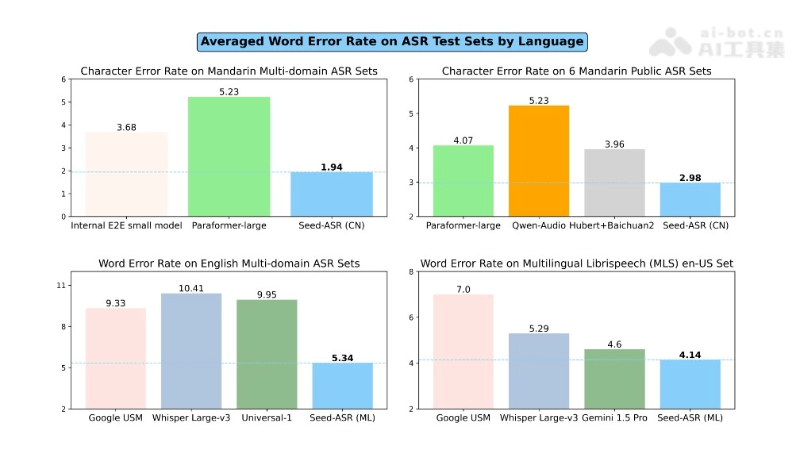
Main features of Seed-ASR
- High-precision speech recognition: It can accurately recognize and transcribe speech signals in multiple languages, dialects, and accents.
- Multilingual support: It supports Mandarin, English, and various other languages, with the ability to expand to more than 40 languages.
- Context awareness: It uses contextual information such as historical conversations and video editing history to improve the accuracy of keyword recognition and transcription.
- Large-scale training: It is trained on a large amount of speech data to enhance the model's generalization ability.
- Staged training strategy: Through stages such as self-supervised learning, supervised fine-tuning, context fine-tuning, and reinforcement learning, it gradually improves model performance.
- Long speech processing: It effectively handles long speech inputs, maintaining information integrity and transcription accuracy.
Technical principles of Seed-ASR
- Large language model (LLM) foundation: Seed-ASR is built on top of a large language model, based on powerful text understanding and generation capabilities.
- Audio-conditioned language model (AcLLM) framework: The framework inputs continuous speech representations and contextual information into a pretrained LLM, enabling the model to understand speech content and generate the corresponding text.
- Self-supervised learning (SSL): Trained on large-scale speech data without labels, the audio encoder can capture rich speech features.
- Supervised fine-tuning (SFT): After the SSL stage, it is trained using a large number of speech-text pairs to establish a speech-to-text mapping.
- Context-aware training: By introducing contextual information (such as historical conversations, video editing history, etc.) for training, it improves the model's recognition ability in specific contexts.
- Reinforcement learning (RL): Using a reward function based on ASR performance metrics, it further optimizes the model's text generation behavior, especially for accurate transcription of semantically important parts.
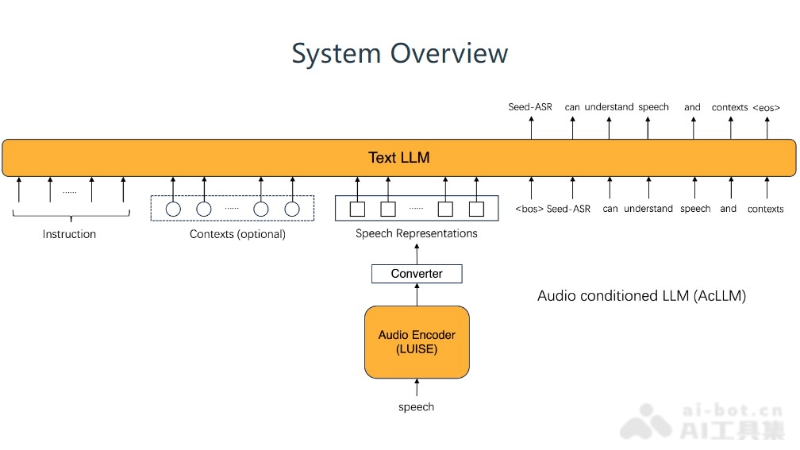
Project address of Seed-ASR
- Project official website:https://bytedancespeech.github.io/seedasr_tech_report/
- arXiv technical paper:https://arxiv.org/pdf/2407.04675
How to use Seed-ASR
- Environment preparation: Ensure that the hardware and software requirements needed to run Seed-ASR are met, such as sufficient computing power, memory, and storage space.
- Obtain the model: Authorized users can obtain the Seed-ASR model and all required dependency libraries from ByteDance or related channels.
- Data preparation: Collect and prepare the speech data you want the model to process. This includes audio files or real-time speech streams.
- Data preprocessing: Preprocess the speech data as needed, such as denoising, segmentation, normalization, etc., to improve recognition accuracy.
- Model Configuration: Configure the Seed-ASR model parameters according to the application scenario, including language selection, context information input, etc.
- Model Deployment: Deploy the Seed-ASR model to a server or cloud platform to ensure it can receive and process speech data.
Application Scenarios of Seed-ASR
- Intelligent Assistants and Voice Interaction: Provide voice command recognition and interaction functions in smartphones, smart home devices, etc.
- Automatic Subtitle Generation: Automatically generate subtitles for video content, live streams, meetings, etc., to improve content accessibility.
- Meeting Notes and Transcription: Automatically record speech and transcribe it into text in business meetings, lectures, seminars, and other occasions.
- Customer Service: Automatically understand customer speech in call centers or online customer service to provide faster responses and problem resolution.
- Voice Search: Provide voice input in search engines or applications to help users quickly find the information they need through voice.
- Language Learning and Education: Assist language learners in practicing pronunciation and listening, and provide real-time feedback and improvement suggestions.