
What is Search-o1
Search-o1 is an innovative framework launched by Renmin University of China and Tsinghua University that can enhance the reasoning ability of large reasoning models (LRMs) when facing complex problems. By integrating the agentic retrieval-augmented generation (RAG) mechanism and the Reason-in-Documents module, it enables LRMs to dynamically retrieve external knowledge during reasoning to fill knowledge gaps. The RAG mechanism supports the model in autonomously deciding when to initiate search queries, and the Reason-in-Documents module is responsible for refining the retrieved documents, extracting information useful for the current reasoning step, ensuring that the information is seamlessly integrated into the reasoning chain and maintaining the coherence and logic of reasoning. Search-o1 demonstrates excellent performance in multiple complex reasoning tasks and open-domain question answering benchmarks, providing a new path for building more reliable and more general intelligent systems.
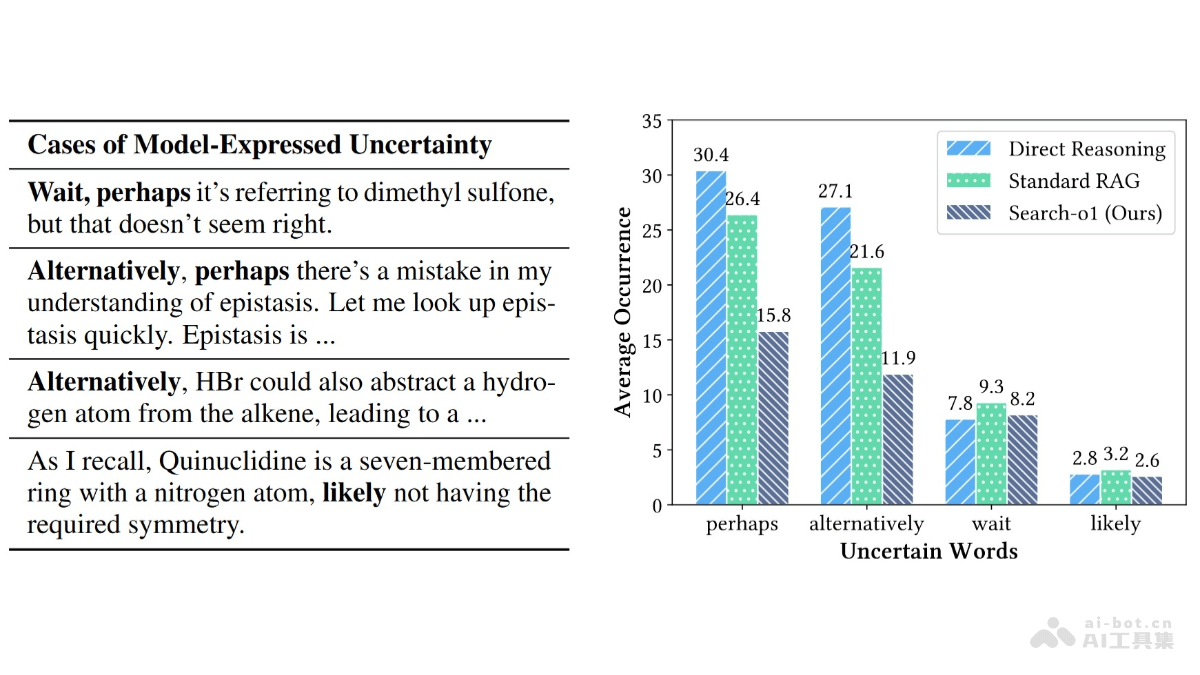
Main features of Search-o1
- Dynamic knowledge retrieval: During reasoning, when the model encounters knowledge gaps, it dynamically retrieves external knowledge to support step-by-step reasoning.
- Knowledge refinement: Refines retrieved documents into concise, relevant information, ensuring that the information is seamlessly integrated into the reasoning chain and maintaining the coherence of reasoning.
- Improve reasoning accuracy: By supplementing external knowledge, it reduces reasoning errors caused by insufficient knowledge, improving the accuracy and credibility of reasoning.
- Multi-task applicability: It performs excellently in multiple complex reasoning tasks such as science, mathematics, and programming, as well as open-domain question answering tasks, demonstrating broad applicability.
Technical principles of Search-o1
- Agentic retrieval-augmented generation (RAG) mechanism:
- Autonomous retrieval: The model autonomously decides when to generate search queries during reasoning, triggering the retrieval mechanism to obtain relevant external knowledge.
- Dynamic iteration: The retrieval mechanism is triggered multiple times within a single reasoning session to meet the knowledge needs of different reasoning steps.
- Special symbols: Search queries and retrieval results are surrounded by special symbols to ensure seamless connection between the retrieval process and the reasoning chain.
- Reason-in-Documents module:
- Document analysis: Based on the current search query, retrieved documents, and previous reasoning steps, it conducts in-depth analysis of the documents.
- Information extraction: Extracts information directly related to the current reasoning step from the documents, ensuring the accuracy and relevance of the information.
- Refined output: Generates concise, relevant information and seamlessly integrates it into the reasoning chain, maintaining the coherence and logical consistency of reasoning.
Project address of Search-o1
- Project official website:https://search-o1.github.io
- GitHub repository:https://github.com/sunnynexus/Search-o1
- HuggingFace model library:https://huggingface.co/papers/2501.05366
- arXiv technical paper:https://arxiv.org/pdf/2501.05366
Application scenarios of Search-o1
- Scientific research: In scientific fields such as chemistry, physics, and biology, it dynamically retrieves and integrates knowledge to solve complex scientific problems, such as chemical reaction analysis, physics problem solving, and biology question answering.
- Mathematics education: In mathematics problem solving and competition tutoring, it retrieves mathematical formulas, theorems, and problem-solving techniques to help students gradually derive solutions to complex mathematics problems and improve their problem-solving ability.
- Programming development: In programming tasks, retrieve programming language syntax, library functions, and code optimization techniques, generate correct code and optimize the performance of existing code, and improve development efficiency.
- Open-domain question answering: In single-hop and multi-hop question answering tasks, retrieve relevant facts and information, perform multi-step reasoning, accurately answer various complex questions, and provide comprehensive knowledge support.
- Healthcare: In disease diagnosis and treatment plan recommendation, retrieve symptoms, disease information, diagnostic methods, and the latest treatment guidelines to assist doctors in making accurate diagnoses and providing optimal treatment recommendations, enhancing the scientific nature of medical decisions.