
What is ScrapeGraphAI
ScrapeGraphAI is an intelligent web scraping toolkit driven by large language models (LLMs), focused on efficiently extracting structured data from various websites and HTML content. It has three core functions: SmartScraper can accurately scrape structured information from webpages based on user prompts; SearchScraper uses AI-driven search technology to extract key information from search engine results; Markdownify can quickly convert webpage content into clean Markdown format, facilitating subsequent processing and storage.
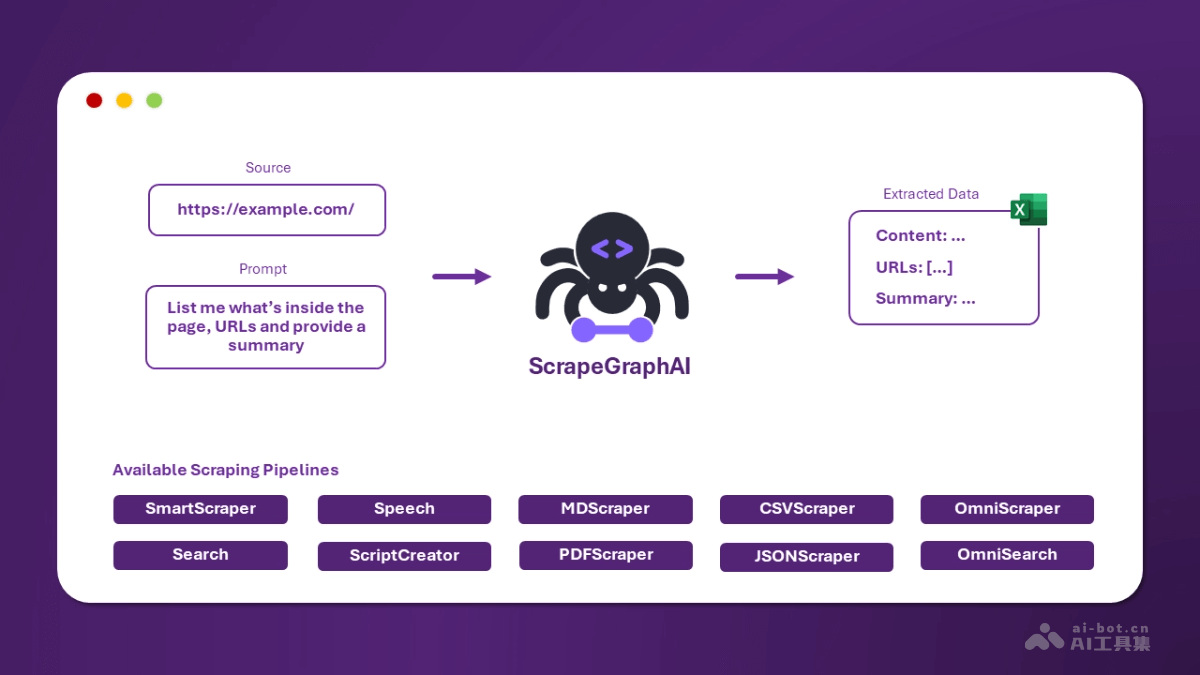
Main Features of ScrapeGraphAI
- Intelligent single-page scraping: Users only need to provide a simple prompt and webpage address, and ScrapeGraphAI can accurately extract the required information without writing complex rules.
- Multi-page search scraping: It can automatically extract relevant information from multiple pages in search engine results and aggregate it into a unified format.
- Markdownify: It can quickly convert webpage content into clean Markdown format, facilitating subsequent processing and storage.
- Adaptive scraping: Based on LLM technology, ScrapeGraphAI can automatically adapt to changes in website structure, greatly reducing the need for frequent maintenance and updates.
- Multi-model support: Compatible with cloud models such as OpenAI, Groq, Azure, and Gemini, as well as local models via Ollama, meeting the needs of different scenarios.
- Multi-platform support: It can handle multiple document formats such as XML, HTML, JSON, and Markdown.
- Formatted output: It automatically organizes scraping results into structured JSON data for subsequent processing and analysis.
- Data storage: It supports saving extracted data as CSV files, making it convenient for users to perform further data management and analysis.
- Voice generation capability: It converts webpage content into audio files, facilitating content consumption during commuting or in other scenarios.
- Code generator: AI can automatically generate directly runnable Python or Node.js scraping code, making it convenient for developers to integrate into their own applications or workflows.
Technical Principles of ScrapeGraphAI
- Natural language driven: ScrapeGraphAI supports users describing the information they need to extract through simple natural language instructions. It can automatically analyze the target webpage structure and extract the required data.
- Graph logic engine: ScrapeGraphAI models the scraping process as a directed graph, where nodes in the graph represent different operations or data processing steps, such as request sending, HTML parsing, data extraction, etc. Through the graph logic engine, scraping tasks are decomposed into multiple discrete nodes, each responsible for a specific task, and the nodes are connected by edges to form a clear direction of data flow. This facilitates parallel processing and error isolation, making the entire scraping process more interpretable and visualizable.
- Intelligent parsing by LLM: ScrapeGraphAI automatically parses users' natural language instructions based on the powerful semantic understanding capability of LLMs. LLMs can understand users' needs and dynamically generate the corresponding scraping logic. This enables ScrapeGraphAI to automatically adapt to changes in website structure, and even when webpage layouts change, it can still accurately extract key information.
Project Address of ScrapeGraphAI
- Github repository:https://github.com/ScrapeGraphAI/Scrapegraph-ai
Application Scenarios of ScrapeGraphAI
- Market trend analysis: Periodically and automatically scrape price trends, stock data, etc., from websites for real-time monitoring and analysis, helping users grasp market dynamics and providing a basis for investment decisions.
- Academic Research: Scrape relevant literature information from online resources to provide rich data resources for academic research, helping researchers gain an in-depth understanding of the latest developments in a specific field.
- Product Information Collection: Automatically scrape information such as product names, descriptions, and reviews from e-commerce websites for product analysis, market research, or building a product database.
- Content Aggregation: Automatically scrape and organize information from multiple data sources for content aggregation platforms or knowledge bases, enriching platform content and improving user experience.
- News Summarization: Scrape articles from news websites, use LLMs for text summarization, and quickly generate news overviews or industry reports to help users stay informed of the latest information in a timely manner.