
What is sCM
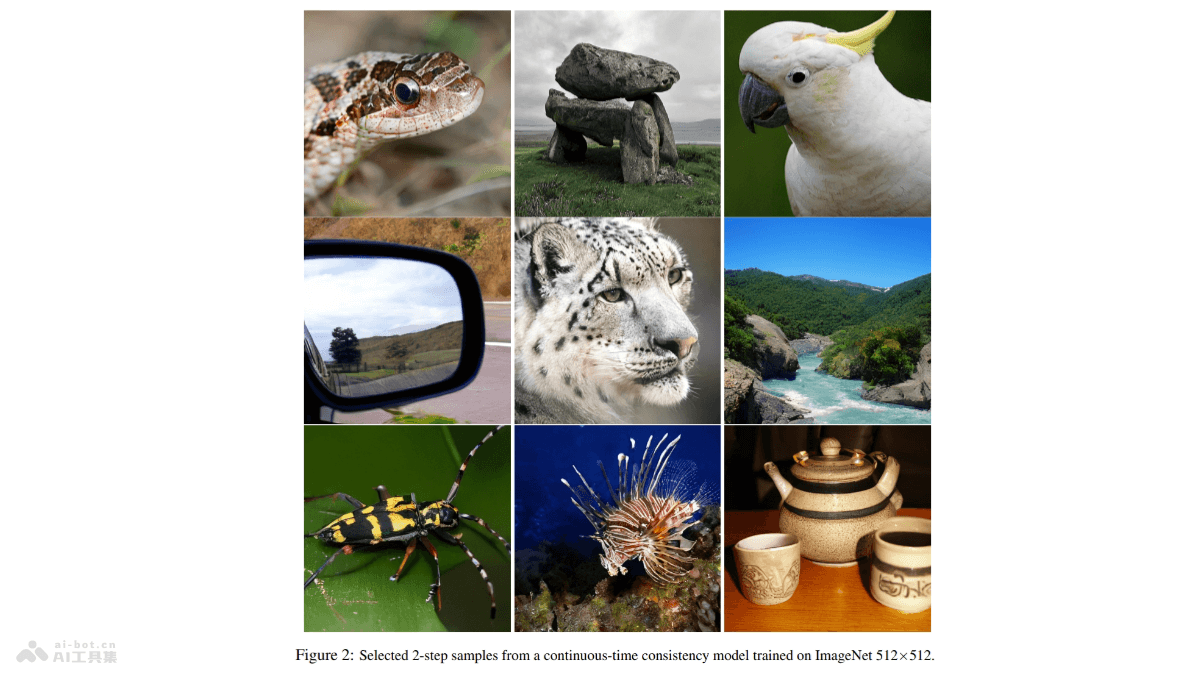
sCM is a continuous-time consistency model introduced by OpenAI, improved based on the principles of diffusion models. sCM simplifies the theoretical framework and optimizes the sampling process, achieving a significant increase in image generation speed. The sCM model requires only two-step sampling to generate high-quality images, and is 50 times faster than traditional diffusion models. Based on a continuous-time framework, it avoids discretization errors, and uses a series of key improvements such as an improved time-conditioning strategy and adaptive dual normalization to improve the stability of model training and generation quality. The release of sCM heralds the application prospects of real-time, high-quality generative AI in multiple fields, including video, images, 3D models, and audio, etc.
Main Features of sCM
- Fast Image Generation: sCM can quickly generate high-quality images, 50 times faster than traditional diffusion models, requiring only a two-step sampling process.
- Real-Time Video Generation: The technological breakthrough of sCM heralds the possibility of real-time video generation, which was previously difficult to achieve due to limitations of computational cost and time.
- 3D Model Generation: sCM can generate three-dimensional models, opening up new possibilities for fields such as 3D printing and virtual reality.
- Audio Generation: sCM can handle the generation of audio content, extending its capabilities to the audio field.
- Cross-Domain Applications: sCM can achieve content generation across different media, and can be applied in multiple fields, such as game development, film production, music creation, etc.
Technical Principles of sCM
- Continuous-Time Framework: sCM is based on a continuous-time model. Compared with traditional discrete-time models, it avoids discretization errors and can theoretically operate on a continuous time axis.
- Simplified Theoretical Framework: sCM proposes a simplified theoretical framework that unifies the parameterization of previous diffusion models and consistency models, simplifies the model expression, and identifies the root causes leading to training instability.
- Two-Step Sampling Process: sCM can generate images with only a two-step sampling process, reducing the computational steps required for generation and improving sampling speed.
- Consistency Training: sCM learns the model based on consistency training, keeping the outputs at adjacent time steps consistent, and uses the single-step solution of learning the PF-ODE (probability flow ODE) to transform noise into clear images.
- Improved Parameterization and Network Architecture: sCM introduces an improved time-conditioning strategy, adaptive group normalization, new activation functions, and adaptive weights to improve the stability of model training and generation quality.
sCM Project Address
- arXiv Technical Paper:https://arxiv.org/pdf/2410.11081
Application Scenarios of sCM
- Artists and Designers: Use sCM to generate novel visual elements, improving creative efficiency and the diversity of works.
- Game Developers: Use sCM to quickly generate various in-game assets, such as characters, scenes, and textures, improving development speed.
- Film and Video Producers: Use sCM to create special effects and animations, or generate backgrounds and scenes in films.
- Musicians and Audio Engineers: Use sCM to generate or edit music and sound effects, for use in music production and audio design.
- Researchers and Scientists: In fields such as medicine and biology, use sCM to generate synthetic datasets to assist research and analysis.