
What is SciReasoner
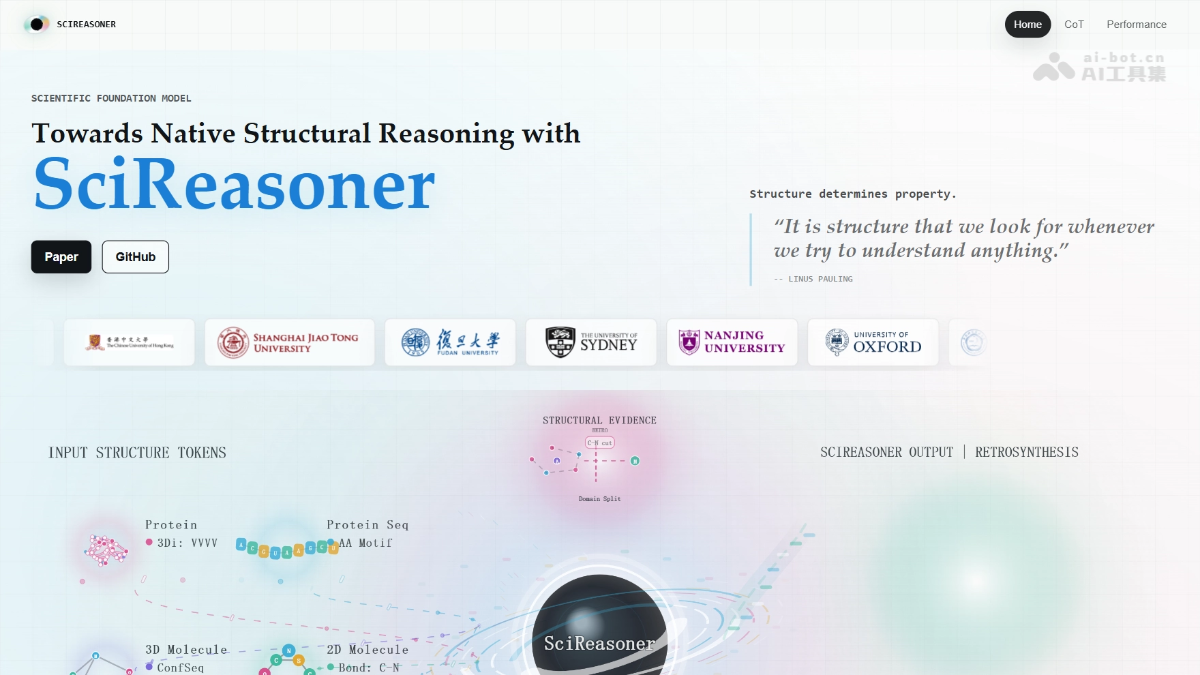
SciReasoner is a next-generation scientific reasoning multimodal foundation model launched by Shanghai Artificial Intelligence Laboratory in collaboration with teams from CUHK, Shanghai Institute of Materia Medica, Chinese Academy of Sciences, Stanford, Oxford, and others. The model is the first to propose a native structure reasoning paradigm, transforming protein 3D structures, molecular topologies, and crystal lattices into addressable reasoning evidence units, enabling AI to organize analysis around real structural evidence like a scientist. The model is based on continued pretraining of Qwen3 and achieves SOTA on 67 out of 86 interdisciplinary benchmarks, covering protein function annotation, retrosynthesis planning, drug screening, and material property prediction, realizing a leap from black-box prediction to interpretable scientific pipelines.
Main Features of SciReasoner
-
Protein Function Annotation: Predicts Gene Ontology terms based on 3D structures (Foldseek 3Di representation), performing particularly well on low-homology and orphan proteins.
-
Retrosynthesis Planning: Analyzes product scaffolds and functional groups, identifies key bond cleavage sites, verifies reactant structures, and assesses reaction feasibility.
-
Molecular Virtual Screening: Performs drug molecule screening based on 3D pharmacophore similarity, without requiring additional docking scores or task fine-tuning.
-
Material Property Prediction: Analyzes crystal space groups, coordination environments, and periodic connectivity to predict physicochemical properties such as formation energy and band gap.
-
Scientific Question Answering and Generation: Supports open-ended scientific question answering and molecular design across proteins, DNA/RNA, small molecules, and crystals.
Technical Principles of SciReasoner
-
Unified Structure-Aware Vocabulary: Discretizes different scientific objects into structure-aware tokens, using ConfSeq for small molecules, Foldseek 3Di for proteins, and SLICES for crystals, avoiding the destruction of chemical semantics by traditional tokenization.
-
Three-Stage Continued Pretraining: Conducts warm-up training, full-parameter multimodal training, and annealing training based on Qwen3 to establish a stable structure-language interface.
-
Post-Training Reasoning Framework: Adopts bootstrapped native structure reasoning, training protein/molecule/material experts through in-domain structural evidence grounding, then integrating expert capabilities through cross-domain reasoning, and using reinforcement learning to connect structure vocabulary semantics with chain-of-thought strategies.
-
Auditable Reasoning Traces: The model outputs reasoning chains wrapped in
<think.../think>, and intermediate claims can be traced back to specific structure tokens, realizing the transformation from black-box prediction to interpretable scientific pipelines.

Follow on WeChat and reply "Open Source" to join theAI Open Source Project Communication Group
How to Use SciReasoner
-
Obtain Resources: Visit the GitHub repository to clone the code and download the model weights.
-
Install Environment: Configure Python dependencies and the runtime environment according to the README.
-
Prepare Data: Organize structural inputs such as protein PDB/3Di, molecule SMILES/ConfSeq, or crystal CIF/SLICES according to the task type.
-
Load Model: Initialize the SciReasoner model and connect the structure-aware vocabulary.
-
Input Instructions: Combine structural data with natural language questions and feed them into the model.
-
Obtain Reasoning: The model outputs a reviewable reasoning chain with
<think.../think>tags and the final prediction result. -
Verification result: Map the structural tokens in the reasoning trajectory back to the 3D structure for expert review.
SciReasoner's core advantages
-
Native structural reasoning: Structural tokens are not auxiliary input, but the core evidence units of reasoning; the reasoning process can unfold around spatial relationships, coordination environments, symmetry, etc.
-
Significant advantage in low-homology scenarios: In protein function prediction with sequence similarity below 30%, Cellular Component Fmax improves from 0.42 to 0.55, far surpassing BLAST and ESM2.
-
Unified cross-disciplinary capability: A single model covers the three major fields of biology, chemistry, and materials science, achieving SOTA on 67 of 86 benchmarks, breaking the barriers of traditional specialized models.
-
Leading interpretability: In double-blind expert evaluations, 98% of cases considered its reasoning trajectory superior or comparable to frontier large language models, and the reasoning chain can be directly mapped to 3D structural regions.
-
High chemical reasoning accuracy: USPTO-50K retrosynthesis Top-1 accuracy reaches 72.0%, significantly exceeding the previous best method RSGPT's 63.4%.
SciReasoner's project address
- Project official website:https://scireasoner.github.io/
- GitHub repository:https://github.com/SpectrAI-Initiative/SciReasoner
- arXiv technical paper:https://arxiv.org/pdf/2607.07708
Comparison of SciReasoner with similar competitors
| Dimension | SciReasoner | ESM2 (Meta) |
|---|---|---|
| Positioning | Cross-disciplinary scientific reasoning foundation model | Protein language model |
| Input modality | Protein structure/sequence, molecules, crystals | Protein sequences only |
| Reasoning paradigm | Native structural reasoning, reviewable trajectory | Sequence embedding prediction, black-box output |
| Low-homology proteins | CC Fmax 0.55 (≤30% similarity) | CC Fmax 0.42 |
| Interpretability | Reasoning chain can be mapped to structural tokens | Attention heatmaps, no natural language reasoning |
| Cross-domain | Unified model for biology + chemistry + materials | Limited to the protein field |
SciReasoner's application scenarios
-
Orphan protein function discovery: For unknown proteins lacking homologous sequences, infer their molecular function and subcellular localization through 3D folded structures.
-
Drug molecule retrosynthesis design: Assist chemists in planning synthetic routes from target molecules to commercially available precursors, clarifying bond-breaking sites and reaction conditions.
-
Screening of novel materials: Predict material stability and electronic properties based on crystal structures, accelerating R&D of functional materials such as battery materials and catalysts.
-
AI-assisted science education: Use its interpretable reasoning trajectory to help students understand the scientific thinking process that "structure determines properties".
-
Cross-modal scientific discovery: Integrate multimodal tasks such as protein-small molecule interactions and RNA function prediction to support systems biology research.