
What is Science Skills
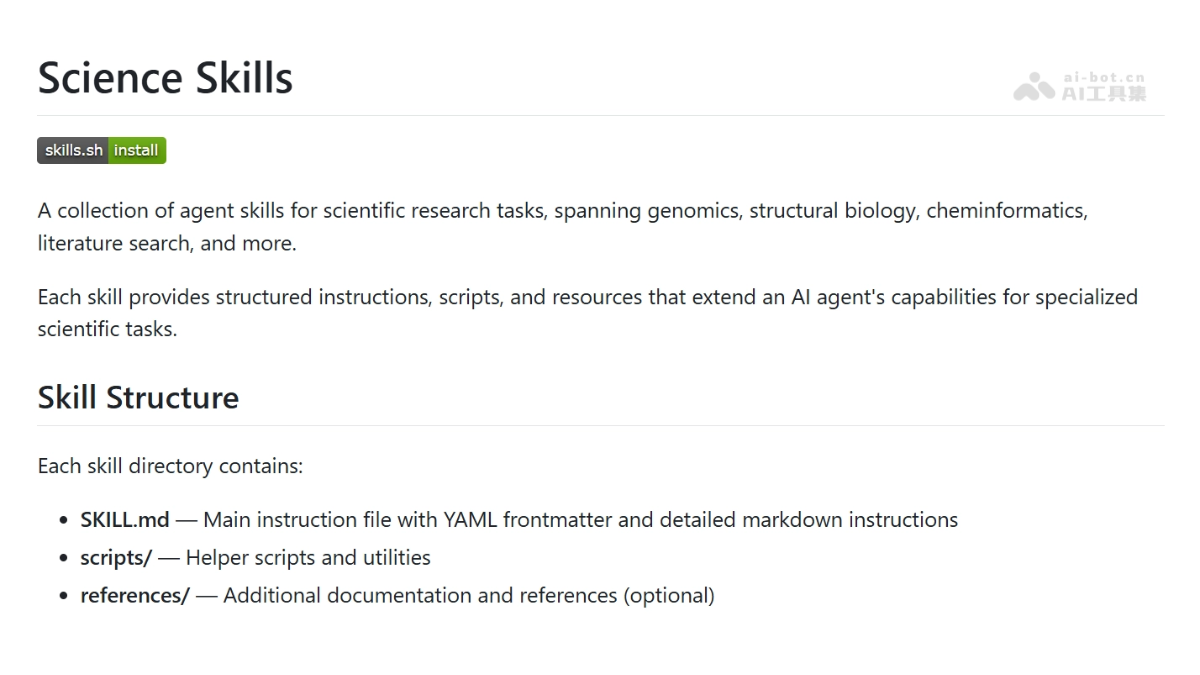
Science Skills is an open-source collection of scientific research skills launched by Google DeepMind, designed to accelerate AI Agent-driven scientific research workflows. The toolkit integrates more than 30 life science databases and tools, including AlphaGenome, AlphaFold Database, and UniProt, covering fields such as genomics, structural biology, chemical informatics, and literature retrieval, enabling researchers to complete complex analysis tasks that originally took hours in just a few minutes.
Main features of Science Skills
-
Genomics analysis: Performs gene variant annotation, disease association analysis, and genomic data mining through skills such as AlphaGenome.
-
Structural biology research: Integrates the AlphaFold Database to support tasks such as protein structure prediction, molecular docking, and structural alignment.
-
Chemical informatics processing: Provides analytical capabilities related to compound property prediction, molecular screening, and drug discovery.
-
Intelligent literature retrieval: Automatically retrieves, filters, and synthesizes academic literature through tools such as OpenAlex, generating structured reviews.
-
Multi-database integration: Provides unified access to 30+ authoritative databases, enabling one-stop scientific querying and analysis across data sources.
Technical principles of Science Skills
- Standardized Skill architecture: Science Skills adopts a unified three-layer modular protocol: each skill consists of
SKILL.md(containing YAML routing frontmatter and Markdown execution instructions),scripts/(executable script tools), andreferences/(supplementary documents loaded on demand), giving skills a reusable, extensible, and maintainable structure. - Progressive disclosure and Token efficiency: By replacing traditional monolithic instructions with a layered architecture: core modules are always loaded (retaining only 38.5% necessary content), while auxiliary content (examples, background, templates) is dynamically loaded when the Agent explicitly needs it through tool calls, reducing the Token cost of a single call by about 39% and achieving an end-to-end savings of 43.2%.
- Script execution isolation
:scripts/The code in runs directly on the file system, and execution results (such as validation status or numerical values) rather than the code itself are injected into the Agent context, reducing Token consumption by about 89% compared with the traditional approach of "generating code in the conversation and then executing it", while ensuring execution determinism and reusability. - Routing layer optimization: Each
SKILL.mdhas a concise routing description in the YAML frontmatter at the top, used to quickly match user requests with the corresponding skill; by compressing lengthy descriptions and removing content unrelated to routing (such as feature lists and trigger word enumerations), it ensures that only the necessary skill context is loaded, avoiding unrelated information occupying Tokens.
How to use Science Skills
- Install the skill package: Install the complete skill collection with one npx command:
npx skills add google-deepmind/science-skills/ - Enable in Antigravity: After downloading Google Antigravity, check the Science plugin in the "Build with Google" step; existing users can download the Science plugin in settings.
- Configure the environment: When a Science Skill is triggered for the first time, the Agent will automatically install the
uvpackage manager; after installation is complete, it is recommended to restart Antigravity. - Configure the API key: Some skills such as AlphaGenome and OpenAlex require API keys; the Agent will guide you through obtaining them and writing them to the
~/.envfile. - Natural language invocation: After installation is complete, simply ask the Agent scientific questions in natural language, and the Agent will automatically load the relevant skills and perform the analysis.
Core advantages of Science Skills
- Agentic workflow acceleration: Compresses manual analyses that originally took hours, such as structural bioinformatics and genomic analysis, down to minutes, significantly improving research efficiency.
- Deep data grounding: Directly integrates 30+ authoritative databases to ensure analysis results are based on the latest and most reliable scientific data, reducing model hallucinations.
- Token-efficient design: Optimized for scientific tasks, completing more complex reasoning and analysis with lower Token consumption.
- Standardized Skill architecture: Each skill uses a unified
SKILL.md + scripts/ + references/structure, making it easy to extend, reuse, and collaborate with the community. - Fully open source: The code uses the Apache 2.0 license, and the documentation uses the CC-BY license, supporting free use and secondary development.
Science Skills project address
- GitHub repository:https://github.com/google-deepmind/science-skills
Comparison of Science Skills with similar competitors
| Dimension | Google DeepMind Science Skills | Elicit 2.0 | Perplexity AI Research Pro |
|---|---|---|---|
| Core positioning | AI Agent science skill pack, focused on life science database integration and automated analysis | Systematic literature review and hypothesis mapping tool | Real-time academic search and citation tracking engine |
| Database coverage | 30+ life science-specific databases (AlphaFold, UniProt, AlphaGenome, etc.) | 140 million+ academic papers | PubMed, arXiv, Semantic Scholar, etc. |
| Working mode | Agent autonomously executes scripts to complete end-to-end scientific analysis tasks | Structured data extraction and evidence synthesis | Real-time search + citation chain reconstruction |
| Open source | Fully open source (Apache 2.0 + CC-BY) | Open source weights (Apache 2.0), can be deployed locally | Closed-source SaaS |
| Applicable scenarios | Genomic/protein/chemical data-intensive research | Systematic reviews, Meta-analyses, evidence synthesis | Rapid literature research, citation verification |
Application scenarios of Science Skills
- Rare disease research: Quickly analyze the mechanisms linking gene mutations to diseases, as the DeepMind team once used Science Skills to discover the potential mechanism by which AK2 gene mutations cause a rare genetic disease.
- Protein structure analysis: Batch predict and compare protein structures to accelerate vaccine design and enzyme engineering research.
- Drug discovery: Perform compound screening and molecular property prediction based on cheminformatics skills to shorten the early R&D cycle.
- Systematic literature review: Automatically search, extract, and synthesize millions of academic papers to quickly generate field review reports.
- Cross-disciplinary data integration: The tool can simultaneously query genomic, protein, compound, and literature data to build multidimensional research insights.