
What is Scenethesis
Scenethesis is an innovative framework launched by NVIDIA for generating interactive 3D scenes from text. The framework combines large language models (LLMs) and visual perception technologies, enabling efficient generation based on a multi-stage pipeline. It uses LLMs for rough layout planning, uses vision modules to refine the layout and generate image guidance, uses an optimization module to adjust object poses to ensure physical plausibility, and uses a judgment module to verify the spatial coherence of the scene. Scenethesis can generate diverse indoor and outdoor scenes with a high degree of realism and physical plausibility, and is widely used in fields such as virtual content creation, simulation environments, and embodied intelligence research.
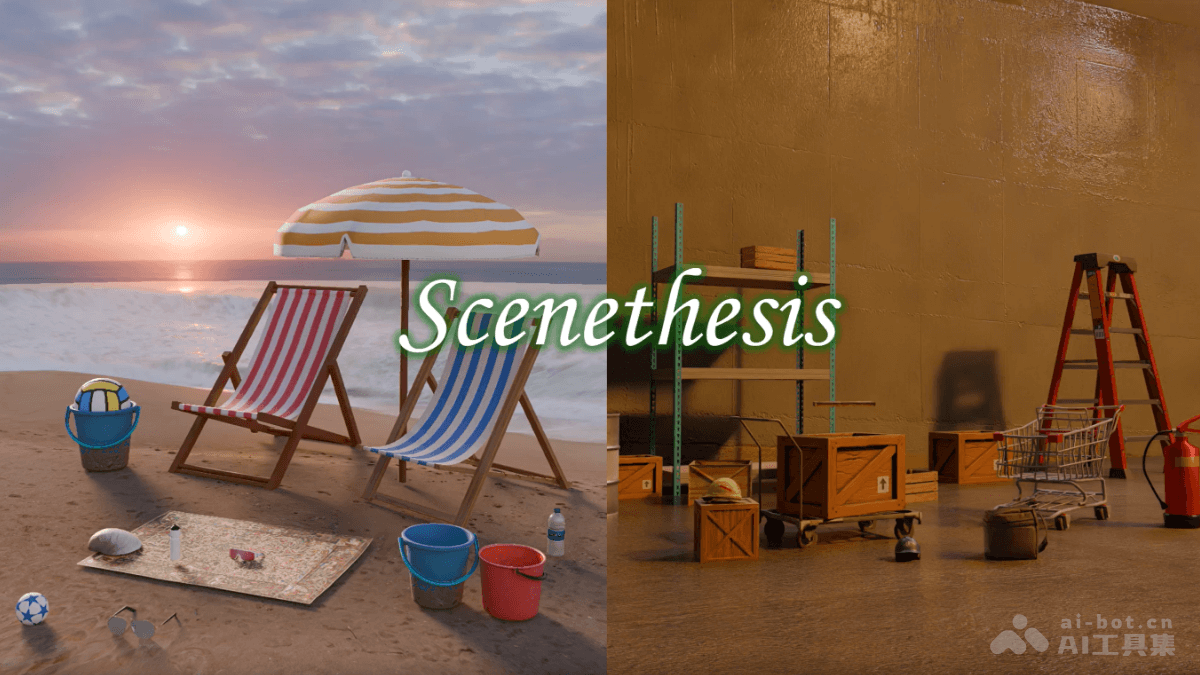
Main features of Scenethesis
- Text-to-3D scene generation: Users input a text description, and the AI automatically generates the corresponding 3D scene.
- Physical plausibility: Objects in the generated scene do not penetrate each other, can be placed stably, and conform to physical rules.
- User interaction: Users can adjust object positions, sizes, etc., and the scene updates in real time.
- Diverse scenes and object library: Supports a variety of indoor and outdoor scenes and includes a rich set of 3D models to choose from.
- Scene validation: Automatically checks scene quality and, when necessary, regenerates and optimizes to ensure high-quality output.
Technical principles of Scenethesis
- Rough layout planning (LLM module): After the user inputs a text description, the LLM parses the text and understands the theme and key elements of the scene. The LLM selects objects related to the scene description from a predefined 3D model library and generates a rough layout plan. The LLM generates detailed prompts describing the preliminary positions and relationships of objects in the scene, providing a foundation for subsequent visual refinement.
- Visual refinement (vision module): Based on the prompts generated by the LLM, the vision module (such as an image generator based on diffusion models) generates detailed images as visual guidance for the scene layout. Based on pretrained visual foundation models (such as Grounded-SAM and DepthPro), the generated images are segmented and depth-estimated to extract a scene graph, including the 3D bounding boxes and spatial relationships of objects. Based on the scene graph and prompts, 3D object models matching the scene description are retrieved from the 3D model library.
- Physics optimization (physics optimization module): Based on semantic correspondence matching techniques (such as RoMa), poses of objects in the 3D models and image guidance are aligned to ensure that the positions, sizes, and orientations of objects are consistent with the image guidance. Signed distance field (SDF) technology is used to detect collisions between objects and adjust object positions and sizes to avoid collisions.
- Scene validation (scene validation module): A pretrained language model is used to evaluate the spatial coherence of the generated scene and ensure that the positions and relationships of objects conform to common sense. If the evaluation results do not meet the requirements, the system triggers a replanning and optimization process until the generated scene reaches high-quality standards.
Project address of Scenethesis
- Project official website:https://research.nvidia.com/labs/dir/scenethesis/
- arXiv technical paper:https://arxiv.org/pdf/2505.02836
Application scenarios of Scenethesis
- Virtual reality (VR)/augmented reality (AR): Create immersive virtual environments, such as virtual tourism or exhibition halls.
- Game development: Quickly generate game levels and virtual worlds to improve development efficiency.
- Embodied intelligence: Provide realistic virtual scenes for AI training, such as home environments.
- Virtual content creation: Generate scene prototypes for films, animations, or advertisements to accelerate the creative process.
- Education and training: Simulate laboratories or training scenarios for teaching and skills practice.